
Introduction
Academic Calendar Planning | A new academic year can look perfectly organized on paper and still become chaotic within a few weeks. Exams start competing with school events, major assignments pile up in the same week, teachers struggle to complete the curriculum, and students suddenly discover that several important deadlines are approaching at once.
The problem often isn’t a lack of effort. It’s a lack of coordinated planning.
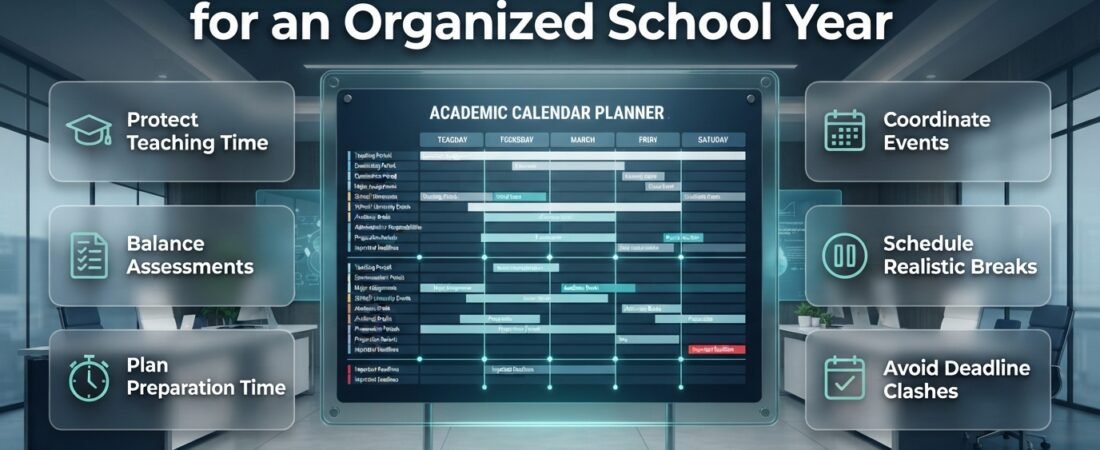
Academic Calendar Planning helps schools, colleges, universities, teachers, administrators, students, and families understand how the entire academic year should work before the pressure begins. A strong calendar isn’t simply a list of holidays and examination dates. It is a framework that connects teaching time, assessments, events, breaks, administrative responsibilities, and realistic preparation periods.
A well-designed academic calendar should make the year easier to manage, not create another document that people have to constantly interpret.
In this guide, you’ll learn how to build an academic calendar from the ground up, calculate realistic teaching time, distribute assessments, manage school events, avoid common scheduling mistakes, involve the right people, use technology effectively, and review the calendar throughout the year.
For institutions that want a more organized approach to scheduling and calendar coordination, RTI Scheduler can also be considered as part of the planning workflow.
What Is Academic Calendar Planning?
Academic Calendar Planning is the structured process of organizing the major academic, administrative, assessment, holiday, and institutional activities that take place during an academic year.
Instead of deciding dates individually, planners look at the entire year as one connected system.
A complete academic calendar may include:
- Academic year start and end dates
- Terms, semesters, or quarters
- Teaching periods
- Examination windows
- Assignment deadlines
- Revision periods
- Student registration
- Orientation
- Public holidays
- Institutional breaks
- Parent-teacher meetings
- Staff development days
- School events
- Project presentations
- Graduation activities
- Report-card deadlines
- Admissions activities
- Curriculum milestones
- Make-up or contingency periods
The purpose isn’t to make the calendar as full as possible. In fact, an overcrowded calendar can be a sign of poor planning.
The real goal is to create a balanced academic rhythm where students have enough time to learn, practice, complete work, receive feedback, revise, and demonstrate their knowledge.
Why Is Academic Calendar Planning Important?
A school or college operates through many interconnected activities. Teachers need teaching time. Students need preparation time. Administrators need reporting deadlines. Parents need advance notice. Facilities need to be available for events and examinations.
If these activities are planned separately, conflicts become much more likely.
A strong academic calendar provides a common reference point for everyone.
It helps answer practical questions such as:
- When does the academic year begin?
- When does each term finish?
- When are examinations held?
- When are major assignments due?
- When are students on break?
- When should teachers submit grades?
- When are parent meetings scheduled?
- When should curriculum units be completed?
- How much teaching time is actually available?
Recent school scheduling guidance similarly emphasizes that effective scheduling must balance teacher availability, student requirements, resources, assessments, and institutional activities rather than treating each schedule as an isolated task.
The Difference Between a Calendar and a Planning System
A basic calendar tells people when something happens.
A planning system also explains how that date affects everything around it.
For example, writing “Final Exam — May 20” is useful, but a stronger planning approach also considers:
- When syllabus completion occurs
- When revision begins
- When teachers submit examination papers
- When students receive preparation guidance
- Whether another major assessment is scheduled nearby
- When marking will take place
- When results must be finalized
That is the difference between recording dates and actually planning the academic year.
What Should an Academic Calendar Include?
The exact structure depends on the institution, but certain categories should almost always be considered.
Academic Term Dates
Begin with the basic academic structure.
Depending on the institution, the year may be divided into:
- Two semesters
- Three terms
- Four quarters
- Annual sessions
- Short summer or winter sessions
Clearly identify the start and end of each period.
This gives planners the boundaries within which everything else must fit.
Teaching Days and Instructional Weeks
One of the most overlooked elements of calendar planning is the difference between calendar time and usable teaching time.
A 16-week semester doesn’t necessarily provide 16 full weeks of instruction.
You may need to account for:
- Holidays
- Examinations
- Orientation
- Staff development
- Institutional events
- School closures
- Field trips
- Special programs
For example:
16 scheduled weeks
minus:
- 1 week of examinations
- 2 major holiday periods
- 1 staff development period
may leave approximately:
12 effective instructional weeks
This calculation gives curriculum planners a more realistic foundation.
Examinations and Assessments
Assessment dates should be treated as major planning milestones.
Depending on the institution, the calendar may include:
- Quizzes
- Unit tests
- Midterm examinations
- Final examinations
- Practical assessments
- Presentations
- Project submissions
- Oral examinations
- Mock examinations
- Make-up assessments
The assessment calendar should be reviewed across subjects instead of allowing every department to schedule independently.
Assignment Deadlines
Large assignments deserve calendar space too.
Consider major:
- Research papers
- Group projects
- Presentations
- Portfolios
- Laboratory reports
- Design projects
- Long-term coursework
When multiple subjects assign major projects during the same week, students can experience an unnecessary workload spike.
Holidays and Breaks
Holidays should be incorporated early rather than added as an afterthought.
Include relevant:
- Public holidays
- Religious holidays
- Winter breaks
- Spring breaks
- Mid-year breaks
- Institutional holidays
- Staff development closures
The dates should always be verified against the relevant official authority before final publication because holiday schedules can vary by country, region, institution, and academic system.
Registration and Orientation
The academic year often begins before classes officially start.
Include:
- Registration
- Course selection
- Orientation
- New student induction
- Timetable publication
- Student information sessions
- Staff preparation
These activities can strongly influence how smoothly the first week operates.
Parent and Community Activities
Schools may also need to schedule:
- Parent-teacher meetings
- Open houses
- Sports days
- Science fairs
- Cultural events
- Career days
- Performances
- Graduation
- Awards ceremonies
The important point is to consider the academic cost of these activities before adding them.
How Do You Create an Academic Calendar Step by Step?
Creating the calendar in the right order makes the process much easier.
Step 1: Define the Academic Year
Start with the largest boundaries.
Determine:
- First day
- Last day
- Number of terms or semesters
- Examination periods
- Major breaks
- Graduation or completion period
Don’t start by entering individual school events.
First establish the skeleton.
Why This Matters
Every later decision depends on these dates.
If the academic year is moved after departments have already scheduled assessments, events, and curriculum milestones, the entire system may need to be rebuilt.
Professional Advice
Get the broad academic structure approved before spending time on detailed scheduling.
Common Mistake
Trying to build the calendar around holidays first.
Holidays are important, but the academic structure should come first.
Step 2: Identify Fixed Dates
Next, separate dates that are difficult or impossible to move.
These might include:
- Public holidays
- Official examination windows
- Graduation
- Accreditation deadlines
- Registration deadlines
- Government-mandated dates
- Institutional closures
Create a separate “fixed dates” list.
Then build flexible activities around those dates.
Why This Works
It prevents planners from creating a schedule that looks good initially but later collapses when an immovable date is introduced.
Step 3: Calculate Actual Instructional Time
Now determine how much time teachers genuinely have.
Don’t simply count the number of weeks between the first and final day.
Calculate:
Total academic weeks − holidays − examinations − major closures − other non-instructional periods = effective teaching time
You can also calculate actual instructional days where necessary.
This becomes the foundation for curriculum pacing.
Example
Imagine a 20-week academic period.
Suppose:
- 2 weeks are examination-related
- 1 week contains major holidays
- 2 days are staff development days
- 2 days are institutional events
The institution doesn’t really have 20 unrestricted teaching weeks.
That difference matters when departments estimate how much curriculum they can realistically cover.
📌 Quick Tip: Always plan from the amount of usable instructional time, not the amount of time visible on the calendar.
Step 4: Map the Curriculum
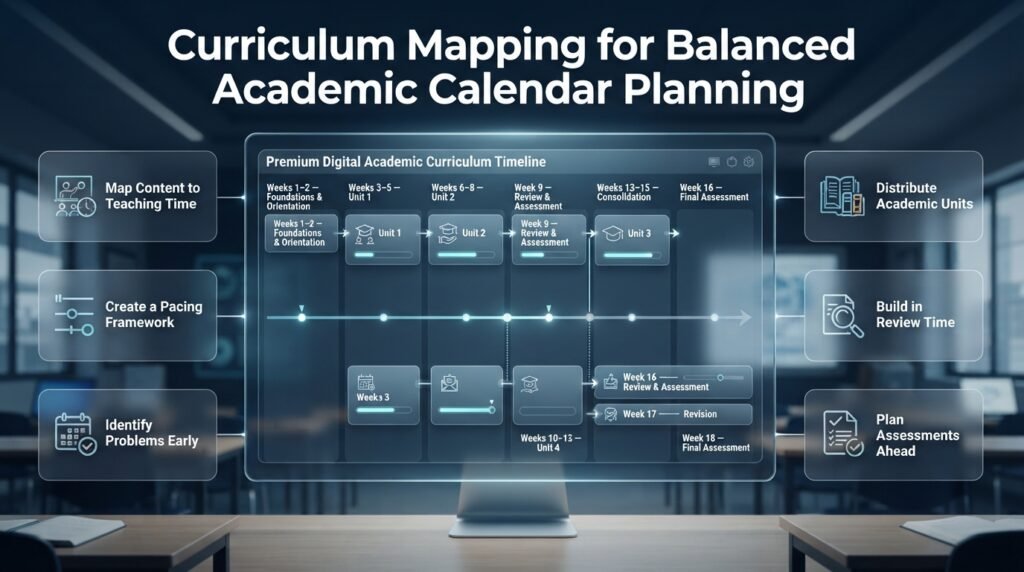
Once available teaching time is known, connect curriculum units to that time.
A simplified structure could look like this:
| Weeks | Main Academic Focus |
|---|---|
| 1–2 | Foundations and orientation |
| 3–5 | Unit 1 |
| 6–8 | Unit 2 |
| 9 | Review and assessment |
| 10–12 | Unit 3 |
| 13–15 | Unit 4 |
| 16 | Consolidation |
| 17 | Revision |
| 18 | Final assessment |
This doesn’t mean teachers must follow every week rigidly.
It creates a pacing framework.
Why Curriculum Mapping Matters
Without curriculum mapping, an institution may discover too late that a large amount of content remains just before final examinations.
The calendar should reveal that problem early.
Step 5: Schedule Assessments
After curriculum pacing is established, add major assessments.
For each assessment, consider:
- What content has been taught?
- Has enough practice occurred?
- Is revision possible?
- Are students facing other major deadlines?
- Do teachers have enough marking time?
- Does the date fall immediately after a break?
Assessment scheduling should support learning rather than simply occupy available calendar space.
Step 6: Add Revision and Preparation Periods
Revision shouldn’t be treated as leftover time.
If students are expected to demonstrate knowledge in a major examination, preparation needs to be part of the academic structure.
A simple sequence is:
Teaching → Practice → Feedback → Revision → Assessment
This is more realistic than:
Teaching → Immediate Examination
Professional Advice
Protect revision windows before major examinations even if that means reducing optional activities.
Step 7: Add Major Institutional Events
Only after protecting core academic requirements should you add major events.
Consider:
- Sports day
- Science fair
- Cultural day
- Career event
- School trip
- Annual function
- Graduation
- Parent meetings
A single event may appear to take only a few hours, but preparation, rehearsals, movement between locations, and timetable changes can consume much more instructional time.
Recent school leadership guidance has highlighted this hidden cost: events can fragment learning time beyond the actual duration shown on the calendar.
Step 8: Add Administrative Deadlines
Now include dates that staff and administrators need.
Examples include:
- Grade submission
- Attendance reports
- Report cards
- Admissions
- Registration changes
- Fee deadlines
- Staff evaluations
- Department reports
- Curriculum reviews
These dates may not affect every student directly, but they are essential to the institution’s operation.
Step 9: Run a Conflict Check
Never publish the first version without reviewing it.
Look for:
- Multiple major exams on the same day
- Several projects due together
- Events during examination preparation
- Holidays immediately before important assessments
- Teacher training during curriculum-critical periods
- Inadequate marking time
- Too many events in one month
A centralized calendar makes these conflicts easier to see.
Step 10: Review With Stakeholders
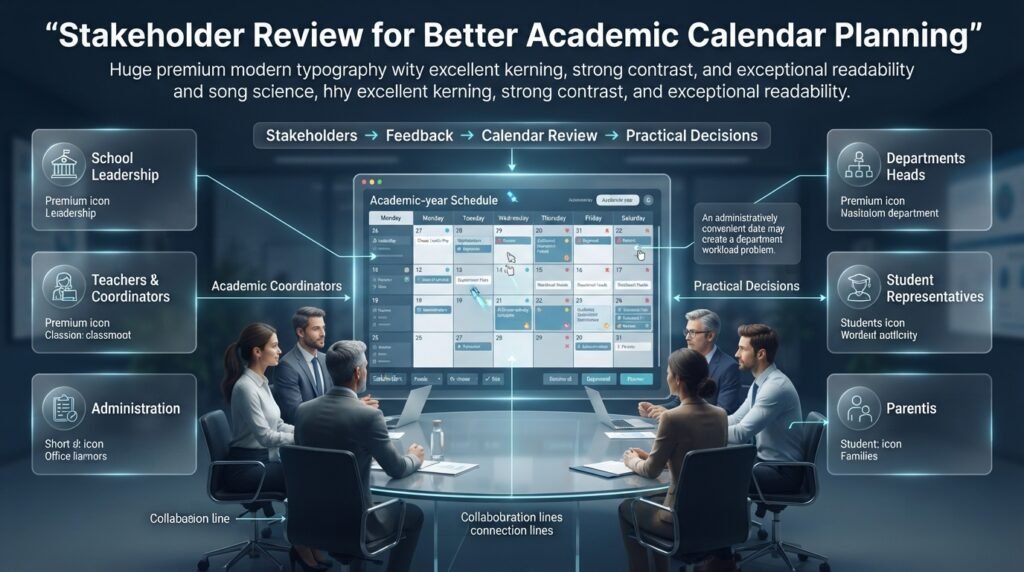
A good calendar shouldn’t be created in isolation.
Depending on the institution, ask for feedback from:
- School leadership
- Academic coordinators
- Teachers
- Department heads
- Administrators
- Student representatives
- Parents
Collaborative planning can reveal practical problems that aren’t obvious from an office desk.
For example, a date may look perfect administratively but create a serious workload problem for a particular department.
How Do You Balance Academic Workload Across the Year?
Balance is one of the most important principles of academic calendar planning.
Students experience all subjects simultaneously.
A mathematics department may think its exam is reasonable. An English department may think its essay deadline is reasonable. A science department may also have a reasonable project.
But if all three occur during the same week, the combined workload may be unreasonable.
Use a Workload Map
| Week | Subject A | Subject B | Subject C | Overall Pressure |
|---|---|---|---|---|
| 4 | Quiz | — | Assignment | Moderate |
| 5 | — | Essay | — | Moderate |
| 6 | Exam | Project | Presentation | High |
| 7 | — | Exam | — | Moderate |
| 8 | Project | — | Exam | High |
This gives coordinators a better view of student workload.
⭐ Expert Tip: Don’t ask only, “Is this deadline reasonable?” Ask, “What else is happening during the same week?”
That small change in thinking can dramatically improve scheduling decisions.
How Should Exams Be Distributed?
Examinations should have enough space around them for preparation, administration, and marking.
A major examination plan may need to account for:
- Syllabus completion
- Revision
- Paper preparation
- Paper review
- Printing
- Room allocation
- Invigilation
- Examination days
- Marking
- Moderation
- Result processing
Some school calendars specifically include paper-setting, marking, and result compilation periods rather than treating the examination itself as the only relevant date.
A Better Examination Sequence
Curriculum Completion
        ↓
Revision
        ↓
Paper Preparation
        ↓
Final Review
        ↓
Examination
        ↓
Marking
        ↓
Moderation
        ↓
Results
This creates a more complete assessment cycle.
How Can You Prevent Deadline Clustering?
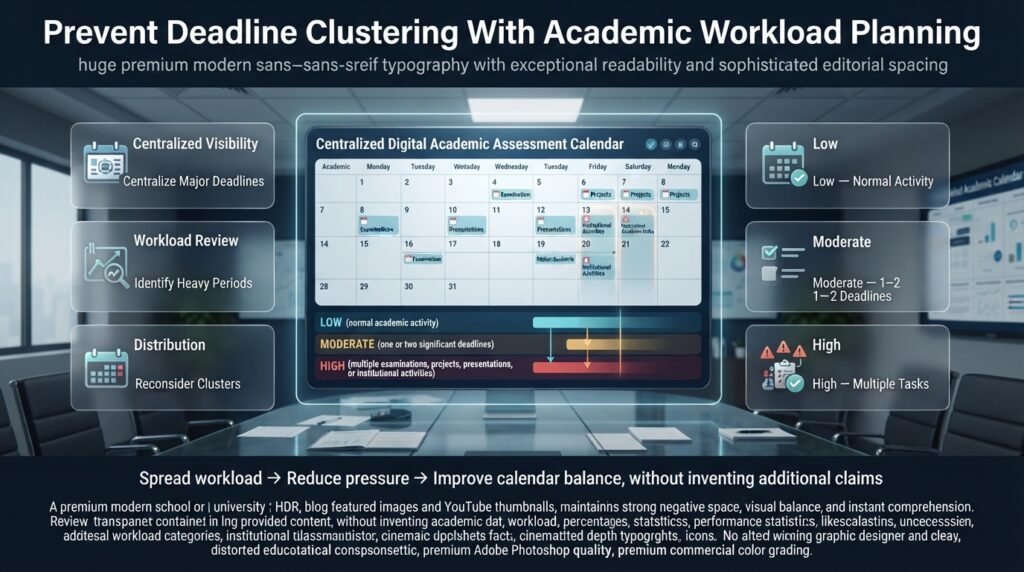
Deadline clustering happens when several major academic tasks fall within the same short period.
The easiest solution is centralized visibility.
Create one assessment overview containing every major deadline.
Then identify periods with excessive workload.
Use Three Workload Levels
Low
Normal academic activity.
Moderate
One or two significant deadlines.
High
Multiple examinations, projects, presentations, or institutional activities.
If several consecutive weeks become high-pressure periods, reconsider the distribution.
⚠ Common Mistake: Looking at each department’s schedule separately. Students don’t experience school by department—they experience the combined calendar.
Should You Include Buffer Days in an Academic Calendar?
Yes, where the academic structure allows it.
A buffer provides room for:
- Unexpected closures
- Weather disruption
- Teacher absence
- Curriculum catch-up
- Examination changes
- Technology problems
- Institutional emergencies
Without contingency time, a single disruption can force every later activity to move.
A buffer doesn’t mean intentionally wasting teaching time.
It means recognizing that real academic years rarely proceed exactly as planned.
How Flexible Should an Academic Calendar Be?
A calendar should be stable but not rigid.
If every minor issue causes a schedule change, people stop trusting the calendar.
If the calendar cannot accommodate genuine disruptions, the institution may struggle when unexpected situations occur.
A Practical Change Process
Before moving a date, ask:
- Why does the date need to change?
- Is the change essential?
- Which other activities depend on it?
- Does it reduce teaching time?
- Does it create another conflict?
- Who needs to be informed?
- Does the updated version need to replace an older version?
This prevents informal changes from spreading through different communication channels.
What Are the Most Common Academic Calendar Planning Mistakes?
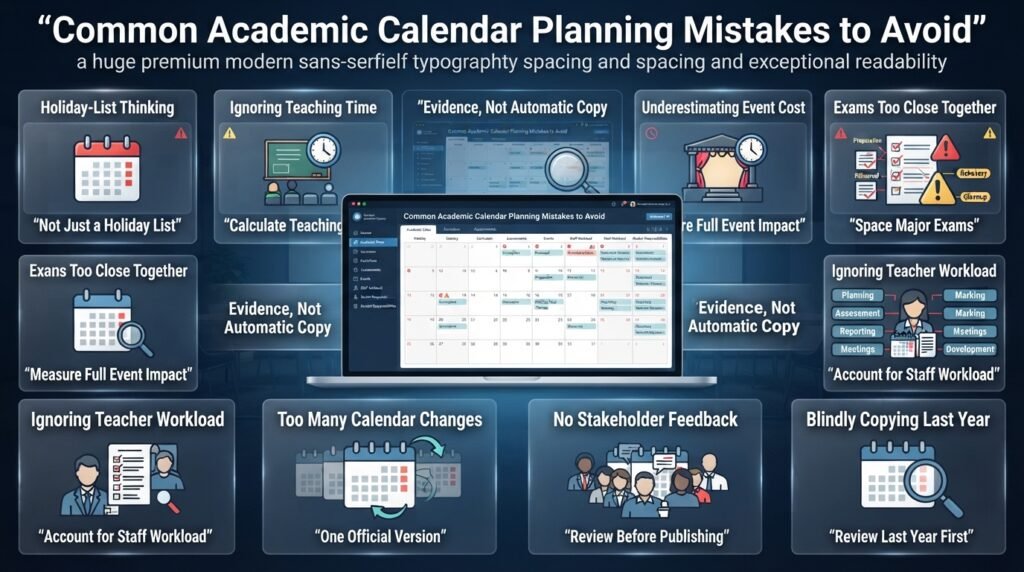
1. Treating the Calendar as a Holiday List
A calendar containing only holidays, examinations, and major events isn’t enough.
The academic year is more complex than that.
Better Approach
Connect major dates to curriculum pacing, assessment preparation, staff workload, and student responsibilities.
2. Ignoring Effective Teaching Time
A semester may look long until holidays and non-teaching activities are removed.
Why It Happens
Planners count calendar weeks instead of actual teaching opportunities.
Why It’s Harmful
Teachers may discover too late that there’s insufficient time to complete planned content.
Solution
Calculate effective teaching time before assigning curriculum units.
3. Scheduling Events Without Measuring Their Real Cost
An event may officially last one hour but require:
- Preparation
- Rehearsal
- Travel
- Setup
- Cleanup
- Timetable adjustments
Solution
Estimate the full academic impact, not just the event duration.
4. Putting Major Exams Too Close Together
Students need time to prepare.
Teachers also need time to manage papers and marking.
Solution
Create an examination sequence that includes preparation and recovery periods.
5. Forgetting Teacher Workload
Teachers need time for:
- Lesson planning
- Assessment
- Marking
- Reporting
- Meetings
- Professional development
A calendar that ignores staff workload can create unnecessary pressure.
6. Making Too Many Changes
Constant calendar changes create confusion.
Solution
Establish one official version and a controlled process for updates.
7. Publishing Without Stakeholder Feedback
Administrators may miss classroom-level problems.
Solution
Give department heads and relevant staff an opportunity to review the draft.
8. Copying Last Year’s Calendar Without Reviewing It
A previous calendar is a useful starting point, but it shouldn’t automatically become the new calendar.
Ask:
- Did last year’s exam period work?
- Were students overloaded?
- Were events worth the time they consumed?
- Were there recurring conflicts?
- Which dates caused confusion?
Use the previous year as evidence, not as a template that cannot be questioned.
How Can Technology Improve Academic Calendar Planning?
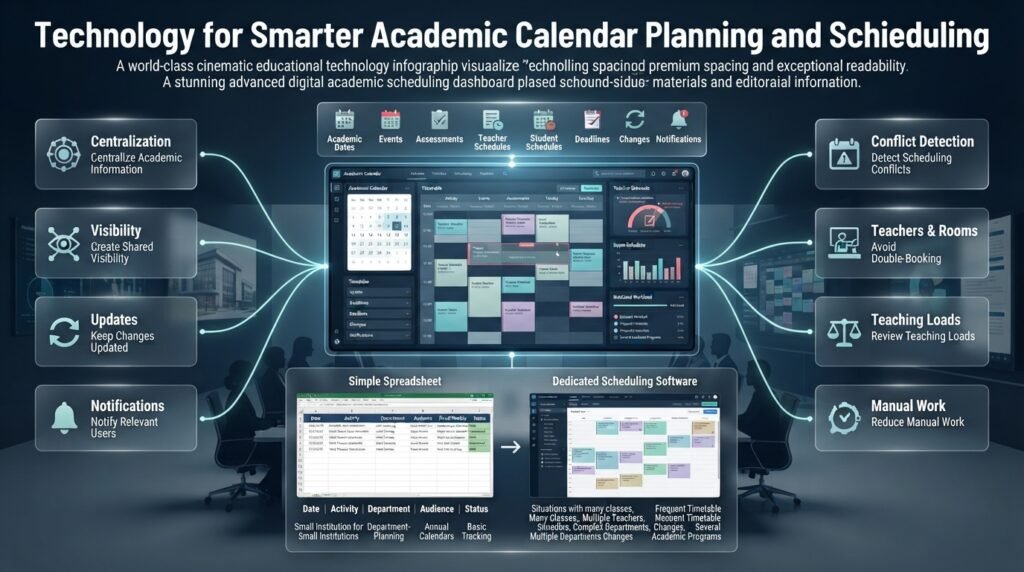
Technology can make calendar management easier when it solves a real coordination problem.
A digital system can help centralize:
- Academic dates
- Events
- Assessments
- Teacher schedules
- Student schedules
- Deadlines
- Changes
- Notifications
The advantage isn’t simply that the calendar is online.
The real advantage is shared visibility.
If one department changes an assessment date, relevant users should be able to see the updated information rather than continuing to work from an outdated spreadsheet or message.
Research and recent scheduling systems also emphasize centralized conflict detection because manual scheduling can lead to problems such as double-booked teachers, rooms, and uneven teaching loads.
When a Spreadsheet Is Enough
A spreadsheet can work well for:
- Small institutions
- Initial planning
- Department-level schedules
- Simple annual calendars
- Basic date tracking
Useful columns include:
| Date | Activity | Department | Audience | Fixed/Flexible | Status |
|---|
When Dedicated Scheduling Software Makes Sense
A dedicated platform becomes more valuable when the institution has:
- Many classes
- Multiple teachers
- Shared rooms
- Complex schedules
- Multiple departments
- Frequent timetable changes
- Several academic programs
The goal isn’t to use technology simply because it’s available.
The goal is to reduce manual work and make conflicts easier to identify.
How Should an Academic Calendar Be Designed for Students?
A calendar may be technically correct and still be difficult to use.
Students should be able to answer important questions quickly.
For example:
When is my next exam?
When is the assignment due?
When does the break begin?
When does the next term start?
The visual hierarchy should make these answers easy to find.
Use Clear Categories
Consider separating:
- Academic dates
- Assessments
- Deadlines
- Holidays
- Events
- Administrative dates
If color coding is used, maintain consistent meanings throughout the calendar. Calendar design guidance emphasizes clarity, consistent visual language, and understandable labels rather than relying on confusing abbreviations.
Offer Different Views
Different users need different information.
A useful system may provide:
- Annual overview
- Term view
- Monthly view
- Student view
- Teacher view
- Department view
The annual calendar gives perspective.
The detailed view supports daily decisions.
How Can Parents Benefit From Academic Calendar Planning?
Parents often plan work, travel, childcare, transportation, and family activities around school schedules.
Early access to the academic calendar helps them prepare for:
- Examinations
- School closures
- Parent meetings
- Major projects
- Holidays
- Important school events
This is particularly useful when major dates are communicated well before they occur.
Parents shouldn’t have to discover an important examination through a message two days before it happens.
How Can Teachers Use the Calendar for Better Planning?
Teachers can use the calendar for backward planning.
Instead of beginning with:
“What lesson should I teach this week?”
start with:
“What should students be able to demonstrate by the assessment date?”
Then work backward.
Backward Planning Model
Assessment Goal
      ↓
Required Knowledge
      ↓
Teaching Sequence
      ↓
Practice
      ↓
Feedback
      ↓
Revision
      ↓
Assessment
This connects daily instruction to larger academic milestones.
The calendar therefore becomes more than an administrative document. It becomes a framework for teaching decisions.
How Should Online and Hybrid Programs Plan Their Academic Calendars?
Online learning introduces another layer of scheduling.
Students may have:
- Live classes
- Recorded lessons
- Online discussions
- Independent reading
- Digital assignments
- Online assessments
- Group projects
A useful calendar should distinguish between activities that happen at a fixed time and activities that can be completed independently.
| Activity | Type | Scheduling Requirement |
|---|---|---|
| Live lecture | Synchronous | Fixed time |
| Recorded lesson | Asynchronous | Flexible |
| Online quiz | Deadline-based | Completion window |
| Group project | Collaborative | Shared deadlines |
| Final exam | Fixed | Specific window |
This distinction helps students understand how much of their week is genuinely flexible.
How Do You Review an Academic Calendar During the Year?
Calendar planning shouldn’t stop when the document is published.
A strong institution monitors the calendar while the academic year is happening.
Review Student Workload
Ask:
- Are deadlines clustering?
- Are students struggling during particular periods?
- Are examinations too close together?
Review Teacher Workload
Look at:
- Marking pressure
- Reporting deadlines
- Professional development
- Meeting schedules
- Curriculum completion
Review Event Impact
Ask:
- Did events consume more teaching time than expected?
- Were they worth the disruption?
- Could they be scheduled differently next year?
Review Communication
Check whether people received changes quickly and clearly.
A calendar is only useful when people trust and use it.
How Do You Improve Next Year’s Academic Calendar?
At the end of the academic year, don’t simply archive the calendar.
Conduct a short review.
Ask:
What Worked?
Identify:
- Smooth examination periods
- Well-spaced assessments
- Successful events
- Clear communication
- Effective buffer periods
What Didn’t Work?
Look for:
- Deadline clusters
- Unnecessary events
- Curriculum delays
- Staff overload
- Confusing changes
- Poor communication
What Should Change?
Turn those findings into specific planning decisions.
For example:
Instead of saying:
“Exams were stressful.”
write:
“Avoid scheduling more than two major assessments for the same student group within a three-day period.”
Specific lessons are easier to apply next year.
What Is a Good Academic Calendar Planning Workflow?
A practical workflow looks like this:
Define Academic Year
        ↓
Set Fixed Dates
        ↓
Calculate Teaching Time
        ↓
Map Curriculum
        ↓
Schedule Assessments
        ↓
Protect Revision Time
        ↓
Add Major Events
        ↓
Add Administrative Deadlines
        ↓
Check Workload
        ↓
Check Conflicts
        ↓
Stakeholder Review
        ↓
Publish
        ↓
Monitor
        ↓
Improve Next Year
This order matters.
If events are added before teaching requirements are protected, the calendar can quickly become overcrowded.
If assessments are scheduled before curriculum pacing is understood, students may be tested before sufficient instruction has occurred.
If administrative deadlines are ignored, staff workload can become concentrated.
A structured sequence prevents these problems.
How Can You Build a Simple Academic Calendar Template?
If you’re starting from zero, use a structure like this:
Annual Overview
Include:
- Academic year
- Terms
- Major holidays
- Examination periods
- Major events
- Breaks
Term Planning
For each term, include:
- Start date
- End date
- Teaching weeks
- Assessment windows
- Curriculum milestones
- Events
- Revision periods
Assessment Planning
Include:
- Assessment name
- Subject
- Student group
- Date
- Preparation deadline
- Marking deadline
- Result date
Event Planning
Include:
- Event
- Date
- Responsible person
- Required resources
- Expected academic impact
- Communication deadline
Administrative Planning
Include:
- Registration
- Reporting
- Staff development
- Admissions
- Parent communication
- Institutional deadlines
This structure keeps different responsibilities visible without putting every detail into one confusing table.
What Makes an Academic Calendar Truly Effective?
The best calendar isn’t necessarily the most detailed.
It’s the one that people can actually use.
An effective academic calendar should be:
Accurate
Dates and information should be verified before publication.
Realistic
The calendar should reflect actual teaching capacity.
Balanced
Workload should be distributed rather than concentrated.
Flexible
There should be room for reasonable adjustments.
Accessible
Students, teachers, parents, and administrators should be able to understand it.
Coordinated
Departments shouldn’t operate from disconnected schedules.
Reviewable
The institution should learn from the calendar after implementation.
Recent guidance on academic calendars similarly stresses that an effective calendar should provide predictability and support decisions throughout the academic period rather than functioning as a simple collection of dates.
What should be included in an academic calendar?
A professional academic calendar should include much more than the first and last day of the school year. It should give students, teachers, parents, and administrators a clear picture of the major academic and operational milestones that will affect them throughout the year. Core items normally include term or semester dates, teaching periods, examinations, assessment windows, holidays, breaks, registration, orientation, parent-teacher meetings, major school events, report deadlines, and other important administrative dates. Current school calendars commonly combine assessments, events, holidays, parent meetings, and reporting milestones in one annual framework.
A useful calendar should also show what happens before and after a major event. For example, an examination shouldn’t appear as a single date with no context. The planning process may also need revision time, paper preparation, marking, moderation, and result reporting.
Important elements to include:
Academic year start and end dates
Term or semester boundaries
Actual teaching days or instructional weeks
Midterm and final assessments
Major assignment deadlines
Revision periods
Public and institutional holidays
Staff development days
Parent-teacher meetings
Registration and enrollment deadlines
Report-card or result dates
Major extracurricular events
Graduation or completion activities
Contingency or make-up periods
Professional tip: Don’t try to put every minor classroom activity into the annual calendar. Keep the annual version focused on dates that genuinely affect planning, workload, attendance, or academic progress.
How do you create an effective academic calendar?
The best approach is to build the calendar from the academic structure outward, rather than randomly adding events as dates become available.
Start by defining the academic year’s boundaries and fixed dates. Then calculate how much actual teaching time is available after accounting for holidays, examinations, closures, and major activities. After that, map curriculum milestones, assessments, revision periods, and institutional events onto the remaining time.
A strong assessment calendar, for example, should protect teaching time instead of allowing tests and data collection to consume the instructional schedule. Recent assessment-planning guidance specifically recommends starting with the instructional purpose and fitting assessment activity around teaching rather than allowing assessment to drive the calendar.
A practical planning sequence is:
Define the academic year.
Add fixed holidays and institutional dates.
Calculate actual instructional time.
Map curriculum units and milestones.
Schedule major assessments.
Protect revision and preparation periods.
Add major school or college events.
Add administrative deadlines.
Check student and teacher workload.
Review conflicts with relevant stakeholders.
Publish the approved version.
Monitor and update it when necessary.
Professional tip: Before finalizing an examination date, ask three questions: Has the content been taught? Has there been enough preparation time? What other major work is happening that week? Those questions can prevent many avoidable scheduling problems.
How can schools prevent too many exams and assignments from being scheduled at the same time?
The most effective solution is to create one centralized assessment and deadline map rather than allowing each department to plan independently.
An English project might be perfectly reasonable by itself. A science presentation might also be reasonable. A mathematics examination might be reasonable as well. The problem occurs when all three land within the same few days. Students experience these demands simultaneously, so academic planning needs to consider the combined workload rather than judging each subject separately.
Current assessment-planning guidance emphasizes protecting teaching time and reducing unnecessary assessment activity, while workload-planning guidance recommends mapping commitments together so pressure points become visible.
A useful workload review should check:
Major exams occurring in the same week
Multiple large assignments with identical deadlines
Presentations immediately before examinations
Projects due after long holiday periods
Heavy assessment periods with reduced teaching time
Teacher marking periods that overlap excessively
Major school events occurring during revision periods
A simple method is to classify each week:
Low: normal academic workload
Moderate: one or two significant deadlines
High: multiple major assessments or events
Critical: several high-demand activities competing for the same time
If several consecutive weeks are marked “high” or “critical,” the calendar deserves another review.
Professional tip: Don’t ask only, “Is this deadline reasonable?” Ask, “Is this deadline reasonable considering everything else this student or teacher has to do during the same period?” That’s a much more realistic scheduling question.
How far in advance should an academic calendar be planned and published?
Major academic dates should be planned well before the academic year begins because students, parents, teachers, and administrators all use the calendar for their own planning. The exact lead time depends on the institution, but the important principle is to establish the major framework early while allowing controlled updates for dates that genuinely cannot be confirmed yet.
For example, some schools publish their complete annual calendars in advance specifically so families can plan travel and commitments around examinations, breaks, and other important dates.
However, publishing early doesn’t mean every detail has to be permanently locked.
A professional calendar can distinguish between:
Confirmed dates
Term opening
Major examinations
Official holidays
Graduation
Scheduled breaks
Tentative dates
Certain extracurricular events
Activities dependent on external confirmation
Dates subject to government or board notification
Dates subject to change
Events affected by weather
External examinations
Certain institutional activities
A practical publication process looks like this:
Planning stage: establish the academic framework.
Coordination stage: check departments, assessments, events, and workload.
Approval stage: obtain institutional confirmation.
Publication stage: release one official version.
Update stage: communicate legitimate changes through the same official channel.
Professional tip: Assign one person or team as the calendar owner. This prevents different departments from circulating conflicting versions and makes it clear who is responsible for approving changes.
How can technology improve academic calendar planning?
Technology can make academic calendar planning considerably easier when an institution has multiple classes, teachers, departments, rooms, assessments, and events to coordinate. The biggest advantage isn’t simply having a digital calendar; it’s having one reliable source of scheduling information that can be updated and reviewed without rebuilding the entire schedule manually.
Modern scheduling approaches increasingly focus on identifying conflicts involving teachers, students, rooms, workload, and resource availability. Manual scheduling can become particularly difficult when an institution has many interconnected constraints.
For a small institution, a spreadsheet and shared digital calendar may be enough. Larger schools and colleges may benefit from dedicated scheduling software that can help coordinate more complex requirements.
Technology can help with:
Centralized academic dates
Assessment scheduling
Teacher availability
Room allocation
Student schedules
Event coordination
Deadline tracking
Calendar updates
Conflict detection
Notifications
Different calendar views
The important distinction is between calendar visibility and actual scheduling intelligence.
A basic shared calendar tells people that an event exists. A more advanced scheduling system can help identify whether that event creates a conflict with another academic responsibility.
Professional tip: Don’t choose software simply because it has the largest number of features. Start by identifying the scheduling problems your institution actually faces, then choose technology that solves those problems without creating unnecessary administrative work.
Final Expert Recommendation
If you’re building an academic calendar from scratch, don’t begin by filling boxes with dates. Begin by asking:
What must happen during this academic year, how much time does each activity realistically require, and what happens when several activities compete for the same time?
That mindset changes academic calendar planning from simple date management into genuine academic strategy.
A strong calendar should ultimately provide clarity, realistic workload distribution, protected teaching time, predictable assessment periods, and enough flexibility to handle real-world changes.
Conclusion
Effective academic calendar planning is not simply about placing classes, exams, holidays, and events on a schedule. It is about creating a realistic academic roadmap that supports teaching quality, student workload, assessment timing, staff responsibilities, and the unexpected changes that can occur during a school or university year. A strong calendar gives everyone a clearer picture of what is coming and helps prevent important activities from becoming rushed or unnecessarily crowded.
The best academic calendars are also flexible. Dates may need to change because of institutional decisions, public holidays, examinations, curriculum adjustments, or unexpected events. Instead of treating the calendar as a fixed document that can never change, it should be reviewed and updated when necessary while keeping students, teachers, administrators, and parents informed.
Ultimately, good planning comes down to balance. Protect instructional time, distribute assessments sensibly, allow room for preparation and recovery, communicate important dates clearly, and review the calendar after each academic cycle. When these principles are followed consistently, the calendar becomes more than a list of dates—it becomes a practical tool for keeping the entire academic year organized and manageable.
For institutions looking to make scheduling, planning, and academic coordination more organized, RTI Scheduler can be a useful starting point for building a more structured approach to academic scheduling.