

Introduction
Assignment Submission Calendar | Missing an assignment deadline can create unnecessary stress for students, teachers, and academic administrators. A student might finish an important project but forget the submission date. Another may have several assignments due in the same week and struggle to decide which task to complete first. Teachers also face challenges when they need to communicate deadlines, monitor submissions, and coordinate coursework across different classes.
An assignment submission calendar provides a practical way to organize these responsibilities in one clear schedule. Instead of relying on memory, scattered notes, or separate reminders, students can see upcoming assignments, submission dates, preparation milestones, and completed work in an organized format.
Whether you’re managing school homework, college coursework, university projects, or multiple academic subjects, a well-maintained calendar can make deadlines easier to understand and manage. It can also help educators create more predictable submission schedules and give students enough time to complete their work.
Academic planning becomes more effective when assignment deadlines are connected with the wider academic schedule. The RTI Scheduler homepage provides the starting point for exploring academic scheduling concepts and related planning resources.
In this guide, you’ll learn how to create an assignment submission calendar, organize multiple deadlines, prioritize difficult coursework, avoid common scheduling mistakes, and use practical planning techniques to improve academic performance without creating an unnecessarily complicated system.
What Is an Assignment Submission Calendar?
An assignment submission calendar is a schedule that records academic tasks, their due dates, submission requirements, and progress milestones. It helps students understand what must be completed, when each task is due, and how much preparation time remains.
Unlike a simple list of assignments, a calendar places deadlines within a time-based structure. This makes it easier to identify busy weeks, prepare for overlapping projects, and distribute work across available study periods.
A calendar can be created in a spreadsheet, a digital calendar, a printable planner, or a dedicated academic scheduling tool. The best format is the one the user can update consistently.
What information should an assignment calendar contain?
A useful assignment submission calendar should include enough information to guide action rather than simply record dates.
| Calendar field | Purpose |
|---|---|
| Assignment title | Identifies the task clearly |
| Subject or course | Shows which class the work belongs to |
| Assigned date | Records when the task was given |
| Official due date | Identifies the final submission deadline |
| Internal target date | Sets an earlier personal completion goal |
| Task requirements | Lists instructions, format, and word count |
| Progress status | Shows whether work is not started, in progress, or completed |
| Submission method | Records whether work must be uploaded, emailed, or handed in |
| Final confirmation | Tracks whether submission was successfully completed |
Not every assignment needs a complicated record. A short homework exercise might require only a title, due date, and status. A research project may need several milestones, including topic approval, research, drafting, editing, and final submission.
Expert tip: Keep the official deadline separate from your personal target date. This small distinction helps prevent confusion when you plan to finish early.
Why Is an Assignment Submission Calendar Important?
An assignment submission calendar is important because it turns academic responsibilities into a visible and manageable plan. Students can identify approaching deadlines, balance competing tasks, and begin important work before it becomes urgent.
Without a structured calendar, students often remember assignments only when a teacher mentions them again or a deadline is approaching. That approach becomes less reliable as the number of courses, projects, and examinations increases.
1. It reduces missed deadlines
A clearly recorded deadline is easier to track than a date remembered mentally. When all assignments appear in one place, students can review upcoming work before deciding how to spend their study time.
For example, a student might have a history essay due on Monday, a science report due on Wednesday, and a mathematics assignment due on Friday. A calendar reveals this sequence early enough to prepare for each task.
2. It improves time management
Time management involves deciding not only what needs to be done but also when to do it.
An assignment submission calendar helps students divide larger tasks into smaller activities. Instead of attempting an entire report the night before it is due, a student can schedule research, outlining, drafting, and proofreading across several days.
3. It supports better-quality coursework
Rushed assignments are more likely to contain incomplete explanations, weak research, formatting problems, and proofreading errors.
Planning ahead creates opportunities to review instructions, check sources, improve arguments, and correct mistakes before submission.
4. It makes workload conflicts visible
Several assignments may have deadlines close together, even when they belong to different subjects. A calendar makes these conflicts easier to identify.
Students can then start demanding assignments earlier, ask teachers for clarification, and adjust study sessions before their workload becomes overwhelming.
5. It encourages personal responsibility
A calendar helps students take ownership of their academic commitments. Instead of waiting for repeated reminders, they can check their own progress and decide what action is needed next.
This habit is particularly valuable for university students, who often have greater responsibility for organizing independent study.
Who Should Use an Assignment Submission Calendar?
An assignment submission calendar can benefit almost anyone who manages recurring academic deadlines. However, its structure should reflect the user’s age, workload, and responsibilities.
School students
School students may need to track homework, worksheets, classroom projects, reading tasks, and short assessments.
A simple weekly calendar is usually sufficient. Each assignment should have a clear due date, a short description, and a completion checkbox.
Parents and teachers can also use the calendar to help younger students build consistent planning habits.
College and university students
Higher education often involves multiple courses with different instructors, assessment methods, and submission platforms.
A university student may need to manage essays, presentations, laboratory reports, group projects, and research papers simultaneously. A detailed calendar with preparation milestones can help prevent one major assignment from disrupting the entire study schedule.
Teachers and academic coordinators
Teachers can use assignment calendars to coordinate coursework across classes and communicate important dates.
When several teachers assign major projects during the same week, students may experience an avoidable workload concentration. Shared planning helps educators identify these conflicts and consider adjustments where appropriate.
Online learners
Online students often study independently and may not receive the same face-to-face reminders available in a classroom.
A calendar provides a consistent overview of assignment deadlines, discussion activities, quizzes, and project milestones. Digital reminders can be especially useful when students study across different time zones or manage flexible schedules.
How to Create an Assignment Submission Calendar Step by Step
Creating an effective assignment calendar begins with collecting accurate information. The goal is not to fill every available space with tasks; it is to create a realistic schedule that shows what needs to happen and when.
Step 1: Collect every assignment deadline
Start by reviewing course outlines, learning management systems, teacher announcements, assignment sheets, and relevant emails.
Record each assignment in one central location. Avoid keeping some deadlines in a notebook, others in a phone application, and others only in your inbox.
For every task, confirm:
- Assignment name and subject.
- Official submission date.
- Submission time and time zone, if relevant.
- Required file format or submission method.
- Word count, marking criteria, or other instructions.
- Any intermediate milestones.
Why this matters: A calendar is only as dependable as the information entered into it. An incorrect date can create the same problems as having no calendar at all.
Step 2: Choose a calendar format
Select a format that matches your study habits and workload.
| Format | Best suited for | Main limitation |
|---|---|---|
| Paper planner | Students who prefer writing by hand | Updates and reminders require manual effort |
| Spreadsheet | Students tracking many courses and tasks | Alerts usually require additional setup |
| Digital calendar | Students who benefit from notifications | Requires reliable access to the application |
| Shared academic calendar | Teachers and groups coordinating deadlines | Permissions and changes need clear management |
| Dedicated planning tool | Students managing multiple academic activities | Features and setup complexity vary |
A paper planner can work perfectly well for a student with a manageable workload. A digital calendar may be more convenient when assignments change frequently or several people need access.
There is no need to adopt several systems unless each one has a clear purpose.
Step 3: Organize assignments by subject
Group assignments by course or subject so that related work is easier to identify.
For example, a university student could use categories for English, Biology, Mathematics, and Computer Science. Each category should have a consistent label throughout the calendar.
If the calendar supports colors, use a small number of meaningful colors. Too many colors create visual noise and make the schedule harder to scan.
Step 4: Identify the most demanding assignments
Not every assignment requires the same amount of preparation.
A short worksheet may take 20 minutes, while a research paper may require several days of reading, writing, and revision. Estimate the time and effort needed for each task before deciding when to begin.
Consider the following factors:
- Expected working hours.
- Difficulty of the subject.
- Availability of research materials.
- Need for group coordination.
- Access to laboratories, equipment, or other resources.
- Importance of intermediate feedback.
A useful calendar accounts for both the submission date and the effort required to reach it.
Step 5: Break major assignments into milestones
Large assignments are easier to manage when they are divided into smaller tasks.
A research project might include these milestones:
- Understand the assignment brief.
- Select and confirm the topic.
- Gather research materials.
- Prepare an outline.
- Complete the first draft.
- Revise the content.
- Check references and formatting.
- Submit the final file.
- Confirm successful submission.
Assign realistic dates to these milestones. Avoid scheduling every stage on the final day.
Step 6: Set an internal completion deadline
An internal deadline is your personal target for finishing an assignment before the official due date.
For example, if an essay is due on Friday, you might aim to finish the main draft by Tuesday and complete proofreading by Thursday.
This creates a buffer for unexpected problems, such as internet interruptions, corrupted files, or additional revisions.
Pro tip: Choose a buffer based on the assignment’s complexity. A short worksheet may need only a small margin, while a major project may require several days.
Step 7: Add reminders
Reminders should prompt useful action rather than simply repeat the deadline.
A practical reminder sequence could be:
- Early reminder: begin research or preparation.
- Progress reminder: check whether the assignment is on schedule.
- Final preparation reminder: proofread and verify the file.
- Submission reminder: upload the final work and confirm receipt.
Avoid creating so many alerts that you begin ignoring them.
Step 8: Review the calendar regularly
Set aside a few minutes each day to check immediate priorities and conduct a more detailed review once a week.
During the review, ask:
- Which assignment is due next?
- Which task requires the most preparation?
- Has any deadline changed?
- Am I behind on an important milestone?
- Do I need to ask a teacher for clarification?
- Is there enough time for final checking?
A calendar should be a working plan, not a document that is created once and forgotten.
What Is the Difference Between an Assignment Calendar and a Deadline Tracker?
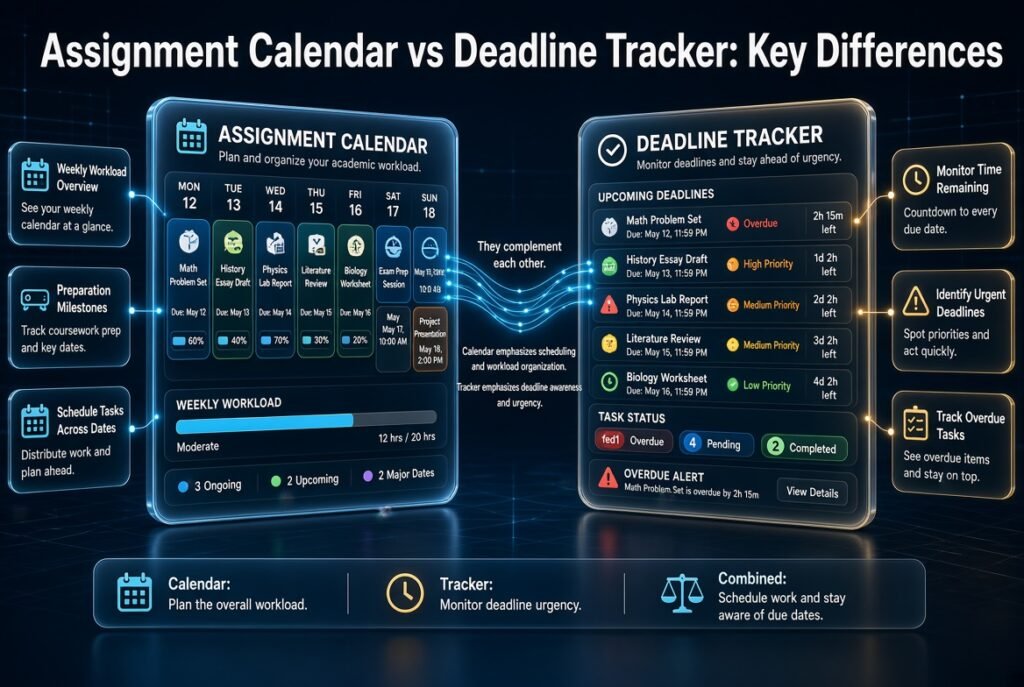
An assignment submission calendar and a deadline tracker serve related purposes, but they emphasize different aspects of academic planning.
An assignment calendar organizes tasks across dates and helps users understand their overall workload. A deadline tracker focuses more directly on due dates, time remaining, and whether a task is approaching or overdue.
| Feature | Assignment submission calendar | Deadline tracker |
|---|---|---|
| Main purpose | Organize assignments across a schedule | Monitor due dates and urgency |
| Weekly overview | Usually central | Optional |
| Preparation milestones | Often included | May be limited |
| Progress monitoring | Can include task stages | Often focuses on deadline status |
| Best use | Planning the complete workload | Checking which deadlines need attention |
For example, a student can use a calendar to schedule three assignments across a week and a deadline tracker to identify which one needs immediate attention.
Students managing complex workloads may benefit from combining both functions in one system.
Those who want to coordinate assignment deadlines with broader academic activities can also explore Academic Planning and Scheduling Tools.
How to Prioritize Multiple Assignment Deadlines
When several assignments are due within a short period, working on the nearest deadline first is not always the best strategy. A short task due tomorrow may require less time than a research project due next week.
Effective prioritization considers urgency, effort, difficulty, and consequences.
Use urgency and workload together
Consider a student with these responsibilities:
| Assignment | Due date | Estimated effort | Suggested action |
|---|---|---|---|
| Mathematics worksheet | Monday | 45 minutes | Complete in the next available study session |
| Biology report | Wednesday | 5 hours | Begin immediately and divide into stages |
| History essay | Friday | 7 hours | Start research early and schedule writing sessions |
| English presentation | Following Monday | 3 hours | Prepare an outline before the weekend |
The biology report and history essay require early attention because they involve more work. Completing the mathematics worksheet quickly may free up time, but it should not cause the student to postpone both larger assignments.
Use a priority matrix
A simple priority matrix can help students decide what deserves attention first.
| Priority | Situation | Recommended response |
|---|---|---|
| High urgency, high effort | A major project is nearly due | Start immediately and identify essential remaining tasks |
| High urgency, low effort | A short assignment is due soon | Complete it efficiently |
| Low urgency, high effort | A major project is due later | Schedule milestones now |
| Low urgency, low effort | A small task is due later | Add it to a planned study session |
The matrix is a guide, not a rigid rule. A task may deserve immediate attention because it depends on feedback, equipment availability, or another student’s contribution.
Avoid treating every assignment equally
A calendar that gives every assignment the same amount of preparation time may be unrealistic.
Instead, allocate time according to the task’s actual requirements. A complex laboratory report may need several sessions, while a short reading response may be completed in one.
The objective is to distribute work intelligently, not simply to fill the calendar.
How to Build a Weekly Assignment Submission Schedule
A weekly assignment schedule turns recorded deadlines into a practical routine. It identifies the study sessions needed to complete work before submission dates arrive.
The schedule should account for classes, employment, travel, family responsibilities, breaks, and personal commitments.
Start with fixed commitments
First, record activities that cannot easily be moved, such as lectures, laboratory sessions, work shifts, and scheduled examinations.
Then identify the study periods that remain available.
This prevents the common mistake of assigning five hours of coursework to a day when only two hours are realistically free.
Allocate specific work sessions
Instead of writing “work on biology,” define the action more precisely.
For example:
- Monday: read the report instructions and gather sources.
- Tuesday: prepare the outline and organize findings.
- Wednesday: write the first half of the report.
- Thursday: complete the draft and check references.
- Friday: review the final version if the official deadline allows.
Specific tasks make it easier to begin because the student knows exactly what to do.
Include breaks and recovery time
A useful schedule does not assume that every study session will be completed perfectly.
Allow time for breaks, meals, rest, and unexpected delays. If every hour is allocated to coursework, a small disruption can affect the entire week.
Expert advice: Plan a little less than your maximum available capacity. A realistic schedule that is followed consistently is more valuable than an ambitious schedule that repeatedly fails.
Example of a weekly assignment calendar
| Day | Planned activity | Goal |
|---|---|---|
| Monday | Review deadlines and collect research | Establish priorities |
| Tuesday | Work on the biology report | Complete the outline |
| Wednesday | Submit mathematics worksheet; draft report | Clear the short task and progress on the major one |
| Thursday | Revise the report and begin essay research | Prepare for upcoming deadlines |
| Friday | Submit the report; work on essay | Complete one major submission |
| Saturday | Draft history essay | Make substantial progress |
| Sunday | Proofread, check next week’s workload, and prepare | Reduce last-minute pressure |
This example should be adjusted to match actual due dates and available study hours. A task must always be completed and submitted according to its official deadline, even if the sample schedule suggests a different sequence.
How Digital Tools Can Improve Assignment Deadline Management
Digital tools can make an assignment calendar easier to maintain, especially when deadlines change or students manage several courses.
However, the most useful tool is not necessarily the one with the largest number of features. It is the one that supports the student’s actual workflow.
Automatic reminders and notifications
Digital reminders can alert students before an assignment is due. This is useful when several deadlines occur in the same week or when students frequently switch between subjects.
Notifications should be timed around meaningful actions, such as starting research or preparing a final upload.
Recurring study sessions
Students can create recurring blocks for weekly reading, review, or coursework preparation.
These sessions provide structure without requiring a new plan every day. They should remain flexible enough to accommodate heavier assignment periods.
Progress status and task labels
A status field makes unfinished work visible.
Useful labels include:
- Not started.
- Researching.
- Drafting.
- Under review.
- Ready to submit.
- Submitted.
- Feedback received.
A submitted assignment should not be marked complete merely because the student finished writing it. Submission itself is a separate step.
Shared calendars for group projects
Group assignments often involve several students, intermediate meetings, and shared responsibilities.
A shared calendar can record meeting dates, draft deadlines, individual contributions, and the final submission date. The group should also establish who is responsible for uploading the completed work.
Shared access requires clear communication. Students should not assume that every group member has seen a deadline change unless the change has been communicated through the agreed channel.
Keep a record of important changes
When an instructor changes a deadline, update the calendar promptly and record the revised date.
For important assignments, keep a note of the source of the change, such as an official course announcement. This helps avoid confusion when older instructions still appear in messages or documents.
Students planning assignments alongside semester milestones can use a broader Semester Milestone Calendar to understand how major academic dates fit together.
How Assignment Calendars Fit into the Academic Calendar
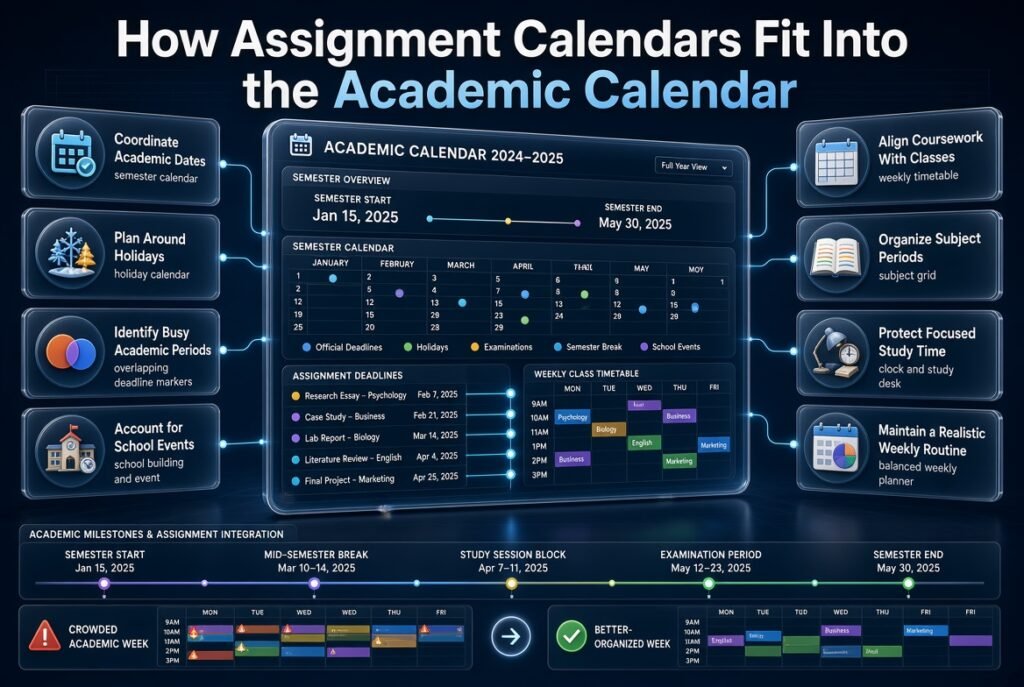
Assignment deadlines do not exist in isolation. They are affected by examination periods, holidays, semester breaks, school events, and other academic commitments.
A student may have sufficient time to complete a project in an ordinary week but struggle when several classes schedule major assessments before a holiday.
Connecting assignment planning with the academic calendar helps users identify these pressure points earlier.
Coordinate deadlines with academic dates
Start by recording major academic events, including:
- Semester start and end dates.
- Examination periods.
- Official holidays.
- Breaks between terms.
- Major school or university events.
- Course registration or project milestones where relevant.
Then compare assignment deadlines against these dates.
This is particularly important for tasks that require campus access, instructor feedback, library resources, or collaboration.
Plan around holidays and breaks
A holiday does not automatically mean that an assignment deadline will move.
Students should always follow the official deadline unless their instructor or institution confirms a change. A calendar can show upcoming holidays, but it should not independently assume that coursework dates are postponed.
The Academic Calendar Planning resource is relevant when organizing coursework within the wider academic year.
For institutions that need to coordinate closures and teaching schedules, the Academic Holiday Calendar Builder can be considered as a related planning resource.
Coordinate coursework with school events
School activities, field trips, departmental events, and extracurricular commitments can reduce the time available for assignments.
A broader school schedule helps students and educators recognize when academic work may overlap with other responsibilities.
The School Year Event Calendar provides a related planning context for organizing events across the school year.
Maintain a realistic weekly study routine
Assignment calendars become more useful when they reflect the actual class timetable.
A student who has laboratory sessions on Tuesday and Thursday may need to schedule research or writing on different days. Knowing when lessons occur makes it easier to identify uninterrupted study periods.
Resources such as the Weekly Lesson Period Planner and Subject Timetable Maker relate to organizing teaching periods and subjects.
Likewise, a Student Class Period Organizer and a Class Timetable Grid Builder can help represent class schedules in a structured format.
These tools address timetable organization rather than assignment completion itself, but they can complement a submission calendar by clarifying when study time is available.
How to Manage Assignment Deadlines During Examination Periods
Examination periods create a special planning challenge because students must prepare for tests while completing coursework.
A student may have an essay due one day before an examination and a laboratory report due shortly afterward. Without an overview, it is easy to underestimate the combined workload.
Separate examination preparation from coursework
Record examinations and assignments as distinct commitments. Each requires its own preparation plan.
For examinations, schedule revision sessions, practice questions, and topic reviews. For assignments, schedule research, writing, checking, and submission.
Keeping these activities separate helps prevent students from treating all academic work as one undifferentiated task.
Identify high-pressure weeks early
Review the calendar several weeks ahead when possible.
Look for periods in which multiple examinations and major submissions occur close together. Begin long assignments before the examination period if the instructions and course schedule allow.
Use assessment schedules to improve planning
Institutional assessment schedules can reveal when students are likely to face additional pressure.
Related resources such as the Exam Schedule Generator, Test Date Timetable Planner, Exam Session Calendar Builder, Assessment Sitting Schedule, and Examination Timetable Organizer address the organization of tests and examinations.
An assignment submission calendar can then be reviewed alongside these schedules to identify possible conflicts.
Important: Never assume an examination date or assignment deadline has changed simply because two events overlap. Confirm any adjustment with the relevant instructor or institution.
How to Track Assignment Progress Without Overcomplicating the Calendar
A calendar becomes difficult to maintain when every small action requires a separate entry. The solution is to use enough detail to guide progress without turning the calendar into a second assignment.
Use milestones for major work
A short assignment may need only one entry. A large research project may benefit from several milestones.
For example, a short mathematics worksheet might use a simple “Not started / Completed” status. A dissertation chapter may require research, outlining, drafting, supervisor feedback, revision, and final submission stages.
Match the level of detail to the task.
Review unfinished work
During each review, focus on assignments that have not progressed as expected.
Ask why the task is delayed. Perhaps the instructions are unclear, the research is taking longer than expected, or the student underestimated the writing time.
Once the cause is identified, revise the plan. Simply moving the same unfinished task to tomorrow without changing the approach may repeat the problem.
Keep completed submissions visible
Mark an assignment as submitted only after the required upload, email, or hand-in has been completed.
Where possible, save a submission receipt or confirmation message. If a platform displays a submission timestamp, check that it corresponds to the correct assignment.
This final verification step prevents a finished document from being mistaken for a successfully submitted document.
Common Assignment Submission Calendar Mistakes to Avoid
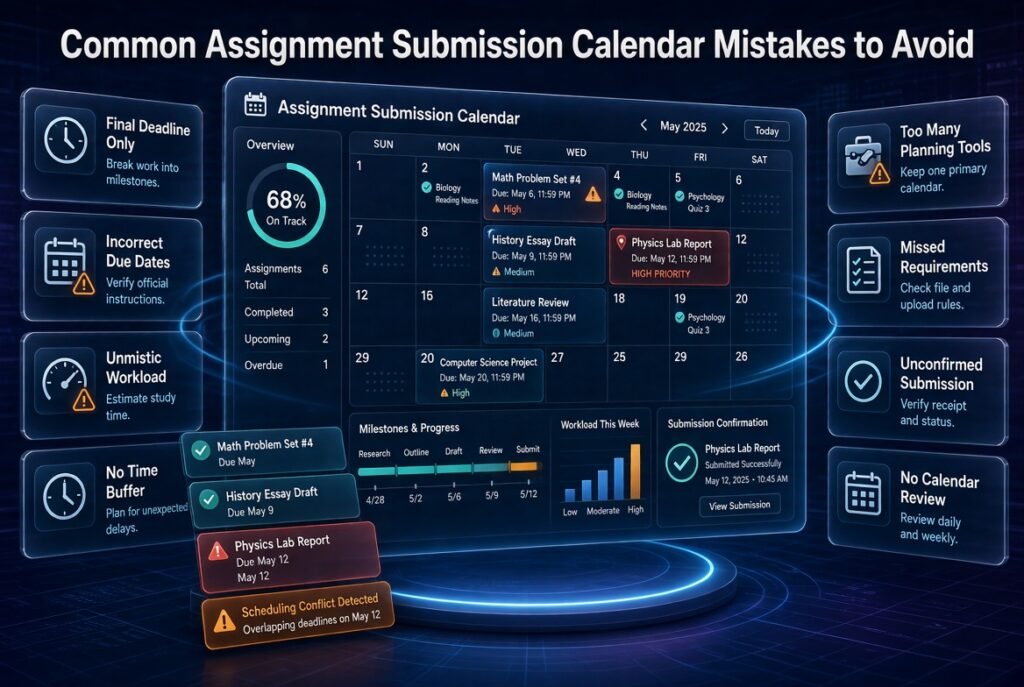
Even a carefully designed calendar can fail if the information is incomplete, deadlines are unrealistic, or the student stops checking progress.
Understanding common mistakes helps create a more dependable planning routine.
Mistake 1: Recording only the final deadline
Why it happens: Students believe they will remember when to begin working.
Why it causes problems: A deadline several weeks away can create a false sense that there is plenty of time. The student may delay until other assignments compete for the same study hours.
How to avoid it: Break large tasks into milestones and schedule the first action soon after receiving the assignment.
Mistake 2: Entering incorrect submission dates
Why it happens: Students copy a date from an old document, confuse two courses, or overlook a revised announcement.
Why it causes problems: An inaccurate calendar can encourage a student to delay work beyond the actual deadline.
How to avoid it: Verify dates against the current official instructions. Update the calendar immediately when an instructor confirms a change.
Mistake 3: Ignoring the estimated workload
Why it happens: Students plan around due dates without considering how long assignments take.
Why it causes problems: Several demanding tasks may end up scheduled for the same evening, making completion unrealistic.
How to avoid it: Estimate the effort required and divide major tasks into manageable study sessions.
Mistake 4: Planning without a time buffer
Why it happens: Students assume every study session will go according to plan.
Why it causes problems: Illness, technical issues, family commitments, or difficult research can delay work.
How to avoid it: Set internal deadlines before official due dates and reserve time for final checks.
Mistake 5: Using too many planning systems
Why it happens: Students experiment with several apps, notebooks, and reminder tools.
Why it causes problems: Deadlines become scattered, updates are missed, and the user no longer knows which version is correct.
How to avoid it: Choose one primary calendar and use other tools only for clearly defined supporting tasks.
Mistake 6: Forgetting submission requirements
Why it happens: Students focus on finishing the content and overlook file formats, naming rules, or upload instructions.
Why it causes problems: A completed assignment may still be rejected, delayed, or submitted incorrectly.
How to avoid it: Record essential submission requirements beside the deadline and review them before uploading.
Mistake 7: Failing to confirm submission
Why it happens: Students assume that clicking a button automatically means the work has been received.
Why it causes problems: An upload can fail, a file can be missing, or a submission can remain incomplete.
How to avoid it: Check the platform’s confirmation message or submission status and retain evidence when appropriate.
Mistake 8: Ignoring calendar reviews
Why it happens: Students create a detailed plan at the beginning of term but rarely update it.
Why it causes problems: Completed tasks remain open, changed deadlines go unnoticed, and new work is not incorporated.
How to avoid it: Conduct a short daily check and a more comprehensive weekly review.
Expert Tips for Building a More Effective Assignment Calendar
A professional approach to assignment planning focuses on consistency, visibility, and realistic commitments rather than complexity.
Plan backward from the submission deadline
Start with the final due date and work backward through the stages required to finish the assignment.
If a project requires research, drafting, revision, and proofreading, give each stage its own target date. This reveals how early the work needs to begin.
Backward planning is particularly useful for research papers and group projects because their intermediate stages often depend on one another.
Prioritize tasks that could block later work
Some assignments depend on information, feedback, or resources that are not immediately available.
For example, a report may require a supervisor to approve the topic before research can proceed. Schedule that approval request early rather than treating it as a minor detail.
The same principle applies to group projects where another person’s contribution is needed before the final document can be assembled.
Use a consistent weekly review
Choose a regular time to review upcoming assignments, remove completed tasks, and adjust the following week’s plan.
Consistency reduces the mental effort required to manage academic responsibilities. It also helps students identify recurring problems, such as repeatedly underestimating essay-writing time.
Distinguish important work from urgent work
An assignment due tomorrow may require immediate attention, but a major project due next week may need to begin today.
Check both urgency and effort before deciding what to do next. This prevents short-term deadlines from continuously pushing important long-term work aside.
Keep instructions close to the deadline
A calendar entry should contain or link to the essential task details within the chosen system, without relying on memory.
At minimum, record the assignment’s requirements, the official due date, and the submission method. Keep the complete instructions in their appropriate course location.
Protect focused study time
Schedule realistic blocks in which a student can work without repeatedly switching subjects.
Frequent interruptions can make complex tasks feel longer and harder to complete. A focused session with one clear objective is often more useful than a long, unfocused period.
Review patterns at the end of each term
At the end of a semester, consider which assignments were completed on time and which caused difficulty.
Look for recurring patterns:
- Which subjects required more preparation than expected?
- Which weeks contained too many major deadlines?
- Which reminders were useful?
- Which study sessions were repeatedly missed?
- What changes would improve the next semester’s plan?
This review turns the calendar into a learning tool rather than just a record of past dates.
How Students Can Use an Assignment Submission Calendar More Independently
An assignment calendar should help students become more independent, not simply create another list of instructions to follow.
The key is to use the calendar to make decisions. When students review their work, they should identify the next action and determine whether their current plan remains realistic.
For example, if a student notices that a research essay is falling behind schedule, the next step is to identify the cause. The student might need to narrow the topic, ask the instructor a question, divide the writing into smaller sessions, or move a less urgent activity.
A useful calendar encourages these adjustments before the deadline becomes an emergency.
Build a simple daily routine
Students can follow a short routine:
- Check assignments due within the next seven days.
- Identify the most important unfinished task.
- Choose one specific action to complete during the next study session.
- Review progress at the end of the session.
- Update the calendar when a task or deadline changes.
This routine is short enough to maintain while still providing meaningful control over academic work.
Use the calendar to communicate early
If an assignment’s requirements are unclear or a genuine problem threatens timely completion, students should contact the instructor as early as possible.
A calendar makes these situations visible before the deadline arrives. Early communication gives the instructor more time to explain requirements or advise on the appropriate process.
Students should follow their institution’s rules for extensions, special consideration, or late submissions rather than assuming an exception will be granted.
How Teachers Can Coordinate Assignment Deadlines Across Subjects
Teachers influence how manageable an assignment calendar becomes. Even an organized student can struggle when several major projects are scheduled close together across different subjects.
Coordinated planning can improve the distribution of academic work while preserving the learning objectives of each course.
Maintain a shared overview of major assessments
Where practical, departments can record significant assignments and examinations in a common planning document or calendar.
This overview does not need to include every small classroom activity. Its main purpose is to reveal major workload concentrations that students may otherwise struggle to manage.
Communicate deadlines clearly
Assignment instructions should state the official due date, submission time, submission platform, file requirements, and relevant assessment criteria.
When dates change, teachers should communicate the update through the official channel and ensure that students can distinguish the revised date from older information.
Consider student workload
Before setting a major assignment deadline, educators can review other known assessments in the same period.
This does not mean eliminating demanding weeks entirely. It means making informed decisions about timing and giving students a reasonable opportunity to demonstrate what they have learned.
Use feedback to improve future scheduling
Teachers can review patterns in late submissions, incomplete work, and student questions to identify where instructions or timelines may need improvement.
A recurring problem may indicate that students need clearer milestone guidance, a better explanation of submission requirements, or more realistic preparation time.
How do you create an effective assignment submission calendar for multiple subjects?
An effective assignment submission calendar begins with one reliable place to record every assignment, regardless of the subject or teacher. Students should collect deadlines from course outlines, classroom announcements, learning platforms, and assignment instructions before organizing tasks by subject. The calendar should show not only when work is due but also when preparation needs to begin.
For larger assignments, divide the work into research, outlining, drafting, editing, and final submission. This approach makes demanding projects easier to manage and helps students recognize overlapping deadlines before they become stressful.
University of Portsmouth+1
Practical points to follow:
Record the exact due date and submission time for every assignment.
Estimate how much time each task will require.
Set personal completion dates before official deadlines.
Review the calendar daily and update it when requirements change.
What is the best way to track assignment deadlines and avoid late submissions?
The most reliable way to track assignment deadlines is to combine a clear calendar with regular progress checks and reminders. A deadline entry should include the assignment name, course, due date, submission method, and current status. Students should also create reminders for important preparation stages instead of relying on a single notification on the final day.
For example, a research paper due on Friday could have a research target on Monday, a draft deadline on Wednesday, and a proofreading session on Thursday. This gives the student opportunities to identify problems and make corrections before the official submission deadline.
finnihealth.com+1
Practical points to follow:
Use one primary calendar to avoid scattered deadlines.
Set reminders for starting, reviewing, and submitting assignments.
Check that the correct file has been uploaded.
Confirm successful submission and keep the receipt when available.
How should students prioritize assignments when several deadlines fall in the same week?
Students should prioritize assignments by considering their deadlines, estimated workload, complexity, and academic importance. Choosing the task with the nearest deadline is not always enough because a major project may require several hours of preparation, while a smaller task may be completed quickly.
Start by reviewing all assignments due within the next seven days. Identify demanding tasks that need early attention, then schedule shorter assignments around the available study periods. If several major assessments overlap, adjust the plan early and contact instructors when clarification or assistance is necessary.
University of Portsmouth+1
Practical points to follow:
Start complex assignments before they become urgent.
Break large projects into manageable milestones.
Consider available study hours, not just the number of days remaining.
Leave a buffer for unexpected delays and final revisions.
Which is better for managing assignment submissions: a digital calendar or a paper planner?
A digital calendar is useful for students who need automatic reminders, frequent updates, or access across multiple devices. A paper planner is suitable for students who prefer handwriting their schedules and reviewing tasks without depending on an electronic device. Both can work effectively when maintained consistently.
The right choice depends on the student’s workload and habits. Someone managing several university courses may benefit from digital notifications, while a student with a smaller number of assignments may prefer a weekly paper planner. The priority is to maintain one dependable record rather than switching between several competing systems.
Active Learning+1
Practical points to follow:
Choose a format that is easy to check every day.
Use digital alerts when deadlines frequently change.
Keep assignment requirements alongside the relevant calendar entry.
Avoid duplicating information across multiple planners without a clear reason.
How can an assignment submission calendar improve academic performance and reduce student stress?
An assignment submission calendar can support academic performance by helping students begin work earlier, distribute their workload, and reserve time for reviewing completed assignments. It also makes competing deadlines more visible, allowing students to make informed decisions about how to use their study time.
The calendar does not automatically improve grades, but it can create better conditions for producing thoughtful, complete work. When students plan research, writing, and revision in advance, they are less likely to depend on last-minute effort. A realistic schedule should also include breaks and flexibility so that one unexpected delay does not disrupt the entire week.
University of Portsmouth+1
Practical points to follow:
Schedule focused study sessions with clear goals.
Set realistic targets based on assignment difficulty.
Review progress weekly and revise plans when necessary.
Track completed submissions to build consistent academic habits.
Conclusion
An assignment submission calendar is an essential planning tool for students, teachers, and academic coordinators who want to manage deadlines more effectively. By organizing assignments, tracking submission dates, and dividing larger projects into manageable tasks, students can reduce last-minute pressure and develop better study habits. A well-structured calendar also makes it easier to identify overlapping deadlines, prioritize demanding coursework, and reserve enough time for reviewing assignments before submission.
The key to successful assignment management is consistency. Students should keep their calendar updated, set realistic personal deadlines, use reminders when necessary, and confirm that every assignment has been submitted correctly. Teachers can also support better academic planning by communicating clear deadlines and coordinating major assessments across subjects.
Whether you prefer a digital calendar, a paper planner, or a dedicated academic scheduling tool, choose a system that fits your routine and is easy to maintain. For additional resources to organize coursework and academic schedules, explore RTI Scheduler.
Ultimately, an effective assignment submission calendar does more than help you meet deadlines. It encourages responsibility, improves preparation, and gives you greater control over your academic workload. Start planning your assignments today to make your study routine more organized, productive, and manageable.