
Introduction
Semester Milestone Calendar | A semester often starts with a clear plan, but that plan can quickly become difficult to manage. Registration deadlines arrive, assignments begin to overlap, examination dates approach, and students discover that several important tasks are due during the same week. Faculty members and academic administrators face similar challenges when coordinating courses, examinations, holidays, and reporting responsibilities.
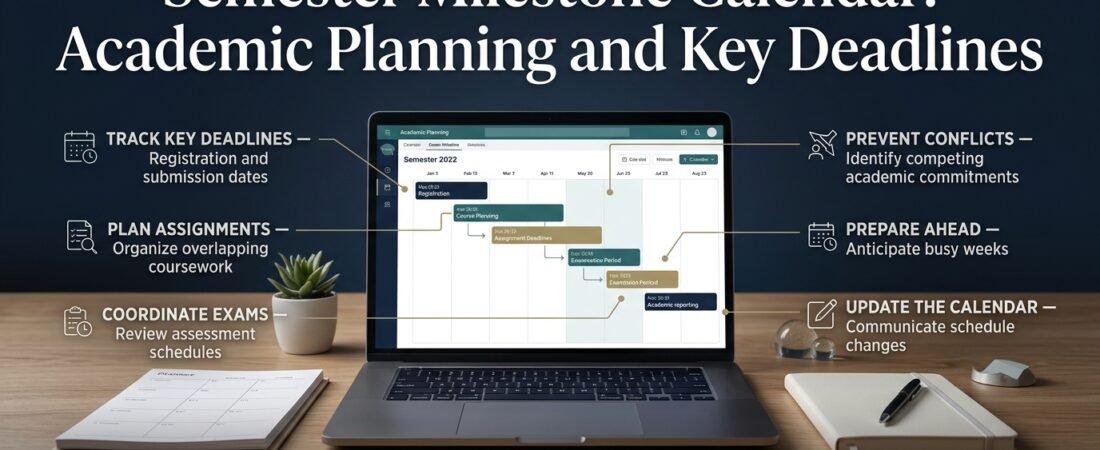
A semester milestone calendar helps prevent these problems by organizing the important dates and academic checkpoints that shape an entire semester. Instead of relying on scattered emails, separate spreadsheets, or personal reminders, students and academic teams can use one structured calendar to understand what needs to happen and when.
For students, it supports better preparation and time management. For instructors, it makes assessment planning more predictable. For administrators, it provides a practical framework for coordinating academic operations across departments.
The key is to build a calendar that does more than list dates. It should help people make decisions, anticipate workload, recognize scheduling conflicts, and respond to changes before they become serious problems.
This guide explains how to create a semester milestone calendar, which milestones to include, how to organize deadlines, which planning tools can help, and how to maintain an accurate calendar throughout the academic term.
What Is a Semester Milestone Calendar?
A semester milestone calendar is a structured overview of the major academic dates, deadlines, events, and checkpoints scheduled during a semester. It typically includes the first day of classes, registration deadlines, important assignments, examination periods, academic holidays, project submissions, and final grade reporting dates.
Unlike a daily timetable, which focuses on individual classes and activities, a milestone calendar highlights the events that influence academic progress and semester-wide planning.
For example, a university might identify course registration as an early milestone, midterm examinations as a middle-semester checkpoint, and final examinations as a major end-of-semester event. Each milestone helps students and staff prepare for the next stage of academic work.
A well-organized calendar usually contains:
- Official semester start and end dates.
- Course registration and enrollment deadlines.
- Add/drop and withdrawal periods.
- Major assignment and project milestones.
- Midterm and final examination periods.
- Public holidays and institutional closures.
- Academic review and feedback periods.
- Final grade submission and results publication dates.
The exact details depend on the institution, program, course structure, and applicable academic policies.
For a broader view of academic planning, visit the RTI Scheduler homepage, which can serve as a starting point when exploring scheduling and academic organization resources.
Why Is a Semester Milestone Calendar Important?
A semester milestone calendar gives everyone a shared understanding of important academic dates. It helps people prepare in advance instead of reacting to deadlines at the last minute.
Imagine a student taking five courses. Two instructors schedule major projects for the same Friday, another course has a midterm examination the following Monday, and the registration change deadline falls during the same period. Without a clear overview, the student may not recognize the workload problem until it is too late to respond effectively.
A milestone calendar makes these obligations visible early.
Its main benefits include:
- Improved time management: Students can divide large assignments into smaller tasks and schedule preparation time.
- Better academic coordination: Faculty members can review assessment dates across courses.
- Fewer missed deadlines: Important dates are easier to locate and remember.
- More effective communication: Students and staff can refer to the same approved schedule.
- Reduced administrative confusion: Departments can coordinate registration, examinations, grading, and reporting.
- Earlier problem detection: Scheduling conflicts can be identified before the semester becomes too busy.
A calendar cannot prevent every unexpected problem. However, it creates a reliable planning structure that makes many common problems easier to manage.
Which Milestones Should a Semester Calendar Include?
The most useful calendar includes milestones that affect enrollment, learning, assessment, and academic administration. The goal is to capture the dates that people genuinely need to know without turning the document into an overwhelming list of daily activities.
1. Semester Opening and Closing Dates
The semester’s beginning and ending dates establish the foundation for every other milestone.
Include the official first day of classes, orientation activities, teaching periods, revision periods, examination windows, and semester completion date where applicable.
These dates help students organize their schedules and allow departments to plan teaching activities around the available instructional weeks.
It’s also important to distinguish the final teaching day from the end of the semester. Some institutions conduct examinations, presentations, practical assessments, or other academic activities after regular classes have finished.
Example: If classes end in the second week of December but final examinations continue until the end of the month, students should see both dates clearly rather than assuming that the semester finishes when lectures stop.
2. Registration and Enrollment Deadlines
Registration milestones can have consequences that extend beyond the current semester. Students may need to select courses, change enrollment, apply for exemptions, or withdraw from a class before a specific deadline.
A useful calendar may include:
- Registration opening and closing dates.
- Course selection deadlines.
- Add/drop periods.
- Late registration deadlines.
- Course withdrawal deadlines.
- Credit transfer or exemption application dates.
- Scholarship and financial aid application deadlines, where relevant.
- Graduation application deadlines.
These events should be labeled precisely because different deadlines may involve different procedures.
For instance, dropping a course during an approved add/drop period may have different transcript consequences from withdrawing after that period. Students should always check the institution’s official rules before making enrollment decisions.
Expert tip: Include a link to the applicable policy or student portal whenever possible. A deadline is more useful when students can immediately find the instructions needed to complete the process.
3. Major Assignments and Project Checkpoints
A semester milestone calendar should help students prepare for important assessments well before the final submission date.
Major coursework milestones may include research proposals, project approvals, draft reviews, laboratory reports, presentations, group project checkpoints, and final submissions.
However, not every weekly assignment needs to appear on the institution-wide calendar. Smaller activities can remain in course-specific schedules.
The central calendar should focus on assessments that require substantial preparation or influence workload across several courses.
For example, a research project might have four important checkpoints:
- Topic approval.
- Research proposal submission.
- Draft review and feedback.
- Final project submission.
These checkpoints turn a large task into a sequence of manageable responsibilities.
4. Midterm and Final Examinations
Examination periods are among the most important academic milestones because they affect students, instructors, classrooms, invigilators, and administrative teams.
Include the midterm examination window, practical assessments, oral examinations, final examination period, makeup examination arrangements, and timetable publication deadlines where applicable.
If the exact examination timetable has not been approved, publish the expected examination window as provisional. Do not present an estimated date as a confirmed appointment.
Students need the final timetable to organize revision, transportation, work commitments, and other responsibilities.
5. Academic Holidays and Institutional Closures
Holidays can affect teaching schedules, assignment deadlines, examination arrangements, and administrative operations.
Include confirmed public holidays, institutional breaks, and approved closures that influence academic activities.
Where dates depend on official announcements or local observation, label them as provisional and specify when they will be reviewed.
The calendar should also clarify the practical effect of a closure. An office closure does not necessarily mean that every online academic activity is canceled, and an announced holiday may require separate arrangements for examinations or assignment submissions.
6. Faculty and Administrative Milestones
Academic planning continues after classes and examinations finish. Instructors may need to grade assessments, verify results, complete reports, and submit final marks.
Administrative milestones may include:
- Grade submission deadlines.
- Attendance verification dates.
- Result approval periods.
- Academic progress reviews.
- Student feedback surveys.
- Grade appeal or re-evaluation deadlines.
- Departmental reporting dates.
- Preparation deadlines for the next semester.
These milestones are particularly important when several departments must complete related tasks in a specific sequence.
Semester Milestone Calendar vs. Academic Calendar vs. Course Schedule
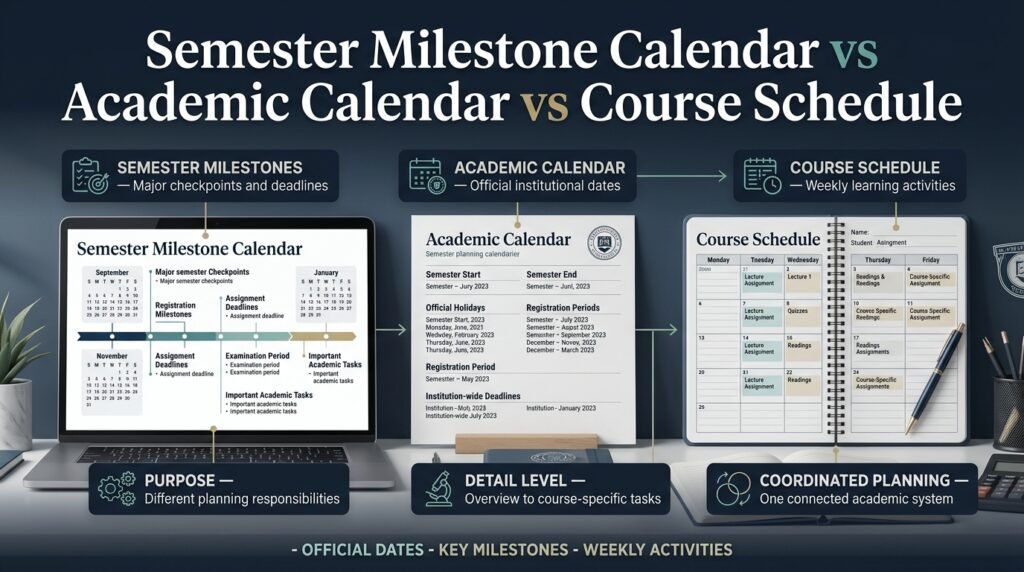
These three planning documents are connected, but they serve different purposes. Understanding their differences helps prevent duplicate work and unnecessary confusion.
| Feature | Semester milestone calendar | Academic calendar | Course schedule |
|---|---|---|---|
| Main purpose | Highlight major semester checkpoints | Show official institution-wide dates | Organize individual course activities |
| Typical users | Students, faculty, coordinators | Entire academic community | Students and course instructors |
| Common contents | Major assignments, exams, registration milestones | Semester dates, holidays, official deadlines | Lectures, quizzes, readings, weekly assignments |
| Level of detail | Major events and deadlines | Institution-wide overview | Course-specific activities |
| Update frequency | When milestones change | When official academic dates change | As teaching activities are adjusted |
An institution can use all three documents together.
The official academic calendar establishes the main structure. The semester milestone calendar highlights important checkpoints within that structure. Individual course schedules provide the detailed instructions students need for weekly learning activities.
For additional planning guidance, explore Academic Calendar Planning and Academic Planning and Scheduling Tools.
These resources are relevant when organizing academic dates, coordinating schedules, and evaluating ways to manage planning information more consistently.
How to Create a Semester Milestone Calendar Step by Step
Building an effective calendar requires a clear process. Entering dates into a spreadsheet is only the beginning; the dates must be verified, coordinated, communicated, and maintained.
Step 1: Collect and Verify Official Academic Dates
Start by identifying the institution’s authoritative academic calendar and any approved departmental schedules.
Collect the semester start and end dates, teaching periods, examination windows, registration deadlines, holidays, and grade submission requirements.
If several documents contain different dates, confirm which version is official before proceeding.
Record the source of each important date and the office responsible for confirming it. This creates a simple audit trail and makes future corrections easier.
Why this matters: Every later milestone depends on the academic structure. An incorrect semester end date can affect project planning, examination arrangements, and grade reporting.
Common mistake: Using last year’s calendar as the primary source without checking whether the institution has changed its dates or policies.
Step 2: Group Milestones by Category
Once the official dates are collected, organize them into categories.
A practical structure includes:
| Category | Examples | Purpose |
|---|---|---|
| Semester structure | Opening day, final teaching day | Establish the academic timeline |
| Student administration | Registration, add/drop, withdrawal | Prevent procedural deadlines from being missed |
| Assessment | Midterms, major projects, final exams | Support workload planning |
| Academic operations | Grade submission, reporting, result publication | Coordinate faculty and administrative work |
| Holidays and closures | Public holidays, institutional breaks | Avoid scheduling conflicts |
| Student support | Advising sessions, progress reviews | Identify support needs at useful points |
Categories help readers find relevant information quickly. They also make it easier for administrators to review one type of milestone without losing sight of the overall calendar.
Step 3: Work Backward From Major Deadlines
Large assignments and institutional activities often require several earlier tasks.
Instead of placing only the final deadline on the calendar, identify the preparation steps that must happen beforehand.
Suppose a research report is due on November 30. An instructor might establish these illustrative checkpoints:
- September 15: Topic approval.
- October 1: Proposal submission.
- October 20: Initial draft.
- November 10: Feedback and revision.
- November 30: Final submission.
This timeline provides opportunities to identify problems before the final deadline.
The exact spacing depends on the project’s difficulty and the course’s learning objectives. A short presentation may need only a few checkpoints, while a dissertation or complex group project may require several stages.
Professional advice: Allow time for feedback, revision, and unexpected delays. A plan that assumes every task will be completed perfectly on the first attempt is unlikely to work well.
Step 4: Review Cross-Course Scheduling Conflicts
A calendar may contain all the correct dates and still create unnecessary pressure if major assessments overlap.
Before publishing it, review the combined workload across courses and departments.
Ask the following questions:
- Are multiple major assignments due on the same day?
- Are several examinations scheduled within an unusually short period?
- Do assessment dates conflict with approved holidays?
- Have students received enough time to complete prerequisite work?
- Is there sufficient time for instructors to mark assignments?
- Are shared rooms, laboratories, or examination facilities available?
- Do administrative deadlines fall during institutional closures?
Some overlaps are unavoidable, but identifying them early gives departments an opportunity to make reasonable adjustments.
Step 5: Choose the Right Calendar Format
The format should suit the institution’s size, technical resources, and planning requirements.
| Format | Best use | Advantages | Limitations |
|---|---|---|---|
| Spreadsheet | Small departments or simple calendars | Easy to edit, sort, and print | Updates may not reach everyone automatically |
| Shared digital calendar | Faculty teams and departments | Supports shared access and reminders | Requires permission management |
| Student information system | Institution-wide administration | May connect with enrollment and academic records | Can require substantial configuration |
| Learning management system | Course-level milestones | Keeps deadlines close to learning materials | May not display every institutional event |
| Printable calendar | Noticeboards and quick reference | Easy to scan and distribute | Can become outdated after changes |
For many institutions, a combined approach works well. Maintain one authoritative digital calendar and provide a printable overview for people who prefer a quick reference.
Step 6: Write Clear and Actionable Milestone Labels
Every milestone should explain what is happening and, where appropriate, what action the reader needs to take.
A vague label such as “Registration” doesn’t explain whether registration is opening, closing, or entering a change period.
A clearer label would be “Final day to add or drop courses.”
For each milestone, include relevant details:
- Event name.
- Date and time.
- Responsible office or instructor.
- Required action.
- Confirmation status.
- Relevant instructions or policy.
- Contact details when clarification is necessary.
For example, a course withdrawal milestone could state the deadline, identify the student portal used for requests, and link to the applicable policy.
This additional context reduces repeated questions and makes the calendar more useful to students who are unfamiliar with institutional procedures.
Step 7: Publish the Calendar and Set Reminders
Once the dates have been verified and conflicts reviewed, publish the calendar through the institution’s usual communication channels.
These might include the student portal, departmental website, learning management system, official email, or shared calendar application.
Use reminders for milestones that require action. Registration changes, major project submissions, examinations, and graduation applications may benefit from advance notifications.
A possible reminder pattern is:
- Two weeks before a major deadline.
- One week before the deadline.
- One day before the deadline, when appropriate.
Not every event needs three reminders. Choose a schedule that suits the importance of the milestone and avoids overwhelming users with unnecessary notifications.
Step 8: Assign Responsibility for Updates
A calendar needs an owner who can verify information, approve changes, and notify affected users.
Depending on the institution, this responsibility may belong to the registrar, academic coordinator, department administrator, or another designated office.
When an important date changes, update the authoritative calendar and communicate the change directly.
For significant changes, retain a record of the original date, revised date, reason, approval, and notification date.
This process helps prevent students and staff from relying on conflicting versions of the same schedule.
What Does a Semester Milestone Calendar Look Like in Practice?
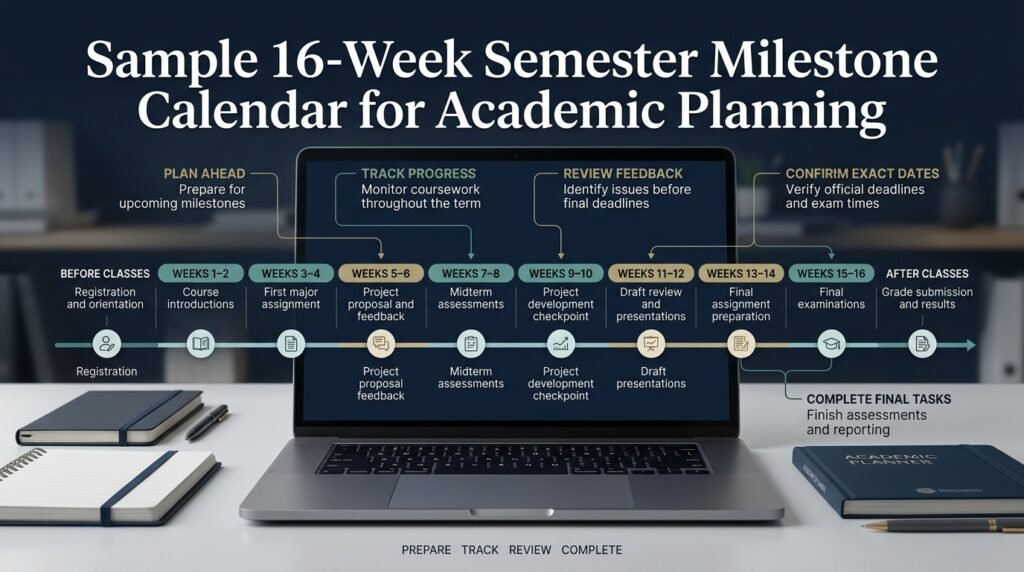
A sample calendar can help students and academic teams understand how milestones fit together over the semester.
The following example uses a hypothetical 16-week semester. It is a planning illustration, not an official academic schedule.
| Semester stage | Example milestone | Main purpose |
|---|---|---|
| Before classes | Registration and orientation | Prepare students and confirm enrollment |
| Weeks 1–2 | Course introductions and topic selection | Establish expectations |
| Weeks 3–4 | First major assignment | Review early academic progress |
| Weeks 5–6 | Project proposal and initial feedback | Identify problems early |
| Weeks 7–8 | Midterm assessments | Measure progress and guide revision |
| Weeks 9–10 | Project development checkpoint | Maintain progress on longer assignments |
| Weeks 11–12 | Draft review and presentations | Provide time for feedback |
| Weeks 13–14 | Final assignment preparation | Complete major coursework |
| Weeks 15–16 | Final examinations | Assess semester learning |
| After classes | Grade submission and results | Complete academic administration |
This overview is useful for understanding the semester’s overall rhythm. However, students need exact dates and times for deadlines that require action.
For example, “Midterms in Week 8” is a useful planning note, but it doesn’t replace a confirmed examination timetable.
How Can Students Turn Milestones Into a Weekly Study Plan?
Students can use the calendar as the foundation for their personal study schedules.
At the beginning of each week, review upcoming milestones and identify the three most important responsibilities. Break each responsibility into smaller tasks and schedule them before the official deadline.
For example, a presentation due in three weeks might require topic selection, research, slide preparation, rehearsal, and final submission.
Instead of waiting until the final week, the student can schedule these activities across the available time.
This method is particularly useful when several courses have major assessments close together.
Pro tip: Schedule preparation time as an actual calendar activity rather than treating it as free time that can be used whenever convenient.
How Can Faculty Members and Administrators Use the Calendar?
Faculty members can use the milestone calendar to coordinate assessment dates, prepare teaching materials, and provide students with consistent information.
Department heads can compare assessment schedules across courses and identify workload concentration. They can also review whether students have enough time between project checkpoints and major examinations.
Administrative teams can use the calendar to coordinate registration, classroom reservations, examination logistics, grade processing, and reporting.
A central calendar does not mean every user needs access to every detail. An institution can maintain a public version containing student-facing milestones and a more detailed internal version for authorized staff.
This arrangement keeps information relevant to each audience while preserving a consistent academic timeline.
How Should You Prioritize Academic Milestones?
Not every milestone has the same consequences. A useful calendar makes important deadlines easy to recognize without marking every event as urgent.
Priorities should reflect institutional policies, academic impact, and the consequences of missing a date.
| Priority | Examples | Recommended approach |
|---|---|---|
| Critical | Final examinations, official withdrawal deadlines | Clear visibility and advance reminders |
| High | Major project submissions, midterms, registration closing | Prominent listing and planned notifications |
| Moderate | Draft reviews, presentations, progress meetings | Include in the relevant calendar |
| Optional | Supplementary workshops and voluntary activities | Include when useful to the audience |
The categories should be adapted to the institution’s circumstances.
For example, a scholarship application deadline may be critical for a student who depends on financial assistance, even if it isn’t a major institution-wide event.
Prioritization should therefore consider both academic operations and the needs of the people using the calendar.
How Can You Manage Holidays and Changing Academic Dates?
Academic dates can change because of official announcements, institutional decisions, unexpected closures, or examination adjustments.
A reliable calendar distinguishes between confirmed dates and those that remain provisional.
For holidays that depend on official announcements or local observation, identify the authority responsible for confirmation and establish a review date. Once the date is confirmed, update the calendar and notify affected users.
If an examination or assignment deadline changes, communicate the new date explicitly. Don’t assume that everyone will notice a small update to a calendar they viewed weeks earlier.
A practical holiday-planning process includes:
- Collect the official holiday information relevant to the institution.
- Identify dates that remain provisional.
- Review their potential effect on classes and assessments.
- Assign responsibility for confirming uncertain dates.
- Update the calendar when official information becomes available.
- Notify students, instructors, and administrators affected by the change.
The Academic Holiday Calendar Builder is a relevant resource to explore when organizing academic holidays and institutional closures.
Common mistake: Publishing an estimated holiday date without explaining that it may change. Students may arrange travel or work commitments based on information that hasn’t been finalized.
What Are the Most Common Semester Calendar Mistakes?
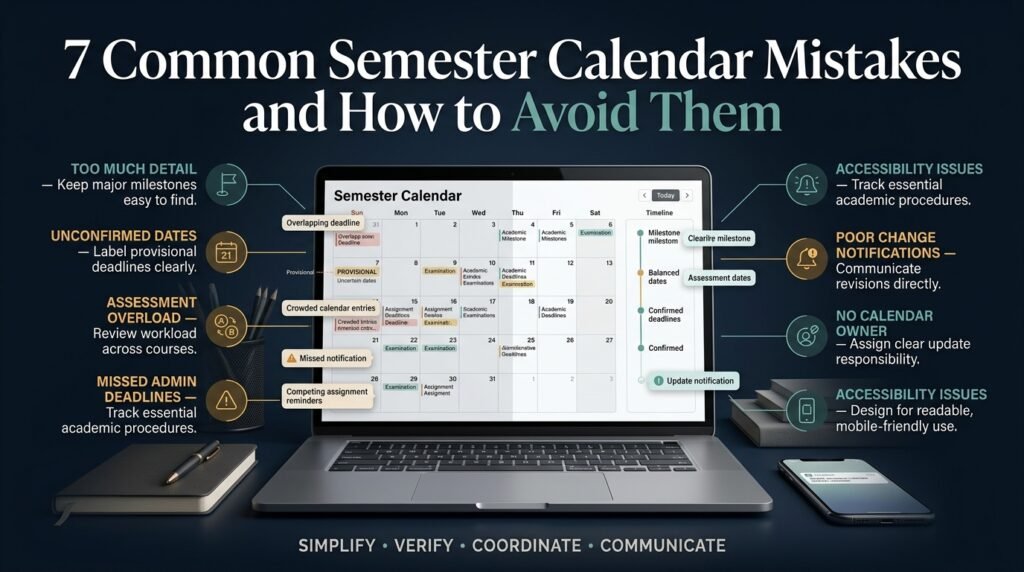
A calendar can look professional but still fail to support academic planning. Most problems arise from unclear information, poor coordination, or a lack of ongoing maintenance.
Mistake 1: Including Too Much Detail
Trying to include every lecture, reading task, meeting, and small assignment makes the central calendar difficult to navigate.
Why it happens: Organizers want one document to serve every purpose.
Why it’s harmful: Major deadlines lose visibility, and readers spend too much time searching for relevant information.
How to avoid it: Keep the milestone calendar focused on significant events. Store routine activities in individual course schedules.
Mistake 2: Using Unconfirmed Dates
An expected date can easily be mistaken for an approved deadline.
Why it happens: Institutions want to publish the calendar early, even when some decisions are pending.
Why it’s harmful: Students and staff may make plans based on information that later changes.
How to avoid it: Label provisional dates clearly, identify who will confirm them, and set a review deadline.
Mistake 3: Ignoring Assessment Workload
Correct dates do not automatically produce a reasonable schedule.
Why it happens: Instructors plan their own courses without reviewing other courses.
Why it’s harmful: Students may face several demanding assessments within a short period.
How to avoid it: Review major assessment dates across the relevant courses before finalizing the calendar. Where possible, distribute demanding submissions more evenly.
Mistake 4: Forgetting Administrative Deadlines
Students may focus on examinations while overlooking course withdrawal, credit transfer, scholarship, or graduation application deadlines.
Why it happens: Administrative tasks often seem less urgent than assignments.
Why it’s harmful: Missing a procedural deadline may affect enrollment, finances, academic records, or graduation.
How to avoid it: Create a separate administrative category and provide links to relevant instructions.
Mistake 5: Failing to Communicate Changes
Updating a document does not guarantee that everyone will see the revision.
Why it happens: Organizers assume users will check the calendar regularly.
Why it’s harmful: Different groups may continue following different versions of the schedule.
How to avoid it: Maintain one authoritative version and send direct notifications when important dates change.
Mistake 6: Assigning No Calendar Owner
A calendar can become outdated when everyone assumes someone else is responsible for maintenance.
Why it happens: Initial publication receives more attention than ongoing administration.
Why it’s harmful: Missing updates reduce trust and generate avoidable questions.
How to avoid it: Assign a specific owner, document update responsibilities, and schedule regular reviews.
Mistake 7: Ignoring Accessibility and Usability
A calendar that works only on a large desktop screen or relies entirely on color may be difficult for some users to access.
Why it happens: Organizers focus on appearance rather than how people will use the document.
Why it’s harmful: Students may struggle to locate deadlines or distinguish important information.
How to avoid it: Use readable text, descriptive labels, mobile-friendly layouts, and clear status words such as “Confirmed” and “Provisional.”
Which Tools Can Make Semester Milestone Planning Easier?
The best planning tool depends on the number of courses, the size of the institution, existing systems, and the complexity of its scheduling requirements.
A small department may only need a shared spreadsheet. A large institution may benefit from a system that connects academic dates with student records, course schedules, and examination administration.
When comparing tools, look for features that solve real planning problems.
Important capabilities include:
- Shared access for authorized users.
- Clear calendar views by semester, department, or course.
- Editing and version control.
- Notifications and reminders.
- Search and filtering.
- Export and printing options.
- Mobile accessibility.
- Permission management.
- Integration with existing academic systems.
Academic planning tools can help teams organize connected scheduling tasks, but software alone doesn’t guarantee an accurate calendar. The institution still needs verified dates, clear ownership, and a process for managing changes.
The RTI Scheduler homepage is another starting point for reviewing academic scheduling resources and considering which planning approach may fit your workflow.
Before adopting any tool, test it using a realistic semester schedule. Check whether users can find important deadlines quickly, identify changes, and distinguish confirmed dates from provisional ones.
How Can You Measure the Success of a Semester Milestone Calendar?
A successful calendar should make academic responsibilities easier to understand and manage. Its value should be assessed through practical outcomes rather than appearance alone.
Track Missed Deadlines
Review whether important deadlines are repeatedly overlooked.
If students frequently miss the same registration deadline, investigate whether the instructions were unclear, reminders were insufficient, or the date was difficult to find.
The purpose is to identify the cause of the problem, not simply to count missed dates.
Review Assessment Conflicts
Record major scheduling conflicts identified during the semester.
If several courses repeatedly schedule major submissions for the same day, introduce a cross-course review before the next calendar is published.
This can help departments improve coordination over time.
Monitor Communication of Changes
Review whether students and staff received important updates promptly.
A calendar may be accurate in its central location but still create confusion if changes are communicated too late or through channels that affected users rarely check.
Collect Feedback From Users
Ask students, faculty members, and administrators whether the calendar is easy to navigate and contains the information they need.
Useful questions include:
- Were major deadlines easy to locate?
- Were date changes communicated clearly?
- Did the calendar help with workload planning?
- Were any important milestones missing?
- Which information was difficult to understand?
Use the feedback to improve the next version.
Evaluate Administrative Efficiency
Consider whether the calendar reduces repeated questions about registration, examinations, holidays, and reporting deadlines.
This is a practical way to determine whether the calendar is improving communication. However, changes in administrative workload may also reflect other factors, so evaluate the results in context.
Expert Recommendations for a More Reliable Semester Calendar
A professional calendar should be accurate, easy to scan, and supported by a dependable process for maintaining it.
Establish One Authoritative Source
Avoid maintaining several unrelated versions of the same calendar. Select a central location and direct users there whenever possible.
Departments can maintain additional schedules, but those schedules should remain aligned with the approved institutional dates.
Give Each Major Milestone an Owner
Identify who is responsible for confirming a date, providing instructions, and reporting changes.
Depending on the event, the owner may be a registrar, department coordinator, instructor, or administrative officer.
Clear ownership reduces the risk of missed updates.
Make Each Milestone Actionable
A milestone should help readers understand what they need to do.
For example, “Course withdrawal deadline” identifies the event, but adding the applicable process and official policy helps students take the correct action.
The amount of detail should be appropriate to the audience. Avoid adding lengthy instructions when a reliable policy link can provide the necessary information.
Allow Realistic Preparation Time
Students need time to research, draft, revise, and prepare for assessments. Faculty members need time to provide feedback, mark submissions, and submit grades.
When working backward from a final deadline, account for these tasks rather than assuming that every stage can happen immediately.
Separate Confirmed and Provisional Dates
Use explicit status labels rather than relying on color alone.
For example, label an examination window “Provisional” until the approved timetable is available. Once confirmed, update the status and notify users if the date differs from earlier expectations.
Review the Calendar With Real Users
Before publication, ask students, instructors, and administrative staff to test the calendar.
Can they identify the final day to add a course? Can they find the examination period? Can they tell whether a holiday has been confirmed?
If users struggle to answer these questions, improve the labels or layout before releasing the calendar.
Semester Milestone Calendar Checklist
Use this checklist before publishing the calendar for an upcoming semester.
- Official semester start and end dates have been verified.
- Registration, add/drop, and withdrawal deadlines are included.
- Major assignments and examination periods have been coordinated.
- Academic holidays and institutional closures have been checked.
- Grade submission and results-related milestones are included.
- Provisional dates are clearly identified.
- Each major milestone has a responsible owner.
- Important deadlines include the required action or policy link.
- The calendar is accessible to its intended audience.
- Reminder and update procedures are established.
- Conflicting or missing dates have been reviewed.
- The next calendar review date has been scheduled.
Completing this checklist helps catch common problems before the calendar reaches students and staff. It also creates a repeatable process that can be improved after every semester.
What Should Be Included in a Semester Milestone Calendar?
A semester milestone calendar should include the most important academic dates, deadlines, and activities that students, instructors, and academic administrators need to plan for in advance. The goal is to provide a clear overview of the semester without overcrowding the calendar with every lecture or minor assignment. A well-structured calendar makes it easier to understand academic expectations, prepare for assessments, and manage administrative responsibilities.
The most useful milestones typically include:
Semester dates: The first day of classes, last day of instruction, revision periods, and final examination dates.
Registration deadlines: Course enrollment, add/drop periods, withdrawal dates, and other important registration requirements.
Assessment milestones: Major assignments, project proposals, presentations, midterm examinations, and final submissions.
Academic holidays: Public holidays, institutional closures, and scheduled semester breaks.
Administrative deadlines: Grade submission dates, result publication, academic reviews, and graduation applications where applicable.
For the best results, distinguish between confirmed and provisional dates. Include links to official policies when students need additional instructions, and keep smaller weekly activities in individual course schedules.
How Do You Create an Effective Semester Milestone Calendar?
Creating an effective semester milestone calendar begins with collecting accurate academic dates and organizing them into a practical schedule. Instead of entering deadlines randomly, work from the institution’s official academic calendar and build a timeline that reflects the sequence of academic activities. This approach helps prevent scheduling conflicts and gives students enough time to prepare for important assessments.
Follow these practical steps:
Collect official dates: Confirm semester opening and closing dates, examination periods, holidays, and registration deadlines.
Identify major milestones: Select the assessments, submissions, and administrative events that require advance preparation.
Plan backward from deadlines: Establish earlier checkpoints for research, drafts, feedback, and final submissions.
Review potential conflicts: Check whether major examinations or assignments overlap across courses.
Choose a suitable format: Use a spreadsheet, shared digital calendar, academic planning platform, or printable calendar according to your needs.
Assign responsibility for updates: Make sure a designated person verifies changes and communicates them to affected users.
Before publishing the calendar, review every date for accuracy and make sure the information is easy to understand. A reliable update process is just as important as the initial planning stage.
What Is the Difference Between a Semester Milestone Calendar and an Academic Calendar?
An academic calendar establishes the official structure of the academic year or semester, while a semester milestone calendar highlights the important checkpoints that students, faculty members, and administrators must manage during that period. Although the two documents are closely connected, they serve different planning purposes.
An academic calendar generally includes the beginning and end of semesters, institutional holidays, registration periods, examination windows, and other official dates. A milestone calendar uses this information to emphasize important responsibilities, such as major project submissions, assessment checkpoints, withdrawal deadlines, and final grade reporting.
The main differences are:
Academic calendar: Provides the official institution-wide timeline.
Semester milestone calendar: Highlights important deadlines and events within that timeline.
Course schedule: Provides detailed information about lectures, weekly assignments, quizzes, and course activities.
Using these resources together creates a more complete planning system. Students can consult the academic calendar for official dates, use the milestone calendar to prepare for important deadlines, and refer to individual course schedules for their weekly responsibilities.
How Can a Semester Milestone Calendar Help Students Avoid Missed Deadlines and Academic Stress?
A semester milestone calendar helps students manage academic responsibilities by making important dates visible before they become urgent. Instead of remembering every deadline separately, students can review their upcoming obligations, identify busy periods, and divide larger assignments into smaller tasks. This creates a more realistic study plan and reduces the risk of leaving important work until the last minute.
For example, a student who has a research project due in four weeks can schedule topic selection, research, drafting, revision, and final submission as separate checkpoints. If a midterm examination falls during the same period, the student can adjust the preparation schedule before the workload becomes overwhelming.
Students can make the calendar more effective by following these practices:
Review upcoming milestones at the beginning of each week.
Set reminders for registration deadlines, examinations, and major submissions.
Break large assignments into smaller, manageable tasks.
Schedule revision time before examination periods.
Check official announcements regularly for changes to academic dates.
Prioritize deadlines according to their importance and the time required to complete each task.
A calendar cannot eliminate every academic challenge, but it can make responsibilities more predictable and help students use their time more effectively.
How Often Should a Semester Milestone Calendar Be Updated?
A semester milestone calendar should be reviewed regularly and updated whenever an official academic date or requirement changes. Even a carefully prepared calendar can become unreliable if examination schedules are revised, institutional closures are announced, or deadlines are adjusted without clear communication.
For routine maintenance, an institution may schedule a monthly review. However, important changes should be addressed immediately rather than waiting until the next review. A designated calendar owner, such as an academic coordinator or administrative officer, should verify the information and ensure that affected students and staff receive timely updates.
A reliable updating process should include:
Regular reviews: Check upcoming milestones and confirm that the published information remains accurate.
Official verification: Confirm changes with the responsible department before revising important dates.
Clear communication: Notify affected users when examination dates, submission deadlines, or registration periods change.
Version control: Maintain one authoritative calendar to prevent confusion between outdated and updated copies.
Provisional date management: Clearly identify unconfirmed dates and update their status when official information becomes available.
Keeping the calendar accurate throughout the semester helps maintain trust, reduces unnecessary questions, and gives students and academic teams a dependable source for planning their responsibilities.
Conclusion
A well-organized semester milestone calendar gives students, faculty members, and academic administrators a clear view of the most important deadlines and responsibilities throughout the semester. By bringing registration dates, examinations, major assignments, academic holidays, and administrative checkpoints into one structured timeline, it becomes easier to plan ahead, manage competing priorities, and reduce avoidable scheduling conflicts.
The most effective calendar is built on accurate information, realistic preparation time, and regular updates. Institutions should verify dates against official academic schedules, identify potential workload conflicts, and communicate changes promptly. Students can strengthen the process by reviewing upcoming milestones weekly, setting reminders, and breaking larger assignments into manageable steps.
Whether you are coordinating an entire academic department or organizing your own studies, a semester milestone calendar can turn a crowded list of deadlines into a practical plan of action. When supported by reliable academic calendar planning and the right academic planning and scheduling tools, it helps create a more predictable, organized, and productive academic experience.