

Introduction
Assessment Sitting Schedule | Planning assessments becomes challenging when several subjects, student groups, examination rooms, and time restrictions must be managed at once. A date that works for one class may create a conflict for another, while a room that appears available may lack the equipment needed for a practical assessment. Without a clear plan, these small problems can quickly turn into major scheduling difficulties.
An assessment sitting schedule provides a structured way to organize assessment sessions by date, time, duration, location, and candidate group. It helps schools, colleges, universities, and training institutions coordinate their examinations while making sure students and staff understand when and where each assessment will take place.
A reliable schedule is more than a list of examination dates. It connects assessment requirements with room availability, staff responsibilities, candidate needs, academic deadlines, and institutional rules. It also gives administrators a consistent reference when they need to review conflicts or communicate changes.
Institutions that want to improve their overall planning process can begin with RTI Scheduler and develop a more organized approach to academic scheduling.
This guide explains how assessment sitting schedules work, which details they should contain, how to prepare one step by step, which tools can make planning easier, and how to avoid common mistakes. You’ll also find practical examples, review checklists, and professional recommendations for creating a schedule that works in real educational settings.
What Is an Assessment Sitting Schedule?
An assessment sitting schedule is a planning document that identifies when, where, and under what arrangements an assessment will take place. Each sitting represents a particular assessment session assigned to a date, time window, venue, and eligible group of candidates.
The term sitting is often used for a scheduled examination session. Depending on the institution, one assessment may have a single sitting for all candidates or several sittings to accommodate different groups, room capacities, or approved arrangements.
For example, a college may schedule a mathematics examination for one group at 9:00 a.m. and another group at 1:00 p.m. Alternatively, a university may hold the same examination simultaneously in several rooms, with each room accommodating a different candidate group.
Both arrangements require careful coordination.
What information should an assessment sitting schedule contain?
A useful schedule contains the information people need to prepare for, attend, and administer each session. The precise fields depend on the size and complexity of the assessment program.
Common details include:
- Assessment title and subject.
- Course code or assessment identification number.
- Examination date and starting time.
- Expected finishing time and duration.
- Candidate group, class, or approved candidate list.
- Examination room or assessment venue.
- Invigilator or responsible staff member.
- Required equipment, materials, or software.
- Reporting time and entry instructions.
- Approved alternative arrangements, managed appropriately.
- Schedule status, publication date, and revision details.
A small school may need only a date, time, subject, class, and room. A large institution may require detailed room allocations, candidate lists, equipment inventories, and staff assignments.
The goal is not to include every possible detail in one document. It is to ensure that each intended reader receives enough accurate information to perform their responsibilities without unnecessary confusion.
Who uses an assessment sitting schedule?
Different people use the same schedule for different purposes.
| User | Main responsibility | Information needed |
|---|---|---|
| Examination coordinator | Organize and approve sessions | Complete assessment and resource details |
| Teachers and departments | Confirm assessment requirements | Subject, duration, candidate group, restrictions |
| Students | Attend assessments as instructed | Date, time, venue, reporting instructions |
| Invigilators | Supervise sessions | Room, timing, assigned duties |
| Room administrators | Prepare venues | Capacity, equipment, setup requirements |
| Academic leadership | Review the overall plan | Assessment coverage, conflicts, readiness |
Keeping these needs in mind helps administrators decide which details belong in the main timetable and which should remain in restricted operational records.
Why Is an Assessment Sitting Schedule Important?
An assessment sitting schedule helps educational institutions coordinate examinations, reduce timetable conflicts, allocate limited resources, and communicate expectations clearly. It allows administrators to check whether assessments can take place as planned before students and staff commit to the published arrangements.
Its value becomes especially clear when several departments share rooms, students take multiple subjects, or examinations require specialist facilities.
1. It reduces scheduling conflicts
A student may be enrolled in several subjects, and a candidate may have assessments administered by different departments. If each department plans independently, overlapping sessions can go unnoticed.
A centralized schedule makes it easier to compare candidate groups, dates, times, and durations. Administrators can identify conflicts before publishing the final timetable.
For example, if a student is registered for both economics and accounting, the coordinator should check whether the two examinations overlap or leave insufficient time between them.
The same principle applies to staff and facilities. An invigilator cannot supervise two rooms simultaneously, and a laboratory cannot accommodate two incompatible assessments at once.
2. It improves communication
Students need to know when to attend, where to report, and whether they must bring particular materials. Teachers and invigilators need equally clear instructions about their responsibilities.
A well-structured schedule reduces repeated questions and makes official information easier to find.
It also gives the institution a consistent source for updates. Rather than sending conflicting messages from separate departments, administrators can maintain one approved timetable and communicate revisions through established channels.
3. It supports better resource allocation
Rooms, equipment, and qualified staff are often limited. Assessment scheduling helps institutions match available resources to actual requirements.
Administrators can compare room capacity with candidate numbers, confirm the availability of computers or laboratory equipment, and check whether enough invigilators are available for each session.
This reduces the risk of discovering shortly before an examination that the assigned room is unsuitable or essential equipment is unavailable.
4. It promotes fair and accessible assessment arrangements
Students should receive clear information and be able to complete assessments under the arrangements approved for them.
A schedule review can identify overlapping examinations, unrealistic transitions between venues, and conflicts involving approved accessibility arrangements.
Fairness also requires following institutional rules for examination security, alternative sittings, and equivalent assessment conditions.
A schedule cannot guarantee every aspect of fairness, but careful planning can prevent many avoidable problems.
5. It makes changes easier to manage
Assessment arrangements sometimes change because of unexpected closures, staffing problems, room availability, or updated requirements.
A central schedule helps administrators identify which sessions are affected, check alternative arrangements, and notify the appropriate people.
Maintaining a clear revision history is particularly important when several departments are involved. It helps prevent students from following an old timetable after an official change.
💡 Pro Tip: Assign one person or team responsibility for maintaining the master schedule. Departments can provide updates, but approved changes should flow through a defined process.
What Is the Difference Between an Assessment Sitting Schedule and an Exam Timetable?

An assessment sitting schedule usually provides session-level information needed to coordinate an assessment, while an exam timetable presents the dates and times of examinations for students, classes, or an institution. In practice, the terms overlap, so the distinction depends on the institution’s terminology and the document’s purpose.
A general exam timetable might state that chemistry takes place on Thursday morning. A detailed sitting schedule may also specify candidate groups, room assignments, equipment, staff responsibilities, and reporting instructions.
| Feature | Assessment Sitting Schedule | General Exam Timetable |
|---|---|---|
| Primary purpose | Coordinate individual assessment sessions | Communicate examination dates and times |
| Candidate details | May include specific groups or lists | Often shows classes or subjects |
| Venue information | May include detailed allocations | Usually includes the student-facing venue |
| Staff assignments | May include invigilator details | Often maintained separately |
| Resource planning | Commonly supports operational coordination | May contain limited operational detail |
| Typical audience | Coordinators and examination staff | Students, teachers, and families |
These are common differences rather than universal rules. An institution may use the term exam timetable for a highly detailed operational document.
Both documents can support the same process. The student-facing timetable communicates the essential arrangements, while the internal schedule helps staff deliver the assessment.
For broader planning, institutions can coordinate examination dates with teaching periods, term dates, and institutional events through Academic Calendar Planning.
What Types of Assessments Need a Sitting Schedule?
Assessment sitting schedules are useful whenever candidates must complete assessments within defined time windows or when rooms, staff, equipment, and student availability must be coordinated. They apply to more than final examinations and can support both formal assessment programs and routine academic testing.
School examinations
Schools may prepare sitting schedules for midterm examinations, final examinations, mock tests, standardized assessments, and subject-specific tests.
When scheduling school assessments, coordinators should consider grade levels, classroom availability, teaching periods, candidate numbers, and the time required to prepare examination rooms.
For instance, a school might assign separate sittings to different grade groups to make better use of available classrooms. However, the arrangement must also consider students who take subjects across multiple groups.
College and university examinations
Colleges and universities often manage assessments across multiple departments, programs, and course combinations.
A single examination period may involve hundreds of students, several buildings, different examination durations, and specialized facilities. The schedule must account for these requirements without creating avoidable conflicts.
Universities may also need to accommodate resits, deferred examinations, oral examinations, practical tests, and alternative assessment arrangements.
Professional certification assessments
Certification providers may schedule candidates for examinations at particular times or within approved testing windows.
Planning may involve registration deadlines, candidate identification, computer availability, supervision, security requirements, and instructions for arriving at the assessment venue.
Where candidates complete assessments in separate sittings, administrators should follow the relevant rules governing examination content, supervision, and equivalent conditions.
Practical and laboratory assessments
Practical assessments often have more restrictions than written examinations.
A laboratory may have a limited number of workstations, while a practical examination may require specialist equipment, individual supervision, or preparation time between candidates.
For example, if a laboratory can accommodate 20 candidates but 60 students must complete the assessment, the coordinator may need to arrange three sittings. The timetable must then account for equipment preparation, cleaning where necessary, staff availability, and any restrictions on candidates who have already completed the assessment.
Online and computer-based assessments
Online assessments may operate through fixed appointments, scheduled sessions, or flexible completion windows.
A fixed sitting requires a clear start time and arrangements for access, technical support, and candidate verification where applicable. A flexible assessment window may instead specify when the assessment becomes available and the deadline by which it must be completed.
These arrangements should not be confused. The availability period tells candidates when they can complete an assessment, while a scheduled sitting identifies a particular session.
How to Create an Assessment Sitting Schedule Step by Step
Creating an effective assessment sitting schedule requires more than choosing dates. Administrators should gather accurate information, identify restrictions, allocate sessions, check resources, review conflicts, and approve the final arrangement before communicating it to candidates.
The following process works as a practical framework for schools, colleges, universities, and other educational institutions.
Step 1: Collect all assessment requirements
Begin by creating a master list of assessments that need to be scheduled.
Ask each responsible department to provide the assessment title, subject, candidate numbers, duration, preferred dates, required facilities, and any restrictions that may affect scheduling.
Record whether the assessment has a fixed date or can be moved within an approved period.
Why it matters: Incomplete information often leads to timetable changes after rooms and staff have already been allocated.
Professional advice: Set a submission deadline for departments and identify missing information before you start assigning sessions.
Example: A department requests a 90-minute practical examination for 45 students. The coordinator needs to know the number of available workstations, the required equipment, and whether the examination can be divided into smaller groups.
Step 2: Confirm the academic calendar
Review the official academic calendar before selecting assessment dates.
Check for holidays, teaching breaks, institutional closures, graduation ceremonies, important academic deadlines, and other events that could affect availability.
Also confirm any externally fixed examination dates and institutional restrictions on when assessments may take place.
A School Year Event Calendar can help coordinators review major school events that may compete with assessment sessions.
Similarly, a Semester Milestone Calendar can help place examinations alongside teaching deadlines, revision periods, and the end of the semester.
Common mistake: Choosing dates based only on classroom availability without checking whether the wider academic calendar permits the assessment.
Step 3: Establish assessment priorities
Not every assessment has the same level of scheduling flexibility.
Some examinations must take place on a specific date. Others require specialist facilities or a limited number of qualified staff. More flexible assessments can usually be arranged around these restrictions.
Classify assessments into three groups:
- Fixed: Dates or times cannot be changed without authorization.
- Restricted: Several options are possible, but particular resources or conditions are required.
- Flexible: Sessions can be arranged within an approved period.
Schedule fixed assessments first, followed by restricted sessions, and then flexible assessments.
This approach reduces the risk of using a scarce resource for an assessment that could easily be moved elsewhere.
Step 4: Allocate suitable dates and times
Assign each assessment to a realistic time slot.
Consider the examination duration, candidate availability, travel between buildings, reporting requirements, and the amount of time needed to prepare the room.
Avoid placing assessments too close together when students or staff need time to move between venues.
For example, if one examination ends at 10:30 a.m. and another begins at 10:30 a.m. in a different building, the timetable may be impractical even if the examinations do not technically overlap.
Use the institution’s rules to determine suitable breaks and permitted daily workloads.
Step 5: Assign rooms and resources
Once possible dates and times have been selected, match each session with an appropriate venue.
Check the actual usable capacity rather than relying only on the room’s advertised seating capacity. Examination spacing, accessibility, equipment, and supervision requirements may reduce the number of candidates that can be accommodated.
Confirm the availability of:
- Examination desks and chairs.
- Computers or specialist equipment.
- Suitable lighting and ventilation.
- Accessible facilities where required.
- Invigilators and technical support.
- Materials and secure assessment storage.
- Setup and changeover time.
A room should be reserved for the full period it is required, including preparation and clearing time where appropriate.
Step 6: Assign candidate groups
Divide candidates into suitable groups if a single session cannot accommodate everyone.
Group assignments should reflect candidate registrations, subject requirements, room capacity, and any approved arrangements.
Avoid grouping students in a way that creates conflicts with their other assessments.
When practical examinations require multiple sittings, also consider whether candidates in different sessions need supervised waiting arrangements or additional security measures under institutional rules.
Professional advice: Keep the authoritative candidate allocation in a controlled record. Public schedules should reveal only the information necessary for candidates to identify their own sessions.
Step 7: Allocate invigilators and support staff
Every session should have the required supervision and operational support.
Check staff availability against the full duration of each assignment. Remember that staff may need to arrive before the official start time to prepare the room, verify materials, and receive instructions.
For computer-based assessments, confirm that technical support is available when required.
A schedule can have suitable dates and rooms but still fail if the people responsible for administering the examination are unavailable.
Step 8: Check for conflicts
Review the draft timetable from several perspectives rather than checking only the examination dates.
Compare:
- Candidate assessment combinations.
- Room bookings.
- Staff assignments.
- Equipment requirements.
- Assessment durations.
- Travel time between venues.
- Special arrangements and institutional restrictions.
A Class Timetable Grid Builder may help when coordinators need to compare sessions across several classes or time periods.
A Student Class Period Organizer can also support the review of student schedules where existing class commitments affect assessment availability.
Step 9: Review and approve the draft
Share the draft with the authorized examination coordinator and relevant department representatives.
Ask reviewers to verify assessment details, candidate allocations, dates, times, room capacity, and staffing.
Resolve discrepancies before the schedule is approved. Keep a record of outstanding issues and the decisions made to resolve them.
Approval should be based on confirmed information, not simply on whether the timetable looks complete.
Step 10: Publish the approved schedule
Publish the final timetable through the institution’s established communication channels.
These may include a student portal, learning management system, school website, email, or printed noticeboard.
The published version should clearly identify the assessment, date, time, venue, reporting instructions, and relevant contact for questions.
Include the publication date or version number so students and staff can distinguish the current schedule from older copies.
Step 11: Monitor changes and maintain records
After publication, maintain a defined process for handling changes.
For each revision, record what changed, why it changed, who approved it, which candidates are affected, and when the revised information was communicated.
Update the official schedule and notify affected students and staff using the appropriate channels.
Avoid silently replacing a published timetable without communicating the change.
What Should a Good Assessment Sitting Schedule Look Like?

A good assessment sitting schedule should be clear, accurate, consistent, and easy to scan. It should provide enough information for candidates and staff to understand their responsibilities without requiring them to search through several unrelated documents.
The following example illustrates a simple schedule.
| Date | Time | Assessment | Candidate group | Venue |
|---|---|---|---|---|
| Monday, May 11 | 9:00–10:30 a.m. | Mathematics | Grade 10A | Room 101 |
| Monday, May 11 | 11:00 a.m.–12:00 p.m. | English | Grade 10B | Room 102 |
| Tuesday, May 12 | 9:00–10:30 a.m. | Biology | Grade 10A | Science Lab |
| Tuesday, May 12 | 11:00 a.m.–12:00 p.m. | History | Grade 10B | Room 103 |
This is an illustrative example. All dates, times, venues, and candidate groups are fictional.
For operational use, the internal schedule may also include invigilator assignments, candidate lists, equipment requirements, approval status, and setup instructions.
Which format is best for an assessment sitting schedule?
The most appropriate format depends on the number of assessments, the frequency of changes, and the level of detail required.
| Format | Best use | Limitation |
|---|---|---|
| Spreadsheet | Small or moderately sized assessment programs | Manual checks and revisions can become difficult |
| Calendar view | Reviewing dates and institutional events | May not show detailed candidate allocations |
| Timetable grid | Comparing sessions across rooms and groups | Can become crowded with many assessments |
| Scheduling software | Complex or frequently changing schedules | Requires setup and staff training |
| Printed timetable | Examination rooms and noticeboards | Can become outdated after revisions |
A small institution may manage a limited number of sessions using a well-maintained spreadsheet. A larger institution may benefit from a dedicated system that supports conflict checking, room allocation, and controlled updates.
Whatever format is chosen, the institution should maintain a single authoritative version of the schedule.
How Can You Prevent Conflicts in an Assessment Sitting Schedule?
Preventing conflicts requires reviewing the relationship between candidates, sessions, staff, venues, and equipment. A timetable may look correct at the subject level but still contain serious problems when individual candidate registrations or resource requirements are checked.
Check candidate-level conflicts
Identify students enrolled in multiple subjects and compare their assessment times.
A student should not be assigned to two overlapping examinations unless an approved alternative arrangement resolves the issue.
Where candidate registration data is available, automated checks can help identify overlaps more efficiently than manual comparisons alone.
Allow realistic breaks between assessments
Two assessments may not overlap directly but can still be difficult to attend consecutively.
Consider the time needed to leave one room, travel to another building, complete any required check-in, and prepare for the next session.
Also consider institutional policies on breaks and the workload placed on students during examination periods.
Prevent room double-booking
Maintain one reliable record of room reservations.
Check the complete period during which each room is required, including preparation, assessment delivery, and changeover.
If two departments need the same room, resolve the conflict before the timetable is approved.
Verify staff availability
Compare every invigilator assignment against the staff member’s other duties.
Ensure that staff have enough time to reach their assigned rooms and complete the required preparation. Where a session requires specialist supervision, confirm that the assigned person has the appropriate authorization or qualifications.
Check equipment and technology
For practical and computer-based assessments, confirm that the required equipment will be available and functional.
If a limited number of computers or workstations means candidates must sit in separate groups, create a schedule that accounts for the complete assessment process rather than simply dividing the candidate list into equal parts.
Use a final conflict checklist
Before approval, verify that:
- Every assessment has a confirmed date and time.
- Candidate overlaps have been reviewed.
- Room capacity meets the requirements.
- No venue is double-booked.
- Required staff are available.
- Equipment and materials are confirmed.
- Breaks and room changeovers are realistic.
- Approved alternative arrangements are in place.
- Relevant institutional rules have been checked.
How Can Assessment Scheduling Software Help?
Assessment scheduling software can help administrators maintain assessment records, coordinate dates and rooms, compare candidate groups, and manage revisions. Depending on the system, it may also support conflict detection, timetable generation, staff allocation, and reporting.
The main advantage is the ability to manage related scheduling information in a consistent workflow rather than relying on disconnected documents.
Manual scheduling versus software-assisted scheduling
| Task | Manual approach | Software-assisted approach |
|---|---|---|
| Enter assessment details | Spreadsheet or document | Centralized records, where supported |
| Identify conflicts | Manual comparison | Automated checks, if available |
| Allocate rooms | Separate booking records | Integrated allocation, if supported |
| Publish updates | Redistribute revised files | Shared updates, depending on permissions |
| Track revisions | Separate change log | Version history, if available |
| Prepare reports | Manual formatting | Automated reports, where supported |
Software does not automatically guarantee a correct schedule. Results still depend on accurate data, appropriate rules, correct permissions, and human review.
Which features should you look for?
When evaluating a scheduling tool, focus on features that address the actual problems your institution faces.
Useful features may include:
- Editable assessment records.
- Candidate group management.
- Calendar and timetable views.
- Room and resource allocation.
- Conflict detection.
- Staff assignment.
- Exportable schedules.
- Revision history.
- Access permissions.
- Clear publication and update processes.
Institutions that coordinate assessments alongside teaching schedules may benefit from Academic Planning and Scheduling Tools.
For example, a Weekly Lesson Period Planner can help administrators review regular teaching commitments before placing additional assessments into the academic week.
A Subject Timetable Maker may also be relevant when reviewing subject-specific commitments that could affect assessment availability.
The right tool is one that fits the institution’s workflow and has verified capabilities for the tasks it needs to perform.
How Should You Manage Different Assessment Dates and Examination Sessions?
Managing different assessment dates requires a consistent method for recording the relationship between each assessment, its permitted time window, and the candidates who must attend.
This becomes especially important when an assessment period includes regular examinations, practical tests, resits, deferred assessments, or alternative sittings.
Distinguish fixed dates from flexible windows
A fixed examination has a specified date and time that should not be changed without authorization.
A flexible assessment window allows candidates or administrators to select from approved options within a defined period.
The schedule should make the distinction clear. Otherwise, students may assume that an assessment can be taken at any time when the institution actually requires attendance at a specific sitting.
Coordinate assessment dates with the academic year
Assessment periods should fit within the wider academic calendar.
Administrators should check term dates, teaching commitments, holidays, and important institutional events before publishing the schedule.
A Academic Holiday Calendar Builder can support holiday planning, helping coordinators identify dates that may be unsuitable for teaching or assessment activities.
This should complement, rather than replace, verification against the institution’s official calendar.
Organize examination sessions systematically
When several examinations take place within the same period, maintain a consistent record of the date, session, candidate group, venue, and approval status.
The Exam Session Calendar Builder is relevant to planning assessment sessions within a broader examination calendar.
For individual examination arrangements, an Exam Schedule Generator may also be relevant to the scheduling workflow.
These resources should be evaluated according to the actual features available and the institution’s needs.
Coordinate tests and assessment deadlines
Short tests and classroom assessments also need appropriate timing, particularly when several subjects share the same student groups.
A Test Date Timetable Planner can help organize known test dates alongside other academic commitments.
The objective is to maintain a coherent assessment plan, not to create separate schedules that contradict one another.
Common Mistakes to Avoid When Creating an Assessment Sitting Schedule
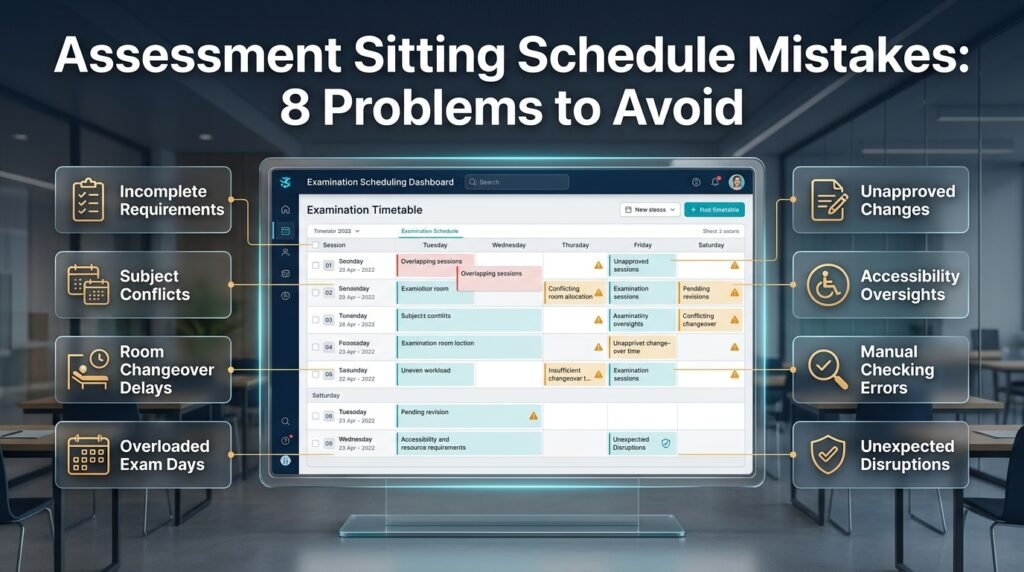
Many scheduling problems happen because administrators focus on filling available time slots instead of checking whether the complete arrangement is practical. Recognizing common mistakes early helps reduce last-minute changes and improves the experience for both candidates and staff.
Mistake 1: Scheduling before collecting complete requirements
Why it happens: Administrators want to publish the timetable quickly, so they begin assigning dates before every department has confirmed its requirements.
Why it causes problems: Missing candidate numbers, examination durations, or equipment needs can force major revisions after rooms and staff have been allocated.
How to avoid it: Collect assessment information using a standard form. Mark incomplete records clearly and confirm essential details before assigning sessions.
Mistake 2: Ignoring conflicts between subjects
Why it happens: Departments plan their examinations independently without checking the complete candidate timetable.
Why it causes problems: Students enrolled in multiple subjects may be assigned overlapping assessments or unrealistic transitions between examination venues.
How to avoid it: Review candidate registrations across subjects. Use automated conflict checks where available and investigate any potential overlap before approving the schedule.
Mistake 3: Forgetting room setup and changeover time
Why it happens: The coordinator schedules only the official examination duration.
Why it causes problems: Staff may not have enough time to prepare desks, distribute materials, check equipment, or clear the room before the next session.
How to avoid it: Reserve the room for the complete operational period, including preparation and changeover where necessary.
Mistake 4: Overloading examination days
Why it happens: Administrators try to fit every assessment into the shortest possible period.
Why it causes problems: Students may face an unreasonable concentration of assessments, while staff and facilities come under unnecessary pressure.
How to avoid it: Review the distribution of assessments across the entire examination period. Apply institutional rules and spread sessions where practical.
Mistake 5: Publishing unapproved changes
Why it happens: Someone updates a spreadsheet or sends a revised date without following the official approval process.
Why it causes problems: Different students and staff may rely on different versions of the timetable.
How to avoid it: Assign responsibility for approving changes, updating the master schedule, and communicating revisions. Include a revision date or version identifier.
Mistake 6: Overlooking accessibility requirements
Why it happens: Individual arrangements are handled separately and are not checked against the final timetable.
Why it causes problems: A candidate may be allocated to an unsuitable room or may not receive the approved timing or facilities.
How to avoid it: Confirm approved arrangements before publication and verify that the required resources are available. Protect confidential candidate information through appropriate access controls.
Mistake 7: Relying entirely on manual checking
Why it happens: A timetable looks manageable because the number of examination rows is relatively small.
Why it causes problems: Manual review can miss conflicts involving shared students, rooms, invigilators, or equipment.
How to avoid it: Use a consistent checking procedure and automated tools where appropriate. Always review unusual cases that may require human judgment.
Mistake 8: Failing to plan for unexpected changes
Why it happens: Administrators assume that the original timetable will remain unchanged.
Why it causes problems: A room closure, staff absence, or institutional disruption may leave no clear alternative.
How to avoid it: Establish a change-management process, identify potential alternative arrangements where practical, and define who can approve revised sessions.
Expert Tips for Managing Assessment Sitting Schedules More Effectively
Professional scheduling depends on preparation, verification, clear responsibilities, and the ability to respond to changes without losing control of the timetable.
Schedule the most restricted assessments first
Start with examinations that have fixed external dates, specialist equipment requirements, limited venue availability, or specific staffing needs.
These assessments offer fewer scheduling options. Placing them first reduces the risk that a flexible session will occupy a time or resource needed for a more restricted examination.
Maintain a central assessment register
Keep one authoritative record of all assessment requirements.
The register should include the assessment name, candidate group, duration, scheduling restrictions, resource needs, responsible department, and confirmation status.
This makes it easier to identify missing information before the timetable is created.
Separate planning records from published schedules
The working schedule may contain draft allocations, unresolved issues, and internal notes. The published schedule should contain verified information appropriate for its audience.
Keeping these records separate reduces the risk of accidentally distributing incomplete arrangements.
Build a realistic contingency plan
Identify the types of disruptions that could affect the assessment period and establish a process for responding to them.
For example, if a room becomes unavailable, the coordinator should check alternative room capacity, equipment requirements, candidate availability, and staff assignments before confirming a replacement venue.
Do not announce a replacement session until the revised arrangement has been checked and authorized.
Protect candidate information
A public timetable generally does not need to include full candidate lists, private accommodations, or other unnecessary personal information.
Share operational details only with authorized staff and provide students with the information relevant to their own assessments.
Good information management supports both privacy and reliable administration.
Review performance after each examination period
After assessments finish, review what happened during the scheduling process.
Consider the following questions:
- Which conflicts were discovered before publication?
- Were any changes made at the last minute?
- Did rooms and equipment meet requirements?
- Were staff assignments practical?
- Did candidates receive clear and timely updates?
- Which parts of the process caused unnecessary work?
Use the answers to improve the next assessment cycle. A short review can reveal recurring issues that are difficult to notice while administrators are busy managing the current timetable.
Measure schedule quality using practical indicators
Institutions can monitor a small number of useful indicators to understand whether their scheduling process is improving.
| Indicator | What it helps measure |
|---|---|
| Number of unresolved conflicts | Whether the timetable is ready for approval |
| Changes after publication | How stable the schedule remains |
| Missing assessment information | Quality of initial data collection |
| Room allocation problems | Accuracy of resource planning |
| Late notifications | Effectiveness of communication |
| Staff feedback | Practicality of the operational arrangements |
These indicators are most useful when they lead to specific improvements. For example, repeated room changes may suggest that room requirements need to be confirmed earlier rather than that administrators simply need to work faster.
Assessment Sitting Schedule Checklist
Use this checklist before publishing the final timetable.
Final schedule review
0 of 12 completeAll assessments and candidate groups are recordedDates, durations, and restrictions are confirmedAcademic calendar conflicts have been checkedCandidate clashes have been reviewedRooms and equipment are suitable and availableInvigilators and support staff are assignedApproved accessibility arrangements are confirmedSetup and changeover time is includedThe draft has been reviewed and approvedThe published version is clearly identifiedStudents and staff know where to find updatesA process exists for recording and approving changes
What Is an Assessment Sitting Schedule, and Why Is It Important?
An assessment sitting schedule is a structured plan that specifies when students or candidates will complete their assessments, how long each sitting will last, and where or how the assessment will take place. Depending on the institution, it may cover classroom tests, internal assessments, online examinations, practical exams, and formal examination sessions.
A well-planned schedule does more than list dates and times. It helps institutions coordinate subjects, prevent timetable conflicts, allocate rooms and invigilators, and give students sufficient time to prepare. Without a clear schedule, students may face several demanding assessments close together, while teachers and administrators may struggle with room availability, staffing, or last-minute changes.
For example, if a school schedules mathematics, science, and English assessments on consecutive days, students may have limited time to revise each subject properly. By reviewing the full assessment calendar in advance, administrators can identify heavy assessment periods and distribute the workload more reasonably.
Key points to consider:
Clear dates and timings: Include the assessment date, start time, expected duration, and any relevant reporting instructions.
Workload balance: Avoid placing several demanding assessments too close together when the academic calendar allows flexibility.
Resource coordination: Confirm room availability, required equipment, invigilator assignments, and access arrangements.
Student communication: Publish the schedule early enough for students and teachers to prepare.
Reliable updates: Establish a clear process for communicating approved changes.
Schools can coordinate assessment dates with wider academic activities through Academic Calendar Planning and organize individual examination periods using an Exam Session Calendar Builder.
The main goal is to create a schedule that supports fair assessment, reduces avoidable confusion, and allows the institution to manage examination activities efficiently.
How Do You Create an Effective Assessment Sitting Schedule for a School or College?
Creating an effective assessment sitting schedule begins with collecting accurate information before assigning dates and times. Administrators should first identify which assessments must take place, which student groups will participate, how much time each assessment requires, and what restrictions may affect scheduling.
Starting with a complete list prevents the common problem of publishing a timetable and discovering later that two assessments conflict or that a room cannot accommodate the required number of students.
A practical approach is to build the schedule in stages. First, collect assessment requirements from departments and teachers. Next, review the academic calendar, identify fixed dates, and arrange assessments around existing commitments. Then check student workload, staff availability, room capacity, and any special arrangements. Finally, review the complete schedule before publishing it.
For instance, a college planning assessments for five departments should not assign dates independently without checking the combined timetable. A date that works for one department may create a conflict for students taking courses across multiple departments.
Recommended steps for creating the schedule:
List all assessments: Record subjects, assessment types, participating groups, and required completion dates.
Confirm durations: Allow enough time for the assessment itself, instructions, transitions, and any required additional time.
Identify fixed commitments: Check holidays, school events, semester deadlines, and other institutional activities.
Allocate suitable sittings: Select dates and times based on student availability, room capacity, and assessment requirements.
Check conflicts: Review overlapping assessments, staff assignments, room bookings, and unusually heavy assessment days.
Allow flexibility: Reserve suitable time or dates for approved rescheduling and missed assessments.
Publish and communicate: Share the final timetable through the institution’s established communication channels.
Review after publication: Make controlled updates when necessary and notify everyone affected.
Institutions can also use a Semester Milestone Calendar to coordinate assessments with major academic deadlines. Where regular teaching periods must remain consistent, a Weekly Lesson Period Planner can help administrators understand how assessment sessions fit into the normal teaching week.
Professional tip: Review the timetable from three perspectives before publishing it: the student’s workload, the teacher’s responsibilities, and the institution’s operational requirements. A schedule is only effective when it works for all three.
How Can an Assessment Sitting Schedule Prevent Exam Clashes and Student Overload?
Exam clashes and excessive assessment workloads usually occur when dates are assigned without considering the complete timetable. An individual teacher may choose a convenient date for a test, but several teachers making the same decision independently can unintentionally create a difficult week for students.
An effective assessment sitting schedule prevents these problems by bringing all relevant dates into one coordinated plan. Administrators can compare assessments across subjects, grades, courses, and student groups before confirming the final arrangements.
For example, suppose students in a particular year group have a mathematics test on Monday, a science examination on Tuesday, and a history assessment on Wednesday. If each assessment requires substantial preparation, the sequence may place unnecessary pressure on students. A timetable review could identify whether one assessment can be moved to a more suitable date without affecting curriculum requirements.
However, avoiding every demanding day is not always possible. Some institutions have fixed examination windows, external assessment requirements, or limited room availability. The objective is to identify avoidable conflicts early and make reasonable adjustments wherever possible.
Practical ways to reduce clashes and overload:
Create a combined assessment calendar: Bring together dates from different departments rather than managing every subject separately.
Identify shared student groups: Check whether students enrolled in multiple courses are expected to complete assessments at the same time.
Review assessment difficulty and duration: Consider the demands of each assessment instead of looking at the number of tests alone.
Coordinate departmental decisions: Ask teachers to submit proposed dates before the timetable is finalized.
Check room and staff conflicts: Make sure that the same room, invigilator, or specialist equipment is not assigned to incompatible sessions.
Keep rescheduling options available: Plan how missed assessments or unexpected disruptions will be handled.
Communicate changes promptly: Ensure students and staff are working from the latest approved timetable.
A Subject Timetable Maker can support subject-level organization, while a Class Timetable Grid Builder can help present scheduled periods in a clear, easy-to-review format.
Professional tip: Do not check only whether two exams occur at exactly the same time. Also review consecutive assessments, travel or room-transition requirements, practical examination preparation, and the overall workload across the week.
A balanced schedule improves organization and gives students a clearer opportunity to prepare. It also reduces the administrative effort required to correct preventable conflicts after the timetable has been published.
What Information Should Be Included in an Assessment Sitting Schedule?
An assessment sitting schedule should contain enough information for students, teachers, invigilators, and administrators to understand what is happening and what they need to do. Missing details can create confusion even when the dates themselves are correct.
For example, publishing “Science — 12 November” does not tell students whether the assessment begins in the morning or afternoon, how long it lasts, which group must attend, or whether they need to bring specific materials. A more complete entry provides these details in a consistent format.
The information required will vary by institution and assessment type. A short classroom quiz may need only a date, period, and subject, while a formal examination may require candidate groups, room assignments, approved accommodations, invigilator details, and specific reporting instructions.
Essential information to include:
Assessment title: The subject, test name, course code, or examination identifier.
Date and time: The scheduled date, start time, and, where appropriate, expected finishing time.
Duration: The time allocated to complete the assessment.
Student group: The relevant grade, class, course, section, or candidate group.
Location or delivery method: The examination room, laboratory, online platform, or other approved setting.
Required materials: Any permitted calculators, stationery, equipment, identification, or practical resources.
Staff responsibilities: Relevant invigilation, supervision, or coordination assignments where appropriate.
Special arrangements: Approved additional time, accessibility provisions, alternative settings, or other required accommodations, communicated appropriately.
Instructions and restrictions: Reporting times, arrival procedures, permitted materials, and relevant assessment rules.
Revision history: The date of the latest update and a clear indication of any approved changes.
The schedule should remain readable rather than becoming overloaded with administrative information. Details intended only for staff can be maintained in a separate internal document, while students receive the information they need to attend and complete the assessment correctly.
For broader academic coordination, institutions may use an Academic Holiday Calendar Builder to account for holidays and non-teaching days. A School Year Event Calendar can also help identify school events that might affect assessment dates.
Professional tip: Use a consistent format for every assessment entry. Standardized labels and date formats make the schedule easier to scan, reduce misunderstandings, and simplify future updates.
Before publication, ask someone who was not involved in preparing the timetable to review it. A fresh reader may notice missing locations, unclear timings, inconsistent labels, or instructions that the original planner overlooked.
How Can Schools Manage Assessment Sitting Schedule Changes Without Confusing Students?
Changes to an assessment sitting schedule are sometimes unavoidable. School closures, staff absences, room problems, timetable conflicts, technical failures, or other unexpected circumstances may require an assessment to be moved. The difficulty is not simply making the change; it is ensuring that every affected person receives accurate information and knows which version of the schedule to follow.
A reliable process begins with a clear approval procedure. Staff should know who can authorize a change, how the revised date or time will be recorded, and which communication channels will be used to inform students and teachers.
For example, if a science examination must move from Thursday to Friday, updating a staff spreadsheet alone is insufficient if students are still using a timetable distributed earlier in the week. The revised information must reach the relevant groups through the institution’s designated communication system.
Best practices for managing schedule changes:
Assign responsibility: Identify the person or department authorized to approve timetable changes.
Record the reason: Keep a brief administrative note explaining why the adjustment was required.
Update the master schedule: Make the change in the central version before distributing revised copies.
Notify affected groups directly: Inform students, teachers, invigilators, and other relevant staff.
Highlight the difference: Clearly identify the changed assessment, new date, time, location, or other revised detail.
Retain the previous version: Keep a suitable record of earlier schedules where institutional procedures require an audit trail.
Check for new conflicts: Confirm that the replacement date does not create another assessment clash.
Confirm receipt when necessary: For high-stakes examinations, use the institution’s established process to verify that essential changes have been communicated.
A Student Class Period Organizer can help students understand their scheduled periods, while the Exam Schedule Generator may support the organization of formal examination dates and sessions.
Institutions can also use Academic Planning and Scheduling Tools to coordinate scheduling activities within a broader planning process.
Professional tip: Establish a single source of truth. Whether the institution uses a central digital timetable or an approved shared document, every update should lead back to the same authoritative schedule. Avoid distributing several conflicting versions without clearly identifying which one is current.
An effective change-management process protects students from relying on outdated information, helps staff prepare for revised arrangements, and makes the assessment process more dependable. It also allows administrators to respond to unexpected situations without losing control of the wider academic timetable.
Conclusion
An effective assessment sitting schedule is essential for organizing assessments, balancing student workloads, and ensuring that examinations run smoothly. By coordinating assessment dates, confirming durations, checking timetable conflicts, and communicating clear instructions, schools and colleges can create a more reliable and manageable assessment process.
The most effective approach is to plan ahead, consider the needs of students and staff, and review the complete schedule before publishing it. Institutions should also maintain a consistent update process so that unexpected changes do not lead to confusion or missed assessments. Using a structured planning approach alongside suitable academic scheduling tools can make these responsibilities easier to manage.
Ultimately, a well-organized assessment sitting schedule is more than a list of examination dates. It is a practical system that supports fairness, preparation, and efficient academic administration. With careful planning and regular review, institutions can reduce avoidable scheduling problems and create a clearer assessment experience for everyone involved.