

Introduction
Educational Productivity Apps | Education involves much more than attending classes and completing examinations. Students must manage assignments, organize lecture notes, prepare for assessments, participate in group projects, and keep track of academic deadlines. Teachers have an equally demanding routine that includes lesson preparation, classroom management, student assessments, communication, and academic planning. Educational institutions must coordinate all these activities while maintaining organized academic schedules.
When these responsibilities are managed through separate notebooks, spreadsheets, paper calendars, and disconnected digital documents, important information can become difficult to manage. Students may forget submission dates, teachers may struggle to coordinate classroom activities, and administrators may spend unnecessary time correcting scheduling conflicts.
This is why educational productivity apps have become an important part of modern learning environments. These applications help students, teachers, and academic institutions organize information, manage time, coordinate responsibilities, and improve the way educational activities are planned.
However, choosing the right application isn’t always straightforward. Some tools are designed for digital note-taking, others focus on task management, while specialized platforms support classroom organization, academic calendars, examination planning, and rotating school timetables.
The important thing is to understand which application solves a particular problem and how different tools can work together without creating unnecessary complexity.
For readers interested in organizing academic responsibilities through a dedicated scheduling solution, RTI Scheduler is also relevant to exploring structured educational planning and scheduling.
This comprehensive guide explains the different types of educational productivity applications, their practical uses, important features, advantages, limitations, and common mistakes. It also examines how students, teachers, and schools can develop a connected digital productivity system that supports better learning and more efficient academic management.
What Are Educational Productivity Apps?
Educational productivity apps are digital tools designed to help people organize, manage, and complete educational activities more efficiently. They support responsibilities such as studying, note-taking, assignment tracking, lesson planning, examination preparation, communication, and academic scheduling.
Unlike applications that focus only on entertainment or general communication, educational productivity tools address specific learning and organizational requirements.
For example, a student might use a digital notebook to record lecture information, a calendar to schedule examination preparation, and a task manager to track assignment deadlines.
A teacher might use classroom management software to distribute assignments, organize learning materials, and monitor student submissions.
An academic administrator may need more specialized software to coordinate teachers, classrooms, instructional periods, academic holidays, and examination sessions.
These applications can serve three main groups:
Students
Students use productivity applications to manage their personal academic responsibilities.
Typical activities include:
- Organizing lecture notes by subject.
- Creating daily and weekly study plans.
- Tracking assignment deadlines.
- Preparing examination revision schedules.
- Managing group projects.
- Recording important academic reminders.
- Monitoring personal learning progress.
For example, a university student taking five different courses may create a separate digital workspace for each subject. Each workspace can contain lecture notes, reading materials, assignment details, and upcoming examination information.
This makes academic information easier to locate and reduces the need to search through multiple disconnected documents.
Teachers
Teachers use educational productivity applications to organize instructional activities and classroom responsibilities.
Common uses include:
- Preparing lesson plans.
- Organizing teaching materials.
- Sharing assignments.
- Recording assessment dates.
- Communicating with students.
- Coordinating classroom activities.
- Reviewing student progress.
For example, a teacher responsible for three classes can maintain separate lesson plans and assignment records for each group.
This helps prevent confusion when different classes follow different instructional requirements.
Schools and Educational Institutions
Educational institutions require more advanced organizational systems because their responsibilities involve multiple departments, teachers, students, facilities, and academic activities.
Administrators may need to coordinate:
- Academic calendars.
- School holidays.
- Semester milestones.
- Teacher availability.
- Classroom assignments.
- Examination periods.
- Rotating timetables.
- Institutional events.
- Assignment and assessment deadlines.
A simple personal productivity application may not be sufficient for these requirements.
Institutions often benefit from combining general productivity software with specialized academic planning and scheduling tools.
Why Are Educational Productivity Apps Important in Modern Education?
Educational productivity applications are important because they help people manage increasing academic responsibilities without relying entirely on manual organization.
The main advantage isn’t simply moving information from paper to a screen. It’s creating a more consistent way to plan activities, monitor progress, and access important information.
1. They Help Students Manage Multiple Academic Responsibilities
Students rarely have only one responsibility at a time.
A typical academic week may include classroom lectures, homework, reading assignments, practical activities, presentations, and examinations.
Without an organized system, students may concentrate on whichever task seems most urgent while forgetting important activities scheduled for later.
A productivity application provides a central location for recording these responsibilities.
For example, a student can create separate task categories:
- Mathematics assignments.
- Science revision.
- English reading.
- History projects.
- Examination preparation.
Each task can have its own deadline and priority.
This creates a clearer overview of the academic workload and makes it easier to decide what needs attention first.
2. They Improve Academic Time Management
Time management is one of the biggest challenges students face.
A student may have several hours available for studying but struggle to decide how to divide that time between different subjects.
Calendar applications and study planners help turn general intentions into scheduled activities.
Instead of writing “Study mathematics this week,” a student can reserve specific periods for reviewing concepts, completing exercises, and practicing examination questions.
This makes academic goals more practical and measurable.
3. They Reduce Missed Assignment Deadlines
Assignment deadlines can become difficult to manage when students take several courses simultaneously.
A task management application allows users to record submission dates, set reminders, and monitor progress.
A large project can also be divided into smaller responsibilities.
For example:
- Understand the assignment requirements.
- Research the topic.
- Prepare an outline.
- Complete the first draft.
- Review and edit the work.
- Submit the final assignment.
Students can assign a separate target date to each stage instead of depending on one final reminder.
4. They Improve Access to Educational Information
Digital productivity applications make it easier to organize and retrieve learning materials.
Students can create folders, subject-based notebooks, searchable documents, and structured databases.
This becomes particularly useful when preparing for examinations because previously recorded information can be found without manually searching through several notebooks.
5. They Support Collaboration Between Students
Group assignments require communication, shared documents, clear responsibilities, and progress monitoring.
Collaboration tools allow students to work on shared projects without depending entirely on face-to-face meetings.
For example, a group preparing a research presentation can divide responsibilities into research, writing, slide preparation, and final review.
Each member can understand their assigned work and monitor the overall project.
6. They Help Teachers Reduce Administrative Work
Teachers often spend considerable time preparing materials, recording assignment information, organizing classroom activities, and communicating instructions.
Digital tools can simplify repetitive administrative tasks.
For example, a classroom management platform can help distribute assignments to multiple students while maintaining an organized record of submitted work.
This allows teachers to spend more time supporting learning instead of repeatedly organizing administrative information.
7. They Improve Institutional Coordination
Schools coordinate activities that frequently depend on one another.
An examination date may affect classroom availability. A school event may require timetable adjustments. A holiday may change instructional schedules.
When these activities are managed separately, administrators may struggle to identify conflicts.
Structured academic planning helps institutions understand how different responsibilities connect.
8. They Encourage Consistent Learning Habits
Productivity applications can support regular study routines through reminders, recurring tasks, progress tracking, and weekly planning.
For example, a student can establish recurring revision periods for important subjects.
Over time, the system encourages students to approach learning as a continuous activity rather than waiting until examination periods.
Expert Tip: Productivity applications should reduce the effort required to organize education. If students spend more time maintaining their applications than completing their academic work, the system needs simplification.
What Are the Main Categories of Educational Productivity Apps?
Educational productivity software covers several different areas of academic work. Understanding these categories helps users avoid choosing applications that provide similar features without solving their actual problems.
Some applications support individual learning, while others help teachers manage classroom activities or allow administrators to coordinate institutional schedules.
1. Student Task Management Applications
Task management applications help students organize academic responsibilities into manageable activities.
Their main purpose is to make it easier to identify what needs to be completed, when it should be completed, and how much work remains.
A typical student task manager includes:
- Task creation.
- Due-date management.
- Priority settings.
- Assignment categories.
- Progress tracking.
- Recurring reminders.
- Project organization.
For example, a student enrolled in mathematics, biology, chemistry, and English can create a separate project for each subject.
Under mathematics, the student might record weekly exercises, textbook chapters, practice examinations, and upcoming assessments.
This approach is useful when students have several responsibilities competing for their attention.
When should you use one?
A task manager is particularly useful when:
- You regularly forget assignment deadlines.
- You have several subjects to manage.
- Large projects feel difficult to organize.
- You need to monitor unfinished work.
- You want a clear daily priority list.
Common limitation: A task manager doesn’t necessarily provide a complete academic timetable. It can show what needs to be completed without explaining when a teacher, classroom, or student group is scheduled for a particular lesson.
2. Academic Calendar and Planning Applications
Academic calendar applications organize educational activities according to dates, weeks, months, semesters, and school years.
They help users understand when important academic events are taking place.
Typical calendar information includes:
- Semester opening dates.
- Examination periods.
- Assignment deadlines.
- Registration windows.
- Academic holidays.
- School events.
- Parent meetings.
- Institutional activities.
A calendar is particularly valuable because academic responsibilities often depend on one another.
For example, an examination preparation period may need to be planned around holidays, regular lessons, and other assessment dates.
A properly organized calendar makes these relationships easier to understand.
When should you use one?
Academic calendar tools are suitable for students who need to organize their study commitments and institutions that need a clear overview of important educational dates.
For schools, a structured academic calendar planning process can help administrators organize important dates throughout the academic year.
3. Digital Note-Taking Applications
Digital note-taking applications provide an organized way to capture, store, and review educational information.
Students can use them during lectures, independent study, research activities, and examination preparation.
Unlike traditional notebooks, digital note-taking platforms may support searchable content, document attachments, diagrams, handwriting, and subject-based organization.
A useful digital notebook structure might look like this:
| Notebook | Sections | Example information |
|---|---|---|
| Biology | Cells, genetics, ecology | Lecture summaries and diagrams |
| Mathematics | Algebra, geometry, statistics | Formulas and worked examples |
| History | Ancient, medieval, modern | Dates and historical events |
| English | Grammar, literature, writing | Vocabulary and writing notes |
This arrangement makes it easier to review specific topics without searching through unrelated material.
Best practice: Create a consistent naming system for notebooks, pages, and attachments. A complicated folder structure can become difficult to maintain.
4. Classroom Management Applications
Classroom management applications help teachers coordinate educational activities and communicate with students.
Their functions may include assignment distribution, announcements, learning material sharing, attendance-related activities, and feedback.
A teacher may use a classroom platform to publish weekly assignments, attach supporting documents, and communicate submission requirements.
Students can then access the information through a centralized environment.
Important distinction: Classroom management software and personal task managers solve different problems. A classroom platform helps teachers distribute and manage academic work, while a personal task manager helps individual students organize their responsibilities.
5. Examination and Assessment Management Applications
Examination management tools help organize assessment-related activities.
These applications can support the planning of examination dates, assessment periods, candidate groups, rooms, and other administrative requirements.
For example, a school conducting examinations for several grade levels must ensure that examination sessions are coordinated without unnecessary conflicts.
An examination planning system may need to account for:
- Assessment dates.
- Subject requirements.
- Candidate groups.
- Examination duration.
- Room availability.
- Invigilator allocation.
- Special examination arrangements.
This is a more specialized requirement than simply adding an examination reminder to a personal calendar.
6. Focus and Time-Management Applications
Focus applications help students establish structured study periods and reduce unnecessary interruptions.
Many use timed sessions, progress indicators, motivational features, or distraction-management functions.
A student might use a 25-minute study session followed by a short break.
Another student may prefer 45-minute sessions because they need longer periods to understand complicated subjects.
The important point is to select a routine that supports concentration without creating unnecessary pressure.
7. Collaborative Learning Applications
Collaborative applications support group assignments, shared documents, project communication, and team-based learning.
Students can use these tools to:
- Assign responsibilities.
- Share research materials.
- Discuss project requirements.
- Review document changes.
- Track completed activities.
- Prepare presentations together.
Teachers can also use collaborative spaces for group exercises and classroom projects.
However, successful collaboration requires more than access to shared software. Participants must understand their responsibilities, deadlines, and communication expectations.
8. Specialized Academic Scheduling Applications
Specialized academic scheduling applications are designed for educational planning requirements that general productivity tools may not handle efficiently.
They can help institutions organize recurring classes, teacher availability, instructional periods, rotating schedules, and examination activities.
For example, a school may operate an A/B day system where students attend different subject combinations on alternating days.
A normal weekly calendar may not clearly represent this arrangement.
A dedicated scheduling approach can provide a more structured way to manage such academic patterns.
10 Popular Educational Productivity Apps and Their Practical Uses

There are many educational productivity applications available, but their suitability depends on the user’s responsibilities.
The following comparison focuses on established tools and the specific problems they are designed to address.
1. Notion: For Complete Academic Organization
Notion is a flexible digital workspace that allows students to create notes, databases, task lists, project pages, and personal study planners.
Its main advantage is that different types of academic information can be connected within one workspace.
For example, a student can create a semester dashboard with separate pages for each course.
Each course page might contain:
- Lecture notes.
- Reading lists.
- Assignment information.
- Examination preparation.
- Research references.
- Personal learning targets.
Students can also create databases that show tasks according to subject, priority, or deadline.
Practical example:
A university student taking six courses can create a semester dashboard and display all upcoming assignments in one central view.
The student can then filter the information to show only mathematics assignments or tasks due during the current week.
Advantages:
- Flexible workspace design.
- Customizable academic databases.
- Project organization.
- Connected notes and tasks.
- Useful collaboration options.
Limitations:
Its flexibility can become a disadvantage when students spend too much time designing their workspace. Beginners should start with simple pages and gradually add functionality.
2. Google Calendar: For Academic Time Management
Google Calendar is useful for managing activities that take place at specific dates and times.
Students can create class schedules, study sessions, examination reminders, and academic appointments.
Teachers can also use shared calendars to coordinate meetings and institutional events.
Practical example:
A student can create recurring events for weekly lectures and add separate study sessions before important examinations.
A school administrator may maintain an academic event calendar containing holidays, assessment periods, and parent meetings.
Advantages:
- Daily, weekly, and monthly calendar views.
- Event reminders.
- Recurring events.
- Calendar sharing.
- Convenient scheduling.
Limitations:
A calendar isn’t a complete assignment management system. Students may still need a separate application to break projects into smaller tasks and track completion.
3. Microsoft OneNote: For Digital Lecture Notes
Microsoft OneNote provides a digital notebook environment where students can organize learning materials into notebooks, sections, and pages.
It is suitable for students who prefer a structured notebook approach.
A student can create a notebook for each course and maintain separate sections for lectures, practical work, revision, and examination preparation.
Practical example:
During a biology lecture, a student can record the topic, add diagrams, write definitions, and attach relevant learning documents.
Later, the student can search the notebook to find the information needed for revision.
Advantages:
- Organized digital notebooks.
- Searchable notes.
- Handwriting and drawing support.
- Document organization.
- Useful educational notebook workflows.
Limitations:
Students who primarily need reminders and short task lists may find a full notebook application unnecessary.
4. Google Classroom: For Classroom Coordination
Google Classroom helps teachers manage digital classroom activities.
It provides a central environment for organizing classwork, distributing assignments, sharing learning materials, and communicating with students.
Practical example:
A teacher can publish a weekly assignment, include instructions, attach supporting material, and provide a submission deadline.
Students can access the assignment and submit their work through the classroom environment.
Advantages:
- Centralized classroom activities.
- Assignment distribution.
- Student submissions.
- Teacher feedback.
- Integration with other educational tools.
Limitations:
Its usefulness depends on institutional adoption. It is not a replacement for every school administration or timetable management requirement.
5. Todoist: For Assignment and Task Tracking
Todoist is a task management application suitable for students who want a clear overview of their academic responsibilities.
Students can create projects, add tasks, establish due dates, and prioritize important work.
Practical example:
A student preparing a research paper can create a project containing research, source review, outlining, drafting, editing, and submission tasks.
This makes a large assignment easier to manage.
Advantages:
- Simple task creation.
- Project-based organization.
- Due dates and priorities.
- Recurring tasks.
- Progress visibility.
Limitations:
It doesn’t provide the same depth of digital note-taking or academic timetable management as specialized applications.
6. Quizlet: For Revision and Knowledge Practice
Quizlet supports learning activities through digital flashcards and other study tools.
Students can create sets containing questions, definitions, terminology, and subject-specific information.
Practical example:
A biology student can prepare flashcards containing important terminology on one side and definitions on the other.
During revision, the student can test whether the information can be recalled without immediately looking at the answer.
Advantages:
- Digital flashcards.
- Reusable study sets.
- Subject-based revision.
- Convenient practice.
Limitations:
Memorizing definitions doesn’t automatically provide deep understanding. Students should combine flashcards with explanations, problem-solving, and practical exercises.
7. Trello: For Group Projects and Visual Planning
Trello uses boards, lists, and cards to organize project activities.
Its visual approach makes it easier to see which tasks are waiting, underway, or completed.
Practical example:
A group preparing a university presentation can create the following lists:
| Project stage | Activities |
|---|---|
| Ideas | Select topic and identify objectives |
| Research | Collect and review information |
| In progress | Prepare written content |
| Review | Check accuracy and presentation quality |
| Completed | Final submission |
Group members can move cards between stages as work progresses.
Advantages:
- Visual task organization.
- Shared project boards.
- Clear responsibility tracking.
- Simple workflow management.
Limitations:
Very large projects may require more detailed project planning, reporting, or dependency management.
8. Google Keep: For Quick Academic Notes
Google Keep is useful for capturing short information that students don’t want to forget.
It supports notes, checklists, and reminders.
Practical example:
A student can create a quick checklist containing three homework tasks, save a research idea, or record an important classroom reminder.
Advantages:
- Simple interface.
- Quick information capture.
- Checklists.
- Reminders.
- Easy everyday organization.
Limitations:
It is not designed to replace a comprehensive academic workspace or detailed semester planning system.
9. Forest: For Focused Study Sessions
Forest uses a motivational approach to encourage users to concentrate during planned work periods.
Students begin a focus session and use the application’s visual progress concept as encouragement to avoid unnecessary phone use.
Practical example:
A student preparing for a mathematics test can start a 30-minute session and focus on solving practice questions before taking a break.
Advantages:
- Encourages structured focus.
- Visual motivation.
- Simple study sessions.
- Helps build concentration routines.
Limitations:
It cannot automatically remove every distraction or guarantee better academic performance.
10. Microsoft To Do: For Daily Academic Planning
Microsoft To Do provides a simple way to organize everyday activities.
Students can create lists for homework, revision, personal responsibilities, and upcoming academic work.
Its daily planning approach is useful for users who prefer straightforward task management.
Practical example:
A student can prepare a daily list containing:
- Complete a mathematics worksheet.
- Review science notes.
- Read one history chapter.
- Prepare for an English presentation.
After completing each task, the student can update its status.
Advantages:
- Simple daily task lists.
- Reminders.
- Task organization.
- Recurring responsibilities.
- Integration with Microsoft’s productivity environment.
Limitations:
It offers less specialized functionality for managing complex academic projects or institutional timetables.
How to Choose the Best Educational Productivity App
Choosing an application should begin with identifying the problem you want to solve.
A popular application may have hundreds of features, but those features are not valuable if they don’t match your academic requirements.
Step 1: Identify Your Main Productivity Problem
Start by examining your current academic routine.
Ask yourself:
- Do I forget important deadlines?
- Are my study materials difficult to organize?
- Do I struggle to create a realistic study schedule?
- Do I have difficulty collaborating with classmates?
- Do I need a better way to prepare for examinations?
- Do I spend too much time organizing information manually?
Write down the two or three most important problems.
This will help you avoid selecting software simply because it is popular.
Step 2: Identify Your User Requirements
Students, teachers, and administrators need different functionality.
| User | Main requirement | Suitable application type |
|---|---|---|
| School student | Homework and study organization | Task manager and calendar |
| University student | Courses, notes, projects, deadlines | Academic workspace |
| Teacher | Lesson and assignment management | Classroom platform |
| Department coordinator | Assessment and activity planning | Academic planning tool |
| School administrator | Institutional schedules | Scheduling software |
| Group project team | Shared work and responsibilities | Collaboration platform |
The purpose of this comparison is to prevent a mismatch between the application and the user’s actual responsibilities.
Step 3: Check the Essential Features
Before selecting a tool, review whether it offers the functions you need.
For an individual student, basic features may be sufficient.
For a school, the requirements can be considerably more complex.
Consider:
- Task creation and editing.
- Calendar management.
- Notifications.
- Collaboration.
- Search functionality.
- Mobile and desktop access.
- Data export.
- Security settings.
- User permissions.
- Integration with existing systems.
Don’t assume that every application supports all these functions.
Step 4: Evaluate Ease of Use
An application should be easy enough to use consistently.
A complicated system may initially appear powerful, but if students and teachers find it difficult to navigate, adoption can become a problem.
Test the most important everyday activities.
For example:
- Create a task.
- Add a deadline.
- Find an existing note.
- Update an activity.
- Review upcoming responsibilities.
If these basic activities require too much effort, consider a simpler alternative.
Step 5: Consider Cost and Accessibility
Educational productivity applications may offer free, paid, or institution-based subscription models.
Compare the available plans before making a decision.
Consider:
- Whether the free version covers your needs.
- Whether paid features are necessary.
- Whether multiple users need access.
- Whether the application supports your devices.
- Whether institutional discounts are available.
- Whether offline functionality is important.
Students shouldn’t purchase advanced plans simply because they assume paid software automatically produces better results.
Step 6: Test the Application Before Fully Adopting It
Try a new application with a small amount of academic information.
For example, organize one course before transferring an entire semester.
This allows you to evaluate whether the interface, workflow, and features are suitable.
For schools, a limited pilot with one department or grade level can help identify practical problems before institution-wide implementation.
Step 7: Review the Results
After using the application for a few weeks, evaluate whether it has improved your routine.
Ask:
- Are fewer deadlines being missed?
- Is academic information easier to locate?
- Has task organization improved?
- Are teachers spending less time on repetitive administration?
- Are users comfortable with the system?
If the answer is consistently negative, reconsider the application or simplify its implementation.
What Features Make an Educational Productivity App Effective?
A useful educational productivity application should offer functionality that solves real problems without making everyday work unnecessarily complicated.
The importance of each feature depends on the intended users.
Task and Assignment Management
The application should allow users to create, organize, and update tasks.
Useful functions include due dates, priorities, progress tracking, categories, and recurring activities.
For students, this supports assignment management and revision planning.
For teachers, it can help organize lesson preparation and assessment responsibilities.
Calendar Integration
Calendar functionality is important when educational responsibilities depend on specific dates and times.
A useful calendar should make it easy to view scheduled activities and identify upcoming commitments.
For institutional environments, the ability to organize different academic events is particularly important.
Reminder and Notification Management
Notifications help users remember important responsibilities.
However, excessive reminders can become distracting.
A good application should allow users to control notification settings and prioritize important events.
Search and Information Organization
Students and teachers may store large amounts of information throughout an academic year.
Search functionality makes it easier to locate notes, documents, tasks, and previous activities.
Consistent naming and categorization also improve information retrieval.
Collaboration and Sharing
Educational activities frequently involve several participants.
A collaboration feature can help users share information, communicate changes, and coordinate responsibilities.
However, users should be able to control who can view or edit shared information.
Mobile and Desktop Compatibility
Students may use a smartphone while travelling and a computer when completing assignments.
Teachers may need to access information from school computers or personal devices.
Compatibility across supported devices makes it easier to maintain consistent access.
Security and Privacy Controls
Educational information may include personal details, student records, assignments, and institutional documents.
Applications should provide appropriate security and access controls.
Before adopting a platform, users should review:
- Privacy policies.
- Account protection.
- Data-sharing settings.
- Access permissions.
- Data retention practices.
- Backup and recovery options.
Schools should also ensure that software use follows their institutional requirements and applicable privacy laws.
Reporting and Progress Tracking
Progress information helps students understand which activities have been completed and which responsibilities remain.
Teachers and administrators may also need reports for academic planning and operational review.
However, reports should be interpreted carefully. Completing more tasks does not necessarily mean that learning outcomes have improved.
How Can Students Build a Complete Digital Study System?
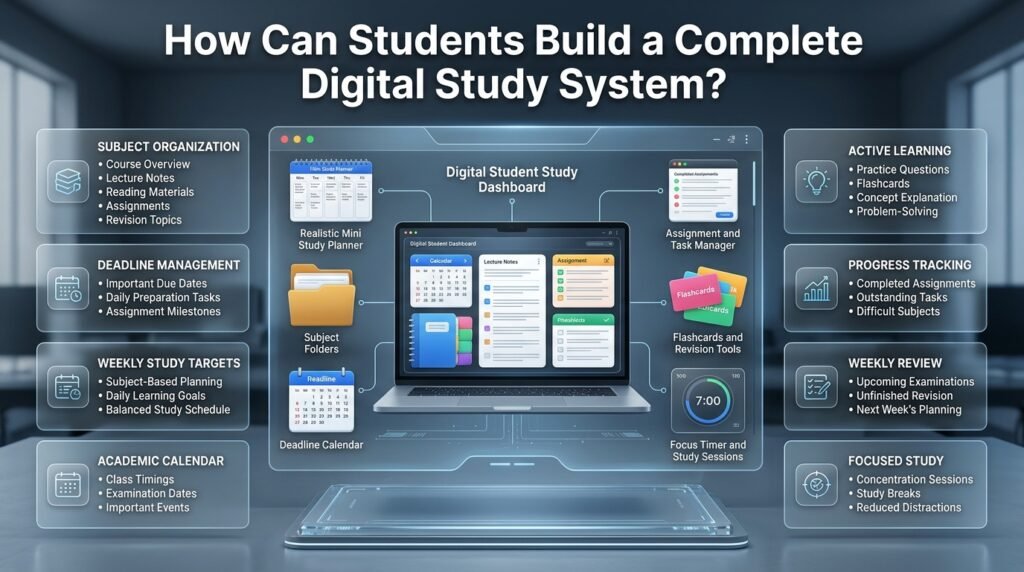
Using one application for every academic responsibility is not always practical.
A more effective approach is to create a small digital system in which each application has a defined role.
For example, a student may use:
- A calendar for scheduled activities.
- A task manager for assignments.
- A digital notebook for learning materials.
- A flashcard application for revision.
- A focus timer for concentration.
These tools can work together without duplicating every piece of information.
Organize Academic Information by Subject
Create a consistent structure for every course.
A useful subject workspace can contain:
| Section | Information |
|---|---|
| Course overview | Course objectives and important details |
| Lecture notes | Information recorded during classes |
| Reading materials | Chapters and supporting documents |
| Assignments | Requirements and submission dates |
| Revision | Topics requiring additional practice |
| Assessments | Examination and test information |
This approach allows students to maintain a predictable organization system throughout the semester.
Separate Important Deadlines from Daily Tasks
A deadline and a task are related, but they aren’t the same thing.
For example, a research assignment may be due on Friday, while the activities required to complete it need to happen on Monday, Tuesday, Wednesday, and Thursday.
The final deadline should appear in the calendar, while the individual preparation activities should appear in the task manager.
This separation prevents students from treating a large assignment as one last-minute activity.
Establish Weekly Study Targets
Weekly targets help students distribute academic work over several days.
For example:
| Day | Academic target |
|---|---|
| Monday | Review mathematics concepts |
| Tuesday | Complete science exercises |
| Wednesday | Prepare English notes |
| Thursday | Revise history topics |
| Friday | Complete outstanding assignments |
| Saturday | Practice examination questions |
| Sunday | Review progress and plan the next week |
This is an example rather than a universal schedule. Students should adjust their plans according to class timings, workload, and personal commitments.
Use Active Learning Rather Than Only Reading Notes
Digital productivity tools should support learning methods that require students to actively use information.
Examples include:
- Answering practice questions.
- Explaining concepts in their own words.
- Solving problems without looking at solutions.
- Creating flashcards.
- Comparing different ideas.
- Reviewing mistakes.
These activities provide more meaningful feedback than simply checking whether a document has been read.
Review Your Progress at the End of Each Week
A weekly review provides an opportunity to evaluate academic progress.
Students should identify:
- Completed assignments.
- Outstanding tasks.
- Difficult subjects.
- Upcoming examinations.
- Unfinished revision activities.
- Changes needed in the next week’s schedule.
The review should lead to practical adjustments rather than unnecessary rewriting of the entire study plan.
How Can Educational Productivity Apps Improve Classroom Management?
Classroom productivity requires coordination between teachers, students, learning materials, and scheduled activities.
A teacher may be responsible for several groups with different learning requirements.
Without a consistent organizational process, important information can become scattered.
Organizing Classroom Responsibilities
Teachers can use digital systems to maintain structured records of classroom activities.
These may include:
- Lesson objectives.
- Homework instructions.
- Assessment requirements.
- Group activities.
- Learning resources.
- Classroom announcements.
The purpose is to make information accessible to the people who need it.
Coordinating Weekly Lesson Activities
A weekly lesson plan provides an overview of instructional responsibilities.
Teachers can organize topics, learning objectives, classroom exercises, and assessment activities across the school week.
A structured weekly lesson period planner can help educators think through lesson distribution and instructional periods.
For example, a science teacher may need to distribute theoretical lessons, practical activities, and revision periods across different days.
A weekly planning process makes it easier to check whether important topics have sufficient instructional time.
Organizing Subject Timetables
Subject timetables show when particular subjects are scheduled.
Teachers and students benefit from knowing which subject is assigned to each instructional period.
A subject timetable maker is relevant when schools need to organize subject-based teaching arrangements.
For example, an administrator may need to coordinate mathematics, English, science, and social studies across multiple classes.
The schedule should consider teacher availability, instructional requirements, and classroom resources.
Managing Student Class Periods
Students follow different class periods throughout the school day.
A clear class-period arrangement helps them understand where they need to be and which subject they should prepare for.
A student class period organizer supports the concept of organizing these responsibilities into a structured daily routine.
This becomes particularly useful when students attend different lessons, specialist activities, or practical sessions.
Creating a Clear Timetable Grid
A timetable grid provides a visual representation of scheduled periods and subjects.
Teachers and students can use it to understand the relationship between days, times, and instructional activities.
A class timetable grid builder is relevant to organizing these arrangements in a structured format.
For example, a school may need a timetable showing six instructional periods from Monday through Friday.
A clear grid helps identify gaps, overlapping assignments, and unusual scheduling patterns.
How Can Schools Manage Academic Calendars More Effectively?
Academic calendar management is a major responsibility for educational institutions.
A school calendar may include instructional periods, holidays, examinations, registration dates, academic events, and important administrative deadlines.
The challenge is not simply recording dates. It is making sure that different activities remain coordinated throughout the academic year.
Start with the School-Year Structure
Before entering individual events, administrators should establish the main academic structure.
This may include:
- School opening dates.
- Semester start and end dates.
- Term divisions.
- Holiday periods.
- Examination windows.
- Registration periods.
- Academic closing dates.
Once the main structure is established, individual events can be added in the appropriate places.
Organize Academic Holidays
Holiday planning affects instructional time, examination preparation, and institutional operations.
Schools should distinguish between different types of non-instructional periods.
These may include:
- Public holidays.
- Seasonal school vacations.
- Semester breaks.
- Institutional closure days.
- Staff development days.
- Emergency closure periods.
A structured academic holiday calendar builder is relevant to organizing these dates.
For example, if a school schedules an examination shortly before a long holiday, administrators should consider whether students have sufficient preparation time.
Track Semester Milestones
Semesters contain multiple academic stages that need to be completed at appropriate times.
These may include course registration, instructional periods, assessment windows, project submissions, and final examinations.
A semester milestone calendar can help administrators maintain an overview of these important stages.
For example:
| Academic milestone | Purpose |
|---|---|
| Semester opening | Begin instructional activities |
| Course registration | Confirm student enrollment |
| Initial assessments | Review early academic progress |
| Midterm period | Evaluate learning progress |
| Project submission | Complete major coursework |
| Final examinations | Assess semester learning |
| Semester closing | Complete academic administration |
The dates should be aligned with the institution’s actual academic policies.
Coordinate School-Year Events
Academic calendars also need to account for activities beyond regular classroom instruction.
Examples include:
- Sports competitions.
- Cultural activities.
- Parent meetings.
- Graduation ceremonies.
- Science exhibitions.
- Academic competitions.
- Teacher development sessions.
A school year event calendar is relevant to organizing these activities.
The important consideration is to avoid placing events in ways that create unnecessary conflicts with examinations, important lessons, or institutional deadlines.
Maintain a Centralized Deadline Overview
Schools often manage several types of deadlines simultaneously.
Some relate to students, others to teachers, and some to administrative departments.
A school deadline overview tool is relevant to keeping these responsibilities visible.
For example, an administrator may need to monitor:
- Assignment submission periods.
- Grade submission dates.
- Examination preparation deadlines.
- Registration closing dates.
- Report card publication.
- Staff documentation deadlines.
A centralized overview makes it easier to identify approaching responsibilities.
How Can Educational Productivity Apps Help With Assignment and Deadline Management?
Assignments are a regular part of academic life. Students may have to complete written coursework, research projects, practical activities, presentations, and subject-specific assessments within the same semester.
Teachers also need to prepare assignment instructions, establish submission dates, evaluate work, and provide feedback.
Managing these activities requires more than a simple list of deadlines.
Understanding Academic Deadline Management
Academic deadline management involves identifying important dates, organizing responsibilities, monitoring progress, and ensuring that academic work is completed within the required time.
For students, this means knowing when an assignment is due and how much preparation remains.
For teachers, it means coordinating submission dates, assessment activities, and feedback responsibilities.
A structured academic deadline management approach helps users think beyond individual reminders and consider the complete academic workload.
For example, a university department may have several courses with different coursework deadlines.
If all major assignments are scheduled during the same week, students may experience unnecessary workload pressure.
Reviewing deadlines across courses can help administrators and teachers identify possible conflicts before they become serious problems.
Managing Coursework Due Dates
Coursework frequently involves several stages.
A student may need to select a topic, conduct research, prepare an outline, write the assignment, review the work, and submit the final document.
A coursework due date manager is relevant to organizing these responsibilities.
Consider this example:
A student has a research paper due on the 25th of the month.
Instead of waiting until the final week, the student can divide the work:
| Target period | Activity |
|---|---|
| First week | Understand the requirements and select a topic |
| Second week | Research and collect information |
| Third week | Prepare the outline and first draft |
| Fourth week | Edit, review, and submit |
This approach makes the assignment easier to manage because progress can be monitored throughout the process.
Organizing Assignment Submission Dates
Assignment submission management is particularly important when students attend several courses.
Different teachers may use different submission methods, deadlines, and assessment requirements.
A structured assignment submission calendar can help organize these dates.
For example, a student may have:
- A mathematics worksheet due Monday.
- A biology report due Wednesday.
- An English presentation due Thursday.
- A history project due Friday.
When these dates are visible in one organized calendar, students can make better decisions about how to distribute their work.
Creating Academic Milestone Reminders
Not every important academic activity is a final submission.
Students and teachers may also need reminders for intermediate milestones.
These could include:
- Research completion.
- Draft submission.
- Project reviews.
- Practical preparation.
- Examination registration.
- Assessment feedback.
- Course completion.
An academic milestone reminder planner is relevant to organizing these smaller stages.
The benefit is that users can identify upcoming responsibilities before they become urgent.
Professional advice: Use reminders for important actions, not every minor activity. Too many notifications can make users ignore the information that genuinely matters.
How Can Schools Organize Examination Schedules?
Examination planning is one of the most demanding academic scheduling responsibilities.
Schools must coordinate examination dates, subjects, candidate groups, rooms, invigilators, and session arrangements.
A scheduling mistake can create problems for students, teachers, and administrators.
Educational productivity tools can help make examination planning more structured.
Creating an Organized Examination Schedule
An examination schedule identifies when students will complete their assessments.
Before creating one, administrators should collect essential information.
This includes:
- Examination subjects.
- Student groups.
- Available dates.
- Assessment duration.
- Required rooms.
- Invigilator availability.
- Institutional examination policies.
A dedicated exam schedule generator is relevant to this process.
For example, a school conducting examinations for Grades 9 and 10 may need to organize mathematics, English, biology, chemistry, and physics assessments.
The schedule should avoid unnecessary subject conflicts and provide reasonable preparation intervals.
Planning Test Dates Across Multiple Subjects
Test dates need careful coordination because students may have several assessments within a short period.
If multiple difficult subjects are scheduled on consecutive days, students may struggle to distribute their preparation effectively.
A test date timetable planner is relevant to organizing assessment dates.
Administrators can review:
- Subject difficulty.
- Student workload.
- Assessment frequency.
- Available instructional days.
- Existing academic events.
- Revision requirements.
For example, a school may choose to separate major mathematics and science assessments rather than scheduling them on consecutive mornings.
This doesn’t mean every examination needs a long gap. The goal is to create a balanced schedule that follows institutional requirements.
Organizing Examination Sessions
An examination date alone doesn’t describe every operational requirement.
A school may conduct several sessions on the same day, involving different student groups and rooms.
A exam session calendar builder is relevant to organizing these arrangements.
A session plan may include:
| Information | Example |
|---|---|
| Examination | Mathematics |
| Date | Scheduled examination day |
| Session | Morning |
| Candidate group | Grade 10 |
| Room | Examination Hall A |
| Duration | According to examination policy |
| Invigilator | Assigned staff member |
The purpose is to make session requirements clear before examinations begin.
Planning Assessment Sitting Arrangements
Assessment sitting arrangements involve the practical organization of examination sessions.
Administrators may need to assign candidates, examination venues, seating arrangements, invigilators, and resources.
An assessment sitting schedule is relevant to this type of detailed coordination.
For example, a school may divide a large candidate group between two examination rooms because of room capacity.
Each room needs an appropriate seating plan and assigned supervision.
The schedule should also account for special arrangements required by individual candidates, following institutional policies.
Maintaining a Complete Examination Timetable
A complete examination timetable provides a coordinated overview of assessment activities.
It helps students understand when examinations take place and helps staff prepare the required arrangements.
An examination timetable organizer is relevant when institutions need to keep examination information structured.
Before finalizing a timetable, administrators should review:
- Subject and date accuracy.
- Candidate group assignments.
- Examination room availability.
- Session durations.
- Invigilator allocation.
- Conflicting assessments.
- Communication with students and staff.
A final review is essential because even a small scheduling error can create unnecessary disruption during an examination period.
How Can Schools Manage Rotating Timetables and Flexible Academic Schedules?
Not every school follows the same timetable structure.
Some institutions operate a traditional weekly schedule, while others use rotating days, alternating subject arrangements, block periods, or multi-day instructional cycles.
These systems require more careful organization than a basic Monday-to-Friday timetable.
Understanding School Rotation Scheduling
School rotation scheduling refers to organizing instructional periods according to a repeating sequence rather than using an identical daily arrangement.
For example, a school may operate a rotation in which subjects move between different days to distribute instructional time more evenly.
This can help schools manage specialist subjects, teacher availability, and shared facilities.
A structured school rotation scheduling approach helps administrators understand how repeating academic patterns should be organized.
The main consideration is that every student and teacher must be able to identify the correct instructional sequence.
Creating a School Rotation Schedule
A rotation schedule needs a clearly defined sequence.
Administrators should first identify:
- The number of rotation days.
- The subjects assigned to each day.
- The duration of each instructional period.
- Teacher availability.
- Classroom requirements.
- Break arrangements.
- Rules for holidays and interruptions.
A school rotation schedule generator is relevant to creating a structured repeating arrangement.
Example:
A school operates a three-day instructional cycle.
| Period | Rotation Day A | Rotation Day B | Rotation Day C |
|---|---|---|---|
| 1 | Mathematics | English | Science |
| 2 | English | Science | Mathematics |
| 3 | Science | Mathematics | English |
This is a simplified example. Actual schedules may include different subjects, teachers, rooms, and instructional durations.
The important thing is to maintain a consistent sequence.
Organizing a Rotating School Day Calendar
A rotating timetable becomes difficult to follow when school holidays, closures, or special events interrupt the normal cycle.
For example, a school may operate a five-day rotation, but a public holiday occurs on the third rotation day.
Administrators need a clear rule for whether the cycle pauses, advances, or follows another institutional arrangement.
A rotating school day calendar is relevant to organizing these repeating schedules.
Before implementing the calendar, schools should establish:
- The rotation starting point.
- The order of instructional days.
- Holiday handling rules.
- Emergency closure procedures.
- Special event adjustments.
- Communication arrangements.
These decisions should be documented so that teachers and students follow the same sequence.
Understanding A/B Day Scheduling
A/B day scheduling is a common type of alternating timetable structure.
Students follow one subject arrangement on A days and another arrangement on B days.
For example:
| Period | A Day | B Day |
|---|---|---|
| 1 | Mathematics | English |
| 2 | Science | History |
| 3 | English | Mathematics |
| 4 | History | Science |
This arrangement can provide longer instructional periods or distribute subjects across alternating days.
An A/B day schedule maker is relevant when schools need to organize these alternating patterns.
Administrators should ensure that holidays and unexpected closures don’t cause confusion about which schedule comes next.
Planning a Six-Day School Cycle
Some schools operate instructional cycles that extend beyond the standard five-day week.
A six-day cycle can distribute subjects across a longer repeating sequence.
For example, Day 1 through Day 6 may contain different subject combinations.
A six-day school cycle planner is relevant to planning this arrangement.
A major consideration is how the cycle continues when weekends, holidays, or school closures interrupt the regular pattern.
Schools should establish a consistent policy before publishing the timetable.
Building a Rotational Timetable Sequence
A rotational timetable sequence defines the order in which instructional days and periods repeat.
It is especially important when teachers, students, and facilities follow different schedules.
A rotational timetable sequence builder is relevant to structuring these repeating arrangements.
For example, a school may follow a rotating sequence in which mathematics receives a different instructional period on each cycle day.
The sequence should be clearly documented so that staff can verify which arrangement applies on any particular school day.
Avoiding Confusion in Rotating Timetables
Rotating schedules require consistent communication.
A school should avoid relying on informal explanations such as “today is the next rotation day.”
Instead, teachers and students should have access to an organized timetable showing the applicable day, period, and subject.
Useful practices include:
- Publishing the rotation sequence.
- Recording the cycle start date.
- Documenting holiday rules.
- Updating special schedule changes.
- Communicating changes to affected classes.
- Reviewing the schedule after unexpected closures.
A rotation system is only effective when everyone understands how it works.
How Can Teachers and Administrators Build a Connected Academic Planning System?

Educational productivity applications become more useful when information is organized around the way an institution actually operates.
A school should not treat academic calendars, lesson schedules, examination dates, and assignment deadlines as completely unrelated activities.
They are connected parts of the same academic environment.
Connect Academic Calendars With Instructional Schedules
The academic calendar establishes the broader structure of the school year.
The instructional timetable determines how teaching activities are distributed within that structure.
For example, an academic holiday affects the number of available teaching days.
A semester closing date may influence when final assessments need to be completed.
Administrators should review these connections before publishing schedules.
Connect Lesson Plans With Subject Timetables
Lesson planning and subject scheduling should support each other.
A teacher may prepare a weekly lesson plan, but the timetable determines when each lesson can actually take place.
If the planned instructional sequence doesn’t match the available periods, teachers may need to adjust their plans.
A coordinated approach helps maintain realistic teaching expectations.
Connect Assignments With Academic Milestones
Assignment deadlines should be reviewed alongside examinations, holidays, and other important academic activities.
For example, students may have several major assignments scheduled during the same week as midterm examinations.
Reviewing the academic calendar and coursework deadlines together can reveal these workload problems.
Connect Examination Sessions With Room Availability
Examination planning should consider the physical resources available to the institution.
A school may have several candidate groups but only a limited number of suitable examination rooms.
The schedule must account for room capacity and session requirements.
This helps prevent last-minute changes.
Establish Clear Responsibilities
A connected planning system also needs clearly assigned responsibilities.
For example:
| Responsibility | Primary role |
|---|---|
| Academic calendar preparation | Administration |
| Subject timetable coordination | Scheduling coordinator |
| Lesson planning | Teachers |
| Assignment instructions | Subject teachers |
| Examination preparation | Examination department |
| Student communication | Relevant teachers and administration |
| Schedule review | Academic leadership |
Actual responsibilities will vary between institutions.
The important thing is to ensure that every major activity has an assigned owner.
How to Implement Educational Productivity Apps in a School or College
Selecting suitable applications is only the first stage. Schools and colleges also need a practical implementation process that considers staff requirements, student access, existing academic procedures, and institutional policies.
A poorly implemented application may create additional administrative work even when its features are useful.
The following process can help educational institutions introduce productivity software more effectively.
Step 1: Review Existing Academic Workflows
Begin by understanding how the institution currently manages academic activities.
Review the processes used for:
- Student assignments.
- Teacher lesson planning.
- Examination scheduling.
- Academic calendars.
- Classroom allocation.
- School events.
- Student communication.
- Administrative deadlines.
Identify which activities are already organized effectively and which require improvement.
For example, a school may have an effective classroom timetable but struggle to manage examination deadlines.
In this situation, the institution should focus on improving examination coordination rather than replacing its entire academic system.
Step 2: Define the Main Implementation Objectives
An institution should establish clear goals before adopting new software.
Possible objectives include:
- Reducing missed academic deadlines.
- Improving access to classroom information.
- Simplifying assignment management.
- Reducing timetable conflicts.
- Improving examination coordination.
- Making academic information easier to update.
- Reducing repetitive administrative tasks.
Each objective should address a specific problem.
Step 3: Select Applications According to Their Purpose
Avoid selecting several applications that perform the same functions.
Instead, identify which responsibilities require general productivity tools and which require specialized educational software.
For example:
| Institutional requirement | Appropriate solution |
|---|---|
| Staff meeting reminders | Calendar application |
| Teaching material organization | Digital workspace |
| Assignment distribution | Classroom platform |
| Student project tracking | Task management application |
| Academic year planning | Academic calendar system |
| Examination coordination | Examination scheduling tool |
| Rotating class arrangements | Specialized timetable planning |
This separation makes the overall system easier to understand.
Step 4: Assign Administrative Responsibilities
Every application should have clearly defined users and responsibilities.
For example, academic administrators may manage the central calendar, while teachers maintain lesson-related information.
Scheduling coordinators may review timetable changes, and department heads may verify assessment arrangements.
Clear responsibilities reduce confusion when information needs to be updated.
Step 5: Organize Existing Academic Information
Before introducing a new system, collect the information that needs to be transferred.
This may include:
- Subject lists.
- Class groups.
- Teacher information.
- Existing timetables.
- Academic dates.
- Examination requirements.
- Institutional events.
Check the accuracy of this information before entering it into the new system.
Incorrect source information can create problems even when the software works correctly.
Step 6: Train Teachers and Administrative Staff
Users should understand how to perform the activities relevant to their roles.
Training should focus on practical tasks rather than explaining every available feature.
For example, teachers may need to learn how to update lesson information, while administrators may need training on academic calendar management.
Provide simple written instructions for common procedures.
Step 7: Test the System Before Full Adoption
Start with a limited implementation.
A school might test the system with one department, one grade level, or one academic activity.
Review whether users can complete their responsibilities without unnecessary difficulty.
If the process works effectively, gradually introduce the system to other departments.
Step 8: Monitor Performance and Improve the Process
After implementation, evaluate whether the application is producing meaningful improvements.
Useful indicators may include:
- Frequency of missed deadlines.
- Number of timetable corrections.
- Time required to prepare academic schedules.
- Assignment completion patterns.
- User feedback.
- Accuracy of academic records.
These measurements should be used to identify problems and improve the system rather than simply measuring how frequently people open an application.
What Are the Most Common Mistakes When Using Educational Productivity Apps?
Educational productivity applications can improve organization, but poor implementation and unrealistic expectations can reduce their effectiveness.
Many problems occur because users focus on software features instead of the academic processes those features are supposed to support.
1. Installing Too Many Applications
Students sometimes download multiple applications for similar purposes.
They may use several calendars, multiple task managers, and different note-taking applications without deciding where important information should be stored.
Why does it happen?
People often assume that adding more digital tools will automatically improve productivity.
Why is it harmful?
Information becomes scattered, notifications increase, and users spend more time maintaining applications.
How can you avoid it?
Choose one primary application for each major responsibility.
For example, use one calendar for scheduled activities, one task manager for assignments, and one notebook for learning materials.
2. Selecting Software Without Understanding User Requirements
An application may be suitable for university students but unsuitable for a school administrator.
Similarly, a simple classroom platform may not support complicated rotating timetables.
Why does it happen?
Users sometimes select software because of popularity rather than functionality.
Why is it harmful?
Important requirements remain unsupported, forcing users to return to manual processes.
How can you avoid it?
Prepare a list of essential requirements before choosing the application.
Compare those requirements against the actual capabilities of the software.
3. Creating Unrealistic Academic Schedules
Students and teachers sometimes create schedules that leave no room for unexpected responsibilities.
Why does it happen?
Users want to organize every available hour.
Why is it harmful?
One delay can disrupt several activities, creating additional pressure.
How can you avoid it?
Include reasonable breaks, flexible study periods, and time for unexpected tasks.
4. Ignoring Calendar Updates
Academic calendars change when schools announce holidays, revise examination dates, or arrange additional activities.
Why does it happen?
Users may assume that previously published information will remain unchanged.
Why is it harmful?
Students and teachers may continue following outdated schedules.
How can you avoid it?
Establish a clear update process and communicate important changes to affected users.
5. Failing to Coordinate Academic Deadlines
Students may receive assignments from different teachers without a shared overview of major deadlines.
Why does it happen?
Each subject is often managed independently.
Why is it harmful?
Several major assignments may become due during the same period.
How can you avoid it?
Review important deadlines across subjects and departments before finalizing academic plans.
6. Overcomplicating Rotating Timetables
Schools using rotating schedules sometimes create complicated arrangements without documenting the sequence clearly.
Why does it happen?
Administrators may focus on individual days instead of the complete repeating cycle.
Why is it harmful?
Teachers and students can become confused about which timetable applies.
How can you avoid it?
Document the rotation sequence, starting point, holiday rules, and schedule-change procedures.
7. Ignoring Teacher and Student Feedback
A system may appear effective to administrators but create difficulties for the people using it daily.
Why does it happen?
Implementation decisions are sometimes made without involving actual users.
Why is it harmful?
Users may avoid the system or develop separate unofficial processes.
How can you avoid it?
Collect feedback from students, teachers, and administrators during the testing period.
8. Depending Entirely on Notifications
Notifications are useful reminders, but they shouldn’t become the only method of managing academic responsibilities.
Why does it happen?
Users assume that applications will automatically remind them about everything.
Why is it harmful?
Notifications can be missed, disabled, delayed, or ignored.
How can you avoid it?
Review important calendars and task lists regularly. Maintain appropriate backup records for critical deadlines.
9. Neglecting Data Security
Educational systems may contain sensitive academic information.
Why does it happen?
Users sometimes focus on convenience and overlook privacy settings.
Why is it harmful?
Unauthorized access or inappropriate sharing can expose student or institutional information.
How can you avoid it?
Use appropriate access permissions, secure accounts, and review the application’s data policies.
10. Measuring Productivity Only Through Completed Tasks
A student may complete numerous small activities without making meaningful progress on difficult subjects.
Why does it happen?
Task completion is easy to measure, while understanding and learning require deeper evaluation.
Why is it harmful?
Users may prioritize easy activities over important learning objectives.
How can you avoid it?
Evaluate academic understanding through practice, assessments, explanations, and actual learning outcomes.
Expert Recommendations for Getting Better Results
An effective digital productivity system should be simple, consistent, and connected to real academic requirements.
The following recommendations can help students, teachers, and institutions make better decisions.
Establish a Single Source of Truth for Important Information
Decide where official academic information will be maintained.
For example, a school may designate one approved academic calendar as the official source for institutional dates.
Teachers and students should know where to check the latest information.
This prevents different departments from relying on outdated copies.
Keep Personal and Institutional Responsibilities Separate
A student may maintain a personal study planner, but institutional examination dates should come from the school’s official schedule.
Similarly, teachers can organize their personal preparation tasks separately from official classroom timetables.
This distinction prevents personal changes from creating confusion about institutional arrangements.
Use Standard Naming Conventions
Consistent naming makes digital information easier to locate.
For example, an institution might use:
- Grade 9 Mathematics.
- Grade 10 Biology.
- Semester 1 Examination.
- Academic Year Event.
- Weekly Lesson Plan.
Avoid using unclear names such as “New Schedule 2” or “Final Updated Version.”
Review Schedules Before Publishing Them
Before sharing a timetable or academic calendar, verify all important information.
Check:
- Dates.
- Days.
- Times.
- Subject assignments.
- Teacher responsibilities.
- Room availability.
- Holiday arrangements.
- Special instructions.
A short review can prevent considerable confusion later.
Maintain a Clear Change-Management Process
Academic schedules sometimes need to change.
When this happens, users should know:
- Who is authorized to approve the change.
- Which information needs updating.
- Who must receive the revised schedule.
- When the updated arrangement becomes effective.
- Where users can find the latest version.
This is especially important during examinations and rotating timetable cycles.
Keep a Balance Between Automation and Human Review
Automation can reduce repetitive work, but academic decisions still require human judgment.
For example, software may help identify a timetable conflict, but an administrator must consider the educational consequences of changing the schedule.
Likewise, a study application can remind a student about revision, but the student must still understand the material.
Evaluate Learning Outcomes, Not Just Software Usage
A successful productivity system should support meaningful educational improvements.
Look beyond the number of tasks completed or reminders generated.
Consider whether students are better prepared, teachers can organize their work more effectively, and administrators can coordinate academic activities with fewer errors.
This is a more useful measure of success.
How Are Educational Productivity Apps Changing the Future of Learning?
Educational technology continues to evolve, creating new opportunities for students, teachers, and institutions.
Productivity applications are increasingly being designed around connected workflows rather than isolated activities.
Several developments are particularly relevant.
Artificial Intelligence and Academic Organization
Artificial intelligence can support academic planning by helping users organize information, generate task outlines, and identify relationships between different activities.
For example, an AI-assisted planning system may help a student break a large assignment into smaller stages.
Teachers may also use AI-supported tools to organize teaching materials or prepare initial lesson outlines.
However, generated information should always be reviewed.
Students should not assume that automated suggestions are accurate or appropriate for every academic situation.
More Connected Learning Environments
Students frequently use different applications for notes, communication, assignments, and scheduling.
Better integration can reduce repeated data entry and make academic information easier to access.
For example, an assignment deadline recorded in a task manager may also appear in a student’s calendar when supported by the connected applications.
The value comes from reducing unnecessary switching between tools.
Personalized Learning Organization
Students have different academic strengths, difficulties, and learning preferences.
Future productivity systems may provide more personalized recommendations based on individual study patterns and academic progress.
For example, a system might help a student identify which subjects need additional revision time.
Such recommendations should support student decision-making rather than replace independent judgment.
Better Institutional Scheduling
Schools are increasingly interested in improving the coordination of academic activities.
More structured scheduling systems can help administrators manage complex requirements involving teachers, classrooms, subjects, and rotating periods.
This is particularly important for institutions that cannot rely on a simple weekly timetable.
Greater Attention to Privacy and Accessibility
As more educational information is stored digitally, privacy and accessibility remain important considerations.
Institutions should consider whether applications are accessible to different users and whether their data practices meet applicable requirements.
A productivity system should support participation rather than create unnecessary barriers.
A Practical Educational Productivity Workflow for Students and Schools
The following examples demonstrate how different applications can work together in realistic educational situations.
Example 1: A High School Student Managing Five Subjects
Imagine a student taking mathematics, biology, chemistry, English, and history.
The student frequently forgets assignments and begins examination preparation too late.
A simple digital workflow could look like this:
| Requirement | Digital approach |
|---|---|
| Weekly classes | Calendar |
| Homework | Task manager |
| Lecture notes | Digital notebook |
| Important definitions | Flashcards |
| Examination revision | Study planner |
| Daily concentration | Focus timer |
The student starts by recording class times and major deadlines.
Next, individual assignments are divided into smaller tasks.
Lecture notes are organized by subject, while flashcards are used to review important terminology.
At the end of each week, the student reviews outstanding work and plans the following week.
The system doesn’t eliminate academic responsibilities. It makes them easier to manage.
Example 2: A University Student Managing Multiple Courses
A university student may have several courses, research assignments, presentations, and examinations.
The main difficulty is understanding how these responsibilities fit together.
A practical approach is to maintain one central academic workspace.
Each course receives its own page containing:
- Course information.
- Lecture notes.
- Reading assignments.
- Project requirements.
- Examination information.
- Weekly targets.
The student then uses a calendar for fixed commitments and a task manager for preparation activities.
This separation makes the academic workload easier to understand.
Example 3: A Teacher Managing Multiple Classes
A teacher responsible for several classes may need to prepare different lessons and assessments.
A classroom management platform can organize student-facing assignments, while a digital planning workspace can maintain lesson preparation information.
A weekly review can identify upcoming assessment dates and teaching responsibilities.
This reduces the need to search through disconnected documents.
Example 4: A School Administrator Coordinating the Academic Year
A school administrator may need to manage the academic calendar, holidays, school events, examinations, and teacher schedules.
A suitable workflow begins with the main academic year structure.
Next, the administrator organizes semester milestones, instructional arrangements, examination periods, and important deadlines.
Rotating timetables should be documented separately when the school follows an alternating instructional pattern.
Before publication, the complete schedule should be checked for conflicts and communicated through the institution’s approved channels.
Example 5: A Department Coordinating Coursework and Assessments
A department may have several teachers responsible for different subjects.
Each teacher establishes assignment and assessment dates, but the department needs a broader overview.
A shared planning process allows the department to review major deadlines across courses.
For example, if three subjects have major assignments due during the same week, the department can discuss whether adjustments are appropriate.
The aim is not to remove academic challenges but to make workload distribution more manageable.
What Are the Best Educational Productivity Apps for Students in 2026?
The best educational productivity apps for students in 2026 are those that make everyday academic responsibilities easier to organize without creating unnecessary complexity. Notion is useful for managing notes and academic projects, Google Calendar helps organize study schedules, Todoist supports assignment tracking, Quizlet assists with revision, and Microsoft OneNote provides a structured digital notebook.
The right choice depends on how students manage their coursework, examinations, and learning materials. Rather than installing several applications with overlapping features, students should select tools that complement one another.
Important features to look for:
Academic organization: Manage subjects, lecture notes, and study materials in one accessible place.
Deadline tracking: Record assignment submission dates and upcoming examinations.
Time management: Organize study sessions around classes and personal responsibilities.
Revision support: Use flashcards, practice questions, and organized learning notes.
Cross-device access: Continue academic work across supported smartphones, tablets, and computers.
How Can Educational Productivity Apps Improve Student Academic Performance?
Educational productivity apps can improve academic organization by helping students manage their time, monitor assignments, establish consistent study routines, and prepare for examinations more effectively. They make academic responsibilities easier to track, reducing the likelihood of forgotten deadlines and last-minute preparation.
However, productivity software alone doesn’t improve academic understanding. Students must use these tools to support active learning, regular revision, and consistent practice rather than simply recording completed tasks.
Practical ways to improve academic performance:
Create weekly study plans: Distribute subjects and revision activities across manageable study periods.
Break down assignments: Divide large projects into research, drafting, editing, and submission stages.
Monitor academic progress: Review completed work and identify subjects requiring additional attention.
Schedule revision sessions: Allocate regular time for difficult topics instead of preparing only before examinations.
Use active learning methods: Combine digital notes with practice questions, flashcards, and independent problem-solving.
What Features Should You Look for When Choosing an Educational Productivity App?
Choosing an educational productivity app requires more than comparing attractive interfaces or popular features. Students, teachers, and educational institutions should evaluate whether an application supports their actual academic responsibilities, works reliably across their devices, and provides appropriate information management capabilities.
For individual students, assignment tracking and calendar organization may be sufficient. Schools and colleges may require additional features such as collaboration, user permissions, examination planning, and institutional scheduling.
Essential features to consider:
Task management: Create assignments, organize priorities, and track completion.
Calendar integration: Manage academic dates, classes, examinations, and important events.
Collaboration: Share documents, coordinate group projects, and communicate with relevant users.
Notifications: Receive useful reminders for important deadlines and scheduled activities.
Security and privacy: Protect academic information through appropriate account and access controls.
Device compatibility: Ensure the application supports the devices used by students and teachers.
Are Free Educational Productivity Apps Good Enough for Students and Teachers?
Free educational productivity apps can provide considerable value for students and teachers, particularly when their requirements involve basic task management, digital notes, reminders, study planning, and classroom organization. Many applications offer useful free functionality without requiring users to purchase a subscription immediately.
However, free plans may have limitations involving storage, collaboration, advanced features, or the number of users. Educational institutions should evaluate these restrictions before adopting an application for an entire department or school.
What should users evaluate before choosing a free app?
Available functionality: Check whether the free version includes the features required for everyday academic work.
Storage limitations: Consider how many documents, notes, and learning materials need to be maintained.
Collaboration options: Check whether students and teachers can share information effectively.
Upgrade requirements: Identify which features require a paid subscription.
Long-term suitability: Make sure the application can support changing academic requirements without creating unnecessary costs.
How Can Schools Use Educational Productivity Apps to Manage Academic Schedules and Examinations?
Schools can use educational productivity applications to coordinate academic calendars, classroom timetables, examination dates, assignment deadlines, and teacher responsibilities. These tools help administrators maintain organized academic information and communicate important scheduling arrangements more consistently.
For institutions with multiple grade levels, different subjects, rotating timetables, and several examination sessions, specialized academic planning software may be more appropriate than relying entirely on general-purpose productivity applications.
Important areas schools should organize:
Academic calendar planning: Maintain semester dates, holidays, school events, and important institutional activities.
Class timetable management: Coordinate subjects, instructional periods, teacher availability, and classroom requirements.
Examination scheduling: Organize assessment dates, candidate groups, examination rooms, and session arrangements.
Assignment deadlines: Monitor important coursework and submission dates across different subjects.
Rotating schedules: Manage A/B days, six-day school cycles, and repeating instructional sequences.
Administrative coordination: Establish clear responsibilities for updating and communicating schedule changes.
Conclusion
Educational productivity apps have become valuable tools for students, teachers, and educational institutions that want to manage academic responsibilities more effectively. From organizing daily study tasks and tracking assignment deadlines to coordinating classroom activities and examination schedules, the right digital tools can make educational planning more structured and manageable.
However, productivity does not depend on using the largest number of apps. It comes from choosing tools that solve genuine academic problems, establishing consistent routines, and using technology to support learning rather than distract from it. Students benefit from better time management and organized revision, while teachers and administrators can improve communication, scheduling, and coordination across academic activities.
For schools and educational institutions, combining individual productivity tools with structured academic scheduling can create a more connected planning system. Resources such as RTI Scheduler can support academic calendar planning, timetable organization, examination scheduling, and other important administrative responsibilities.
Ultimately, educational productivity apps are most effective when they simplify everyday tasks, reduce unnecessary confusion, and give learners and educators more time to focus on meaningful teaching and learning.