
Introduction
School Year Event Calendar | A school year can become difficult to manage when examinations, holidays, parent-teacher meetings, sports competitions, classroom projects, and school celebrations all compete for time. Without a clear schedule, teachers may face overlapping deadlines, parents may miss important announcements, and administrators may spend unnecessary time resolving avoidable conflicts.
A well-organized school year event calendar brings these activities together in one practical planning system. It helps schools prepare for important dates, coordinate staff responsibilities, protect instructional time, and keep families informed throughout the academic year.
Whether you manage a small school, coordinate a department, teach several classes, or support your child’s education, a thoughtfully designed calendar can make everyday planning more predictable.
This guide explains how to create a school year event calendar, which events to include, how to organize holidays and academic milestones, how to avoid scheduling conflicts, and how to maintain an accurate schedule. You’ll also find a sample annual calendar, practical checklists, digital planning recommendations, and answers to common questions.
What Is a School Year Event Calendar?
A school year event calendar is a structured schedule of important dates, activities, deadlines, holidays, assessments, and administrative responsibilities throughout an academic year. It gives school leaders, teachers, students, and parents a shared understanding of upcoming events and helps everyone prepare before deadlines arrive.
Unlike a basic holiday list, a comprehensive school event calendar connects academic planning with school operations and community activities.
For example, a school might schedule examinations in November, parent-teacher meetings after report cards are released, and a sports competition several weeks before the end of the term. Recording these activities together helps administrators check whether the dates work for students, teachers, facilities, and families.
What is the difference between a school calendar and an event calendar?
A school calendar usually establishes the academic structure, including term dates, school closures, examination periods, and instructional days. An event calendar focuses on activities such as sports days, performances, parent meetings, science fairs, field trips, and school celebrations.
Many schools combine both into one master calendar. They may then create separate views for academic deadlines, extracurricular activities, staff responsibilities, and parent-facing announcements.
This approach avoids maintaining several conflicting schedules while allowing different groups to access the information relevant to them.
Who benefits from a school year event calendar?
A well-maintained calendar supports several groups.
- School administrators can coordinate facilities, staffing, academic deadlines, and major activities.
- Teachers can plan lessons, assessments, projects, and classroom events around the wider schedule.
- Students can prepare for examinations, assignments, performances, and competitions.
- Parents can arrange transportation, family commitments, meetings, and school-related expenses.
- Support staff can organize transport, equipment, maintenance, supervision, and event preparation.
The greatest benefit comes when everyone uses the same approved schedule rather than relying on separate notes, messages, and outdated documents.
Why Is a School Year Event Calendar Important?
A school year event calendar makes academic planning more manageable by reducing uncertainty, improving communication, and helping staff identify potential problems before they affect students or families.
Its purpose is not simply to fill every date. It is to create a realistic schedule that balances learning, assessment, extracurricular participation, holidays, and administrative responsibilities.
1. It prevents scheduling conflicts
Schools often use the same rooms, teachers, sports facilities, and equipment for different activities. When departments plan independently, important events can accidentally overlap.
Imagine that a school schedules a parent-teacher conference on the same afternoon as an interschool sports competition. Teachers may be needed at both activities, and parents may struggle to attend.
A shared calendar allows administrators to identify the conflict before the dates are published.
2. It helps teachers manage their workload
Teachers need time to prepare lessons, assess student work, develop examinations, and organize classroom activities. A calendar provides a broader view of the academic year so teachers can distribute these responsibilities more evenly.
For instance, if several departments are planning major projects during the same week, the academic coordinator can review the schedule and discuss alternative deadlines.
3. It gives parents time to prepare
Families need advance notice of school closures, examination periods, special clothing requirements, trips, and parent meetings.
Publishing these dates early makes it easier to arrange transportation, childcare, appointments, and travel. It also reduces repeated questions to the school office.
4. It improves resource planning
A school performance may require an auditorium, sound equipment, rehearsals, and technical support. A science exhibition may need display boards, laboratory materials, and classroom space.
Recording these activities early allows administrators to reserve facilities, estimate costs, assign staff, and arrange supplies before demand becomes urgent.
5. It creates accountability
A calendar becomes more effective when each major activity has a responsible person and a preparation timeline.
Instead of recording only the date of a school exhibition, for example, the planning team can also record registration deadlines, material requirements, setup times, and final checks.
Pro Tip: For every major event, record three things: the event date, the person responsible, and the deadline for preparation. These details turn a calendar from a passive reference into a practical management tool.
What Events Should Be Included in a School Year Event Calendar?
The right calendar includes the events that affect academic progress, attendance, staffing, facilities, or family planning. Start with the dates that determine the school year, then add academic activities, extracurricular events, and administrative responsibilities.
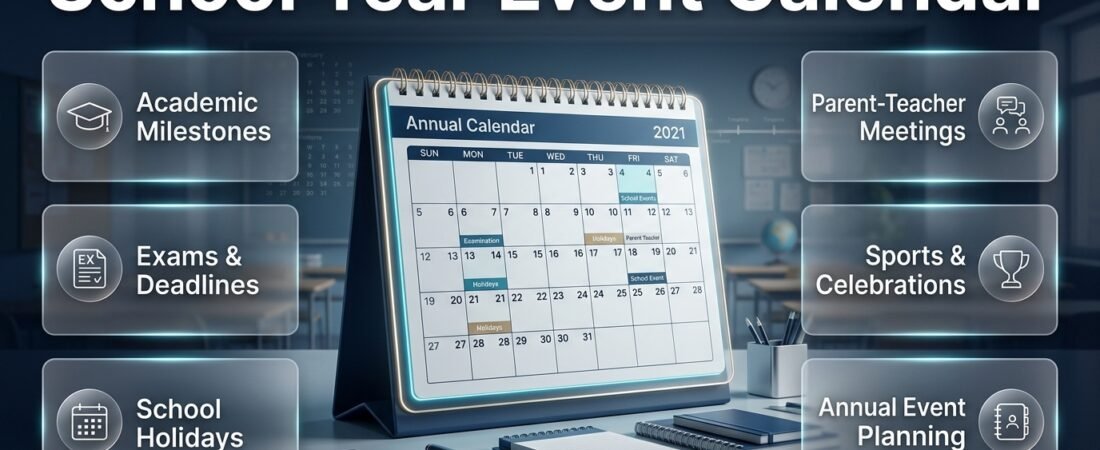
Academic milestones and term dates
Academic milestones establish the structure of the school year. They help teachers plan curriculum coverage and give students a clear view of important learning deadlines.
Include:
- First and last instructional days.
- Term and semester start dates.
- Midterm and final examination periods.
- Assessment and assignment deadlines.
- Curriculum completion targets.
- Report card preparation and distribution.
- Graduation and promotion ceremonies.
- Student registration and orientation.
These dates should be established before most optional activities are added.
School holidays and seasonal breaks
Holidays affect attendance, teaching time, staffing, transportation, and family arrangements.
Include official public holidays, winter breaks, summer vacations, spring breaks where applicable, and school-specific closure days. Staff training days should also be recorded when students will not attend regular classes.
Always confirm holidays with the relevant education authority or school leadership. Religious holiday dates may be subject to official announcements, so provisional dates should be clearly identified.
Examinations and assessment activities
Examination planning involves more than recording the first day of a test.
A complete internal assessment schedule may include:
- Examination preparation periods.
- Paper-setting and review deadlines.
- Examination room allocation.
- Student revision sessions.
- Practical assessments.
- Marking and moderation periods.
- Result compilation.
- Report card distribution.
These supporting milestones help teachers complete assessments accurately without leaving important administrative work until the last minute.
Parent-teacher meetings and family engagement
Parent engagement activities give families opportunities to understand student progress, discuss concerns, and work with teachers on improvement plans.
Useful events include new-student orientation, open-house days, parent-teacher conferences, curriculum information sessions, and student progress meetings.
Scheduling meetings after teachers have reliable assessment information can make discussions more productive. Allow enough time for appointments and ensure that meeting arrangements are communicated clearly.
Sports and extracurricular activities
Extracurricular activities support teamwork, creativity, confidence, and interests beyond regular lessons.
Consider including sports days, interschool competitions, debate tournaments, science fairs, music performances, art exhibitions, reading weeks, robotics competitions, and club showcases.
Before approving dates, check venue availability, staff supervision, transportation, safety arrangements, equipment requirements, and any permission forms that families must complete.
Cultural celebrations and community events
School celebrations can strengthen relationships between students, staff, and families.
Depending on the school’s community, events might include cultural days, national celebrations, language activities, environmental awareness programs, charity projects, and community service initiatives.
Plan these activities inclusively. Consider different cultural backgrounds, make participation expectations clear, and provide sufficient notice for families.
Administrative and staff development dates
Some activities affect the school even when students do not attend them directly.
Include staff training, curriculum planning days, enrollment deadlines, admissions events, teacher orientation, internal reporting deadlines, and required administrative reviews.
Maintaining these dates in the internal calendar helps school leaders coordinate operations without cluttering the public schedule with every internal task.
How Do You Create a School Year Event Calendar Step by Step?

Creating a reliable calendar requires more than entering dates into a spreadsheet. The process should begin with confirmed academic requirements, involve the people responsible for delivering events, and finish with approval, publication, and ongoing maintenance.
Step 1: Confirm the academic year’s essential dates
Start with the dates that determine the structure of the year.
Confirm the opening and closing days, term boundaries, official holidays, examination windows, and required reporting deadlines. Consult the relevant education authority and school leadership where appropriate.
Do not build the entire schedule around unconfirmed dates.
Why it matters: Optional events must fit around essential academic commitments, not compete with them.
Professional advice: Mark each date as confirmed, provisional, or awaiting approval. This makes uncertainty visible during planning.
Step 2: Collect event requests from departments
Ask department heads, teachers, activity coordinators, and administrative staff to submit their proposed activities.
Use a consistent submission format containing:
- Event title and purpose.
- Preferred date or date range.
- Intended audience.
- Estimated duration.
- Venue and equipment requirements.
- Responsible staff member.
- Preparation deadlines.
- Estimated costs, if applicable.
Collecting this information before scheduling allows administrators to compare requests and identify resource demands.
Step 3: Group events into clear categories
Organize events into categories such as academics, examinations, holidays, parent engagement, extracurricular activities, and staff development.
Consistent categories make the calendar easier to scan and filter.
Color coding can help distinguish event types, but include text labels as well. Users should not have to rely on color alone to understand the schedule.
Step 4: Check for scheduling conflicts
Review the complete proposed calendar before approving individual dates.
Ask whether major events overlap with examinations, whether teachers have competing responsibilities, whether rooms are available, and whether students face several demanding assignments at once.
Also consider setup and travel time. Two events may appear separate on the calendar but still be impractical if they require the same staff or facilities within a short period.
Step 5: Assign event owners and preparation deadlines
Every significant event should have a clearly identified owner.
The event owner coordinates preparation, confirms arrangements, and reports changes to the calendar coordinator.
For example, a science fair might require project instructions six weeks in advance, student registration four weeks beforehand, material checks one week before the event, and final setup the day before.
These deadlines make it easier to monitor progress and prevent last-minute confusion.
Step 6: Choose the right calendar format
Select a format according to the school’s size, technical resources, and communication needs.
| Format | Best use | Main limitation |
|---|---|---|
| Printed annual calendar | Quick reference for families | Changes can be difficult to distribute |
| Spreadsheet | Initial planning and event collection | Can become confusing without clear ownership |
| Shared digital calendar | Frequent updates and reminders | Requires access and maintenance |
| School management platform | Coordinating broader school operations | May require setup, training, or subscription |
| Website calendar | Publishing approved dates to families | Needs regular updating |
A school can use several formats, but one version should remain the authoritative source for approved dates.
Step 7: Review and approve the calendar
Before publication, ask school leadership and relevant department heads to review the proposed schedule.
Check dates, times, venues, event descriptions, holiday arrangements, and any requirements for students or families.
Make sure the calendar does not contradict the official academic schedule. Resolve outstanding questions before describing provisional information as final.
Step 8: Publish the calendar and explain how to use it
Share the calendar through the school’s preferred channels, such as the parent portal, school website, email, or printed handbook.
Explain where families can find updates and how changes will be communicated. If digital subscriptions are available, provide simple instructions for enabling reminders.
Step 9: Monitor and update the schedule
Review upcoming events regularly and confirm arrangements with event owners.
When a change is approved, update the master calendar, check related deadlines, and notify affected groups. Record the reason for major changes so the school can review recurring planning problems later.
Quick Tip: Display a clear “Last updated” date on the public calendar. This helps families recognize whether they are using the latest version.
What Does a School Year Event Calendar Look Like?

A sample annual schedule helps administrators understand how to distribute activities across the year. The following example illustrates one possible arrangement; it is not an official calendar and should be adapted to the school’s actual academic structure.
| Month | Example event | Main preparation task |
|---|---|---|
| August | Student orientation | Confirm enrollment and family information |
| September | Opening academic activities | Establish classroom routines |
| October | Parent-teacher meetings | Prepare progress updates |
| November | Science fair | Coordinate projects and materials |
| December | Term assessments and winter break | Finalize assessment arrangements |
| January | New-term planning | Review academic targets |
| February | Reading week and cultural activities | Arrange resources and participation |
| March | Midterm examinations | Confirm rooms and revision plans |
| April | Sports day | Coordinate facilities and supervision |
| May | Project presentations | Track submissions and assessment |
| June | Final examinations and graduation | Coordinate examinations and ceremonies |
| July | Summer break and annual review | Evaluate the calendar and plan ahead |
Schools that operate on a different academic cycle should adjust the months and events accordingly.
How should events be distributed throughout the year?
Avoid placing every major activity near the end of a term. Students need sufficient time for learning, revision, and assessment, while teachers need manageable periods for preparation and marking.
A balanced schedule should protect instructional time, spread major events across the year, and avoid unnecessary pressure during examination periods.
For example, a school can schedule a major science exhibition several weeks before final examinations rather than placing it in the busiest assessment week.
The objective is not to make every month equally busy. Some periods naturally require more activity than others. The goal is to ensure that the overall workload remains realistic.
How Can Schools Avoid Event Scheduling Conflicts?
Schools can reduce scheduling conflicts by maintaining one approved calendar, checking shared resources, assigning clear responsibilities, and reviewing the schedule before major dates are published.
Maintain one authoritative calendar
Separate departmental calendars can be useful, but major dates should be reflected in the central schedule.
If each department maintains an independent version, administrators may overlook conflicts or communicate inconsistent information.
Define who can approve dates, who can update the master calendar, and how departments should submit changes.
Check the full school schedule
Before approving an event, review its impact on other activities.
Consider examination dates, teacher availability, classroom bookings, sports facilities, transportation, and student workload.
A schedule that works for one department may create problems for another. Cross-department review is therefore essential.
Leave room for unexpected changes
Do not schedule every available day with a major activity.
Leave reasonable gaps for preparation, setup, cleanup, and unexpected disruptions. For outdoor events, consider a backup date or alternative venue.
The amount of flexibility required depends on the activity and the school’s operating conditions.
Establish a change-approval process
Not all changes require the same level of approval.
A routine classroom activity might be adjusted by a teacher, while changing a major examination date or school closure may require senior approval.
Define these responsibilities before the year begins so staff know how to handle changes.
Common Mistake: Updating an internal calendar without informing families. A date change is not complete until the relevant public information has been corrected and affected people have been notified.
How Should Schools Plan Holidays and Semester Milestones?

Holiday planning and semester milestones deserve special attention because they affect teaching time, attendance, assessment deadlines, and family commitments.
Start with official holidays and approved academic dates, then build school-specific activities around them.
Create a reliable holiday schedule
Record official holidays, seasonal breaks, school closures, and staff development days. Check whether the academic calendar requires adjustments around these dates.
If a holiday is provisional, label it clearly. Do not allow an estimated date to become an unverified public commitment.
Schools that need a structured process for organizing academic dates can explore Academic Calendar Planning as a relevant planning resource.
Plan semester milestones separately, but connect them to the master calendar
Semester milestones include course completion targets, revision periods, assessment windows, grading deadlines, and report distribution.
These dates should be planned together because moving one milestone can affect several others.
For example, postponing a final examination may also affect marking time, report card preparation, and the next term’s planning.
A dedicated Semester Milestone Calendar can help readers explore the organization of important academic deadlines.
Review holiday arrangements before publication
A holiday may influence transport schedules, staff availability, assignment deadlines, and event preparation.
Check these dependencies before confirming the calendar. Make sure families understand when classes resume and whether any activities require action before the break.
The Academic Holiday Calendar Builder is another relevant resource for organizing school breaks within a wider academic schedule.
Expert Tip: Whenever an important date changes, review the events that depend on it. A single adjustment may require several related changes elsewhere in the calendar.
Should Schools Use a Digital School Year Event Calendar?
A digital school year event calendar is especially useful when many people need current information, events change regularly, or families benefit from reminders. It can make coordination easier, provided the school establishes clear permissions, reliable updates, and responsibility for maintaining the schedule.
Digital calendar versus printed calendar
| Feature | Digital calendar | Printed calendar |
|---|---|---|
| Updating dates | Usually quick | Often requires a revised notice |
| Reminders | May support automatic alerts | Usually requires manual reminders |
| Collaboration | Can support shared editing | Limited collaboration |
| Accessibility | Depends on device and platform access | Easy to consult without a device |
| Availability | May depend on internet access | Available offline |
| Best role | Current schedule and updates | Convenient annual overview |
These formats can complement each other. A school may distribute a printed annual overview while using its digital calendar as the authoritative source for changes.
Which digital calendar features matter most?
Choose tools based on practical needs rather than the number of features they advertise.
Useful capabilities include:
- Shared access for authorized staff.
- Event categories and filtering.
- Recurring events.
- Reminders and notifications.
- Role-based editing permissions.
- Mobile-friendly viewing.
- Printing or exporting.
- Clear change history.
- Options for sharing approved dates with families.
Larger schools may also need integration with attendance systems, academic planning software, or a broader school management platform.
For institutions reviewing their planning workflow, Academic Planning and Scheduling Tools provides a relevant starting point for exploring academic scheduling resources.
You can also visit the RTI Scheduler homepage to explore the site’s academic planning focus and determine whether its available resources suit your institution’s needs.
How can schools keep digital calendars simple?
Use short event names, clear dates, consistent categories, and brief descriptions. Include start and end times when relevant, specify the venue, and explain whether students or parents must take action.
Avoid turning the public calendar into a long list of internal administrative tasks. Keep detailed preparation checklists in the staff planning system.
Privacy also matters. Public calendars should not contain confidential student information, private staff details, sensitive meeting notes, or personal information that families do not need to access.
How Can Parents and Students Use a School Event Calendar?
A school calendar becomes more valuable when families and students use it as part of their regular planning routine. Checking upcoming dates early can prevent missed deadlines and reduce last-minute stress.
How parents can use the calendar
Parents can review the coming month to identify holidays, examination periods, parent meetings, school trips, and activities that require preparation.
A simple routine is to review the next month’s dates near the end of each month and check the coming week’s schedule every weekend.
Pay particular attention to:
- School closures and early dismissals.
- Examination dates.
- Permission-form deadlines.
- Parent-teacher meetings.
- Project submission dates.
- Required clothing or equipment.
- Changes to transport arrangements.
Families should also check official school notifications when a major date changes rather than assuming an old printed calendar remains accurate.
How students can use the calendar
Students can use the calendar to organize their workload and prepare for assessments in manageable stages.
If a project is due in three weeks, for example, they can reserve the first week for research, the second for drafting, and the final week for revision and practice.
Older students may also use personal reminders to plan revision sessions, while younger students may benefit from help from parents or teachers.
How teachers can use the calendar
Teachers can coordinate lesson plans, projects, assessments, field trips, and classroom activities with the wider school schedule.
Regular communication between departments helps prevent several demanding assignments from falling in the same week. Teachers can also use the calendar to reserve preparation time before major activities.
What Are the Most Common School Calendar Planning Mistakes?
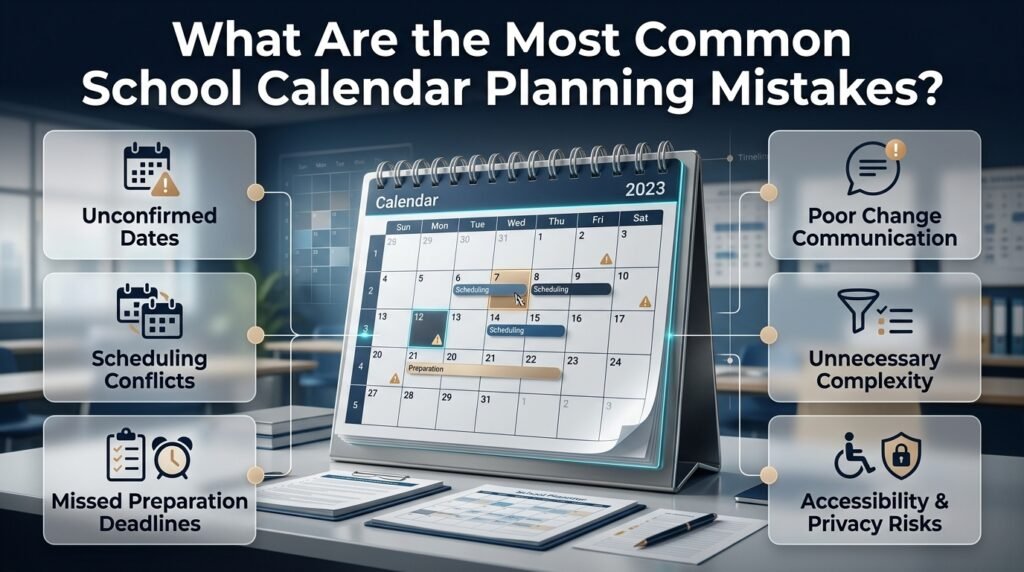
Most calendar problems occur when planners focus on the event date without considering the people, resources, deadlines, and communication required to make the event successful.
Publishing unconfirmed dates
Why it happens: Schools want to give families early notice.
Why it causes problems: Repeated changes create confusion and can reduce confidence in school communications.
How to avoid it: Confirm important dates before publication and clearly label provisional information.
Scheduling too many major activities together
Why it happens: Departments plan independently and may not see the full school schedule.
Why it causes problems: Students face competing demands, teachers become overloaded, and families may struggle to attend events.
How to avoid it: Review the master calendar and distribute major activities more evenly.
Forgetting preparation deadlines
Why it happens: The calendar records the event but not the work required beforehand.
Why it causes problems: Equipment, permission forms, transport, and communication may be arranged too late.
How to avoid it: Add preparation milestones and assign a responsible person to each major event.
Failing to communicate changes
Why it happens: Staff assume that updating the calendar is sufficient.
Why it causes problems: Parents may continue relying on an older email, message, or printed notice.
How to avoid it: Update the authoritative calendar and notify affected groups through the school’s agreed communication channels.
Making the calendar unnecessarily complicated
Why it happens: Every minor activity is added to the public schedule.
Why it causes problems: Important dates become difficult to find.
How to avoid it: Keep the public calendar focused on dates that affect students and families, while maintaining detailed internal task lists separately.
Ignoring accessibility and privacy
Why it happens: Planners focus on convenience without considering different user needs or access permissions.
Why it causes problems: Some families may struggle to understand the schedule, while sensitive information may be exposed.
How to avoid it: Use readable formatting, descriptive labels, accessible layouts, and appropriate access controls.
What Is the Best Way to Maintain a School Year Event Calendar?
The best maintenance process combines regular reviews, clear ownership, accurate information, and consistent communication. Assign a calendar coordinator who checks upcoming events, confirms details with event owners, and makes sure approved changes reach the correct audience.
Create a recurring review routine
A practical maintenance schedule can include:
- Monthly review: Examine events planned for the next two or three months.
- Weekly review: Confirm immediate arrangements and outstanding preparation tasks.
- Pre-event review: Verify staff, facilities, equipment, transportation, and communication.
- Post-event review: Record lessons that could improve future planning.
- Annual review: Evaluate the completed calendar and identify improvements for the following year.
The exact frequency depends on the school’s size and activity level. What matters most is making the review process a defined responsibility.
Measure whether the calendar is effective
Schools can use a few simple measures to evaluate their planning process.
| Measure | What it reveals |
|---|---|
| Number of date changes | Whether initial planning is reliable |
| Late scheduling conflicts | Whether reviews are effective |
| Events with assigned owners | Whether responsibilities are clear |
| Missed preparation deadlines | Whether planning timelines are realistic |
| Family communication complaints | Whether published information is understandable |
| Staff feedback | Whether the calendar supports daily work |
Use these findings to improve the next planning cycle rather than treating every problem as an isolated incident.
Expert Advice for Creating a More Reliable School Calendar
An effective school calendar is not necessarily the most detailed one. It is the one that helps people make decisions early, understand their responsibilities, and respond calmly when circumstances change.
Protect essential learning time
School events should support the educational experience rather than constantly interrupt it.
Review how assemblies, celebrations, trips, and competitions affect instructional time. Coordinate activities with academic departments before confirming dates, especially during important assessment periods.
Plan backward from major events
Start with the event date and work backward to identify the preparation milestones.
For a graduation ceremony, this could include venue confirmation, guest communication, student registration, certificate preparation, rehearsals, and final equipment checks.
Backward planning reveals resource requirements early and makes deadlines easier to manage.
Separate public information from internal operations
Parents need to know when an event takes place, where it will be held, and what action they must take.
Staff may also need setup times, equipment lists, task assignments, and contingency plans.
Maintaining separate public and internal views keeps the main calendar readable without sacrificing operational detail.
Build flexibility into the schedule
Unexpected closures, staff absences, weather conditions, and changes to official requirements can affect school activities.
For major events, identify backup dates where practical and determine which activities can be moved with the least disruption.
Avoid filling every available day. A reasonable amount of flexibility can prevent one unexpected change from disrupting the entire term.
Document decisions and responsibilities
Record who approved important dates, who manages each event, and how changes should be communicated.
This is particularly useful when staff responsibilities change during the year. A clear record allows another staff member to continue the planning process without reconstructing decisions from old emails.
Expert Tip: Before publishing the calendar, review it from three perspectives: the administrator responsible for operations, the teacher responsible for instruction, and the parent responsible for family planning. Each perspective can reveal a different scheduling problem.
School Year Event Calendar: Key Takeaways
- A school year event calendar combines academic milestones, holidays, examinations, meetings, and extracurricular activities in one organized schedule.
- Confirm essential academic dates before adding optional events.
- Involve teachers, administrators, and activity coordinators in the planning process.
- Check for conflicts involving staff, students, facilities, examinations, and family commitments.
- Assign event owners and preparation deadlines for significant activities.
- Use a digital calendar for updates and reminders, with a printed overview when useful.
- Keep public information simple and protect confidential student and staff details.
- Review upcoming events regularly and communicate approved changes promptly.
- Evaluate the completed calendar to identify improvements for the following academic year.
Conclusion
A well-organized school year event calendar transforms a busy academic year into a more manageable and predictable schedule. By coordinating examinations, holidays, parent meetings, school celebrations, and extracurricular activities, schools can reduce avoidable conflicts and give teachers, students, and families more time to prepare.
The most effective approach begins with confirmed academic dates, realistic preparation deadlines, clear responsibilities, and a reliable process for communicating changes. Choose a format that fits your school’s needs, maintain one authoritative schedule, and review it regularly.
Start by listing your essential academic milestones, then add major events, assign responsibilities, and check for conflicts before publishing the calendar. With consistent maintenance and thoughtful planning, your school year event calendar can become a dependable resource for a successful academic year.
How Do You Create an Effective School Year Event Calendar?
Creating an effective school year event calendar starts with identifying the dates that shape the academic year, including the first and last school days, holidays, examination periods, parent-teacher meetings, and major school activities. Once these dates are confirmed, administrators can add departmental events, extracurricular programs, and important deadlines while checking for scheduling conflicts.
A well-planned calendar should also include preparation timelines and assigned responsibilities. For example, if a school is organizing a science fair, the schedule should account for student registration, project preparation, equipment arrangements, and the final exhibition date. This approach helps teachers and administrators manage responsibilities without unnecessary last-minute pressure.
Important steps to follow:
Confirm official academic dates and school holidays before scheduling other activities.
Collect event requests from teachers, department heads, and activity coordinators.
Assign a responsible person and preparation deadline to every major event.
Review the complete schedule for conflicts involving examinations, facilities, and staff availability.
Publish the approved calendar and establish a process for communicating changes.
What Events Should Be Included in a School Year Event Calendar?
A comprehensive school year event calendar should include academic milestones, holidays, examinations, parent meetings, extracurricular activities, staff development days, and administrative deadlines. The goal is to provide a complete overview of the school year without overwhelming users with unnecessary details.
Academic events should receive particular attention because they directly affect teaching plans and student progress. Schools should also include activities that require advance preparation, such as sports competitions, cultural celebrations, field trips, science fairs, and graduation ceremonies. Families benefit from knowing about school closures, permission-form deadlines, and parent-teacher conferences well in advance.
Essential calendar categories include:
Academic milestones: Term dates, examination periods, report cards, and graduation.
Holidays: Public holidays, seasonal breaks, and school closure days.
School activities: Sports days, performances, exhibitions, and educational trips.
Family engagement: Parent-teacher meetings, orientation sessions, and open houses.
Administrative planning: Enrollment deadlines, staff training, and reporting schedules.
Organizing these events into clear categories makes the calendar easier to navigate and helps school leaders maintain a balanced academic schedule.
How Can Schools Prevent Scheduling Conflicts in Their Annual Event Calendar?
Schools can prevent scheduling conflicts by maintaining one central calendar, coordinating event requests across departments, and reviewing important dates before they are approved. This process helps administrators identify overlapping examinations, meetings, competitions, and facility bookings before they disrupt school activities.
For example, scheduling a sports tournament on the same day as a major examination may create problems for students and staff. Similarly, holding multiple events that require the same auditorium or teachers can lead to unnecessary changes. A centralized planning process allows schools to identify these issues early and select more suitable dates.
Practical ways to avoid conflicts:
Maintain one authoritative calendar for approved school events.
Check examination schedules before confirming extracurricular activities.
Coordinate classroom, auditorium, sports facility, and equipment bookings.
Distribute major assignments and events to prevent excessive student workloads.
Review upcoming activities regularly and communicate approved changes promptly.
Schools should also leave reasonable gaps between major events. A little flexibility makes it easier to accommodate unexpected closures, staff absences, and changes to academic requirements.
Is a Digital School Year Event Calendar Better Than a Printed Calendar?
A digital school year event calendar is particularly useful when dates change frequently or multiple people need access to current information. It can support reminders, shared updates, event categories, and convenient access through compatible devices. However, a printed calendar remains valuable for families who prefer a physical reference or have limited access to digital tools.
The most practical solution for many schools is to use both formats. A digital calendar can serve as the authoritative source for updated information, while a printed annual overview gives parents and students a quick reference to important dates. The school should ensure that both formats communicate consistent information and that significant changes are shared directly with affected families.
Features worth considering in a digital calendar:
Automatic reminders and notifications, where supported.
Shared access for authorized teachers and administrators.
Clear categories for holidays, examinations, and school events.
Mobile-friendly viewing and printable schedules.
Appropriate editing permissions and protection of confidential information.
The right choice depends on the school’s size, available resources, staff familiarity, and the needs of its community. A simple system that stays accurate is more valuable than a complicated platform that nobody maintains.
How Far in Advance Should a School Year Event Calendar Be Planned and Updated?
Schools should begin planning the annual calendar as early as practical, ideally once the main academic dates and official holidays can be confirmed. Early planning gives administrators time to coordinate examinations, reserve facilities, organize school activities, and inform families before they make their own commitments.
However, creating the calendar once and leaving it unchanged is rarely sufficient. Schools need a regular review process to confirm upcoming arrangements, identify new conflicts, and update approved changes. Major events often require additional preparation deadlines several weeks or months in advance, depending on their complexity.
A practical maintenance routine includes:
Annual planning: Establish term dates, holidays, examinations, and major events.
Monthly review: Check upcoming activities and confirm arrangements with event owners.
Weekly review: Verify immediate deadlines, locations, and outstanding preparations.
Pre-event checks: Confirm staffing, equipment, transportation, and communication.
End-of-year evaluation: Review scheduling problems and identify improvements for the next academic year.
A designated calendar coordinator should oversee updates and ensure that important changes reach teachers, students, parents, and other affected groups. This keeps the schedule dependable throughout the school year.
Conclusion
A well-organized school year event calendar helps schools manage academic responsibilities, coordinate important activities, and keep students, parents, teachers, and administrators informed throughout the year. By planning holidays, examinations, parent-teacher meetings, school events, assignment deadlines, and staff development activities in advance, schools can reduce scheduling conflicts and create a more predictable learning environment.
The most effective calendar is not simply a list of dates. It is a practical planning resource that connects academic priorities with school events, provides enough time for preparation, and makes important information accessible to everyone who needs it. Regular reviews and timely updates also help schools respond to unexpected changes without disrupting essential activities.
To improve long-term planning, schools can use digital scheduling tools alongside their academic calendars. Resources such as Academic Calendar Planning and Academic Planning and Scheduling Tools can support a more structured approach to organizing dates, coordinating responsibilities, and tracking important milestones.
Ultimately, investing time in a clear and flexible school year event calendar helps educational institutions improve communication, use resources more efficiently, and maintain a better balance between academic goals and extracurricular activities. With consistent planning and collaboration, schools can make each term more organized, productive, and manageable for the entire school community.