

Introduction
Examination Timetable Organizer | Preparing an examination timetable can quickly become complicated when several subjects, classes, teachers, examination rooms, and assessment dates must fit into the same academic schedule. A single scheduling mistake can create overlapping exams, insufficient revision time, room shortages, or unnecessary stress for students and staff. An Examination Timetable Organizer helps bring these details together in a clear, structured, and manageable format.
Whether you are a school administrator preparing a term examination schedule, a teacher coordinating classroom tests, or a student organizing upcoming assessments, a well-planned timetable makes the process easier. Instead of relying on scattered notices, handwritten lists, or multiple spreadsheets, you can organize examination dates, subjects, time slots, durations, and preparation requirements in one place.
For schools and academic institutions, an organized examination process also supports better communication and more efficient administration. Students can understand what is coming next, teachers can prepare their assessments, and administrators can identify scheduling conflicts before publishing the final timetable.
The RTI Scheduler homepage provides the wider context for academic planning and scheduling tools that help organize educational activities. An examination timetable can become an important part of this broader planning process when it is coordinated with the academic calendar, teaching schedule, and assessment deadlines.
This guide explains how an examination timetable organizer works, how to create a reliable exam schedule, which information to collect, how to prevent common scheduling mistakes, and how students and educational institutions can use a timetable more effectively.
What Is an Examination Timetable Organizer?
An Examination Timetable Organizer is a planning method or digital tool used to arrange examinations according to their dates, subjects, time slots, duration, participating students, and other scheduling requirements. Its main purpose is to make examination information easy to understand while reducing conflicts and administrative confusion.
A basic organizer might be a spreadsheet containing exam dates and subjects. A more advanced scheduling system may support multiple classes, examination sessions, room assignments, timetable adjustments, and calendar coordination.
The best approach depends on the number of examinations and the complexity of the institution’s requirements.
For example, a small class preparing for five tests may need only a weekly timetable. A school conducting examinations for several grades may require separate schedules for different student groups, examination rooms, supervisors, and subject departments.
What information should an examination timetable contain?
A useful timetable should provide enough information for students and staff to understand exactly when and where each examination will take place.
Typical details include:
- Examination date and day.
- Subject or course name.
- Class, grade, or student group.
- Starting and finishing times.
- Examination duration.
- Examination venue or room.
- Reporting time, where applicable.
- Special instructions or permitted materials.
- Relevant examination contact or department.
Not every institution needs every field. However, leaving out essential details can create avoidable questions after the schedule is published.
Example: A timetable that says “Mathematics — Tuesday” is incomplete if students do not know the examination time, room, or duration. A clearer entry would include the date, starting time, expected finishing time, class, and venue.
Why Is an Examination Timetable Organizer Important?
An examination timetable organizer is important because it turns multiple assessment requirements into a coordinated schedule. It helps students understand their examination sequence and allows administrators to check whether the available dates, rooms, and staff can support the planned assessments.
Without a structured timetable, information may be distributed across classroom announcements, departmental messages, printed notices, and separate spreadsheets. When one date changes, not everyone may receive the correction.
A centralized schedule reduces this risk by giving the relevant people a consistent reference point.
1. It reduces examination conflicts
A timetable makes it easier to identify when two examinations are scheduled for the same student group at overlapping times.
For example, if Grade 9 students have Mathematics and Science examinations on the same morning, administrators can check whether the arrangement is intentional and whether students have enough time to complete both assessments.
The same review can identify conflicts involving shared rooms, specialist equipment, or teachers assigned to supervise multiple examinations.
2. It supports better student preparation
Students often need to balance several subjects with different levels of difficulty. A timetable allows them to see which examinations are approaching and distribute their revision time accordingly.
If a student has Biology on Monday and Mathematics on Wednesday, the schedule provides a starting point for deciding when to revise each subject.
However, the timetable alone does not guarantee effective preparation. Students still need to consider syllabus size, their existing understanding, and the time required for practice.
3. It improves administrative coordination
Teachers, department heads, examination coordinators, and school administrators may all contribute to examination planning. A shared schedule helps everyone work from the same approved information.
This is particularly useful when different departments submit examination requirements independently.
4. It makes changes easier to manage
Examination dates sometimes change because of holidays, unexpected closures, staff availability, or other institutional requirements.
A properly maintained timetable provides a clear starting point for reviewing the effect of a change. Administrators can identify which student groups, rooms, and other scheduled activities may be affected before publishing a revision.
💡 Pro Tip: Assign one responsible person or department to approve timetable changes. Allowing several people to distribute separate versions without coordination can create more confusion than the original schedule.
Who Can Benefit From an Examination Timetable Organizer?
An examination timetable organizer is useful for anyone who needs to coordinate or follow multiple assessments. The specific benefits depend on the user’s responsibilities and the complexity of the examination process.
| User | Main purpose | Practical benefit |
|---|---|---|
| School administrators | Coordinate institutional examinations | Better oversight and fewer scheduling conflicts |
| Teachers | Organize subject tests and assessments | Clear dates and improved preparation |
| Examination coordinators | Manage examination sessions | More consistent scheduling and communication |
| Students | Track upcoming examinations | Better revision planning |
| Parents and guardians | Understand examination dates | Easier support for study routines |
| Colleges and universities | Coordinate courses and student groups | Better visibility across examination periods |
| Tutors and training providers | Arrange tests and progress assessments | More predictable assessment planning |
For school administrators
Administrators usually need to consider several requirements at once. They may have to coordinate grade levels, subject departments, classroom availability, examination durations, and staff responsibilities.
A timetable organizer helps bring these requirements together before the schedule is approved.
For teachers
Teachers can use a timetable to confirm when assessments are taking place, check whether students have competing deadlines, and plan teaching activities around examination periods.
They should also communicate subject-specific requirements early so that administrators have accurate information before assigning dates.
For students
Students can convert the published examination schedule into a personal revision plan. They can identify demanding subjects, schedule practice sessions, and avoid leaving all preparation until the final evening.
For parents and guardians
A clear timetable helps families understand when students may need additional study time, quiet working periods, or practical support with their routines.
Examination Timetable Organizer vs. Exam Schedule Generator
An examination timetable organizer and an exam schedule generator are related, but their emphasis can differ. An organizer focuses on arranging, reviewing, and maintaining examination information, while a generator emphasizes creating a schedule from supplied requirements.
A basic organizer may be sufficient when the timetable contains a small number of assessments. More complex examinations may benefit from a dedicated generation process that considers several constraints before dates are assigned.
| Feature | Examination timetable organizer | Exam schedule generator |
|---|---|---|
| Main purpose | Arrange and maintain examination information | Produce a proposed examination schedule |
| Typical use | Tracking and reviewing exam dates | Creating schedules from requirements |
| Conflict review | Can be performed manually or with supported checks | May be part of the generation workflow |
| Best suited to | Students, teachers, and coordinators | Schools managing more complex scheduling |
| Final approval | Required where institutional rules apply | Still required before publication |
Institutions looking for a dedicated scheduling workflow can explore the Exam Schedule Generator as a related planning resource.
The important distinction is that creating a timetable is only one part of examination management. A reliable process also includes checking constraints, obtaining approval, communicating the final schedule, and handling changes.
How to Create an Examination Timetable Organizer Step by Step
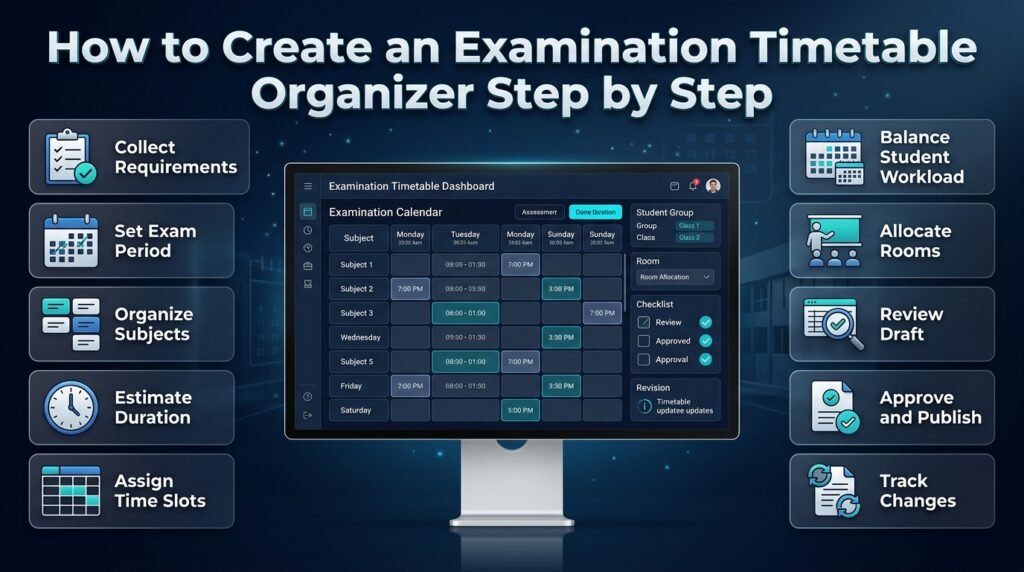
Creating an effective examination timetable begins with collecting accurate information. Dates should not be assigned simply because a particular day appears available. Student availability, assessment duration, room capacity, institutional policies, and preparation requirements must also be considered.
The following process provides a practical starting point for schools, teachers, and students.
Step 1: Collect all examination requirements
Start by gathering the information needed for every planned examination.
For an institution, this may include:
- Subject names and course identifiers.
- Classes, grades, or student groups.
- Proposed examination dates.
- Assessment duration.
- Number of participating students.
- Room and equipment requirements.
- Staff availability.
- Special scheduling restrictions.
Students creating a personal organizer can simplify this list. They may only need the subject, examination date, syllabus, estimated revision time, and any important instructions.
Why it matters: Incomplete information can force major changes after the timetable has been prepared.
Professional advice: Ask every relevant department to submit its requirements by an agreed deadline. Confirm unusual requirements before assigning dates.
Example: If Chemistry requires a laboratory and Mathematics requires a standard examination room, the coordinator must consider those differences when assigning venues.
Step 2: Identify the examination period
Determine the beginning and ending dates of the examination period before assigning individual subjects.
Check the academic calendar for public holidays, institutional closures, planned events, and other dates when examinations should not take place.
Schools that need a broader view of important academic dates can coordinate their examination planning with Academic Calendar Planning.
This step helps establish the available scheduling window and reduces the risk of choosing dates that conflict with existing institutional commitments.
Common mistake: Starting with individual subjects before checking the overall academic calendar.
How to avoid it: Confirm the approved examination period first, then assign dates within that period.
Step 3: List subjects and student groups
Create a complete list of examinations and identify the students who must attend each one.
The same subject may require separate examination sessions for different grades or groups. Conversely, multiple classes may share an examination if their requirements and institutional rules permit it.
Make sure the timetable distinguishes between subjects that have similar names but different course levels.
Example: Grade 8 Mathematics and Grade 10 Mathematics should not appear as an indistinguishable entry. Each should have a clear class label and relevant examination details.
Why it matters: A schedule can look organized while still assigning the wrong examination to the wrong student group.
Step 4: Estimate examination duration
Record how long each examination should last. Include any additional time required for permitted arrangements, reading instructions, or other approved procedures.
Duration affects more than the finishing time. It may influence room availability, supervision arrangements, breaks, and whether another examination can reasonably follow.
For example, a 45-minute classroom test may fit into a regular lesson period. A three-hour examination may require a dedicated session and additional planning.
Do not shorten an assessment merely to make the timetable easier to arrange. Examination duration should reflect the approved assessment design and applicable policies.
Step 5: Assign suitable dates and time slots
Once the requirements are collected, begin assigning examinations to the available dates and sessions.
Consider the following factors:
- Whether the date is available under the academic calendar.
- Whether the student group has another examination at the same time.
- Whether the gap between demanding subjects is reasonable.
- Whether rooms and equipment are available.
- Whether the required staff can supervise the examination.
- Whether institutional rules restrict the timing or sequence.
A schedule should be practical for the people who must use it, not merely complete on paper.
For larger institutions, it can help to schedule examinations with the fewest available options first. An assessment requiring a specialist room or a limited number of qualified supervisors may be harder to place than a standard written paper.
Step 6: Check student workload and examination spacing
Review the order of examinations from the students’ perspective.
Two examinations on the same day may be permitted in some settings, but that does not automatically make the arrangement suitable. Consider assessment duration, subject difficulty, age group, institutional policy, and the availability of reasonable breaks.
Where possible, avoid unnecessary concentrations of demanding examinations.
Example: If a class has Physics on Tuesday and Chemistry on Wednesday, the coordinator should consider whether the arrangement is appropriate for the institution’s assessment policy and the students’ overall workload.
There is no universal spacing rule for every school. Use the institution’s requirements and the practical demands of the assessments rather than applying an arbitrary interval to every subject.
Step 7: Allocate rooms and supervision
For institutional examinations, confirm that the planned venues can accommodate the number of candidates and meet the assessment’s requirements.
Check:
- Room capacity and seating arrangements.
- Accessibility requirements.
- Equipment or laboratory needs.
- Availability of appropriate supervision.
- Time needed to prepare and reset rooms.
- Any restrictions on simultaneous examinations.
A room may be physically available but still unsuitable for a particular examination.
For example, a computer-based assessment may require functioning devices and reliable access to the necessary systems. A science practical may require equipment that a standard classroom does not provide.
Step 8: Review the draft timetable
Before publishing the schedule, conduct a structured review.
Check every entry against the original requirements. Confirm dates, days, start times, finishing times, subject names, class labels, rooms, and any special instructions.
Then review the timetable from three perspectives:
- Student perspective: Are there overlapping examinations or unreasonable arrangements?
- Teacher perspective: Are assessment requirements and staff commitments accurate?
- Administrative perspective: Are rooms, resources, and institutional restrictions properly addressed?
Use a second reviewer where possible. A fresh review can identify errors that the person who created the timetable may overlook.
Step 9: Obtain approval and publish the final version
After the necessary checks, send the timetable to the authorized person or department for approval.
Once approved, publish it through the institution’s established communication channels. Make sure students, teachers, and other relevant stakeholders know where to find the official version.
If the institution uses printed notices and digital copies, confirm that both contain the same information.
Expert Tip: Give the final timetable a clear version date. This helps readers distinguish the approved schedule from earlier drafts.
Step 10: Monitor changes and keep records
After publication, monitor requests for changes and assess their effect before approving them.
If an examination must move, review the affected student groups, other assessments, room assignments, supervision arrangements, and communication requirements.
Record the change and publish the updated version through the official channel. Where appropriate, identify which information has changed so readers can quickly understand the revision.
A timetable should remain accurate throughout the examination period, not only on the day it is first published.
How Students Can Use an Examination Timetable for Revision
An examination timetable becomes more valuable when students use it to organize their preparation rather than simply memorize the dates.
The first step is to identify how much preparation each subject requires. A student who already understands most of a topic may need practice and review, while a student struggling with the same subject may require more time to revisit the fundamentals.
Create a subject priority list
Write down every upcoming examination and assess each subject according to three factors:
- How soon the examination takes place.
- How much material remains to be studied.
- How confident you feel about the subject.
A simple priority system can help:
| Priority | Situation | Suggested response |
|---|---|---|
| High | Exam is approaching and preparation is incomplete | Schedule focused revision soon |
| Medium | Preparation is progressing but some topics need work | Plan regular practice sessions |
| Low | Exam is later and understanding is strong | Maintain revision and review weak areas |
This is a planning aid, not a reason to ignore a subject. Even a lower-priority examination needs sufficient preparation.
Build a realistic revision timetable
After identifying priorities, divide the available study time into manageable sessions.
For example, a student with a Mathematics examination on Thursday might plan to review formulas, solve practice problems, check mistakes, and complete a timed practice paper across several days.
A useful revision timetable should include breaks and leave room for unexpected difficulties. Planning every minute without flexibility can make the schedule difficult to follow.
Students who want to coordinate regular lessons with preparation can use ideas from the Weekly Lesson Period Planner to understand how structured time blocks can support their routine.
Use the examination order strategically
The order of exams can help students decide when to review each subject.
However, preparation should not be limited to the next examination. If a difficult subject comes later in the week, starting early may prevent an excessive workload immediately before the test.
A practical strategy is to focus on the nearest examination while maintaining short review sessions for subjects that need more preparation time.
Keep the timetable updated
Students should use the latest official examination dates. If a teacher announces a change, verify it through the school’s recognized communication channel before rearranging the entire revision plan.
Do not assume that an informal message automatically replaces the published timetable.
What Features Make an Examination Timetable Organizer Effective?
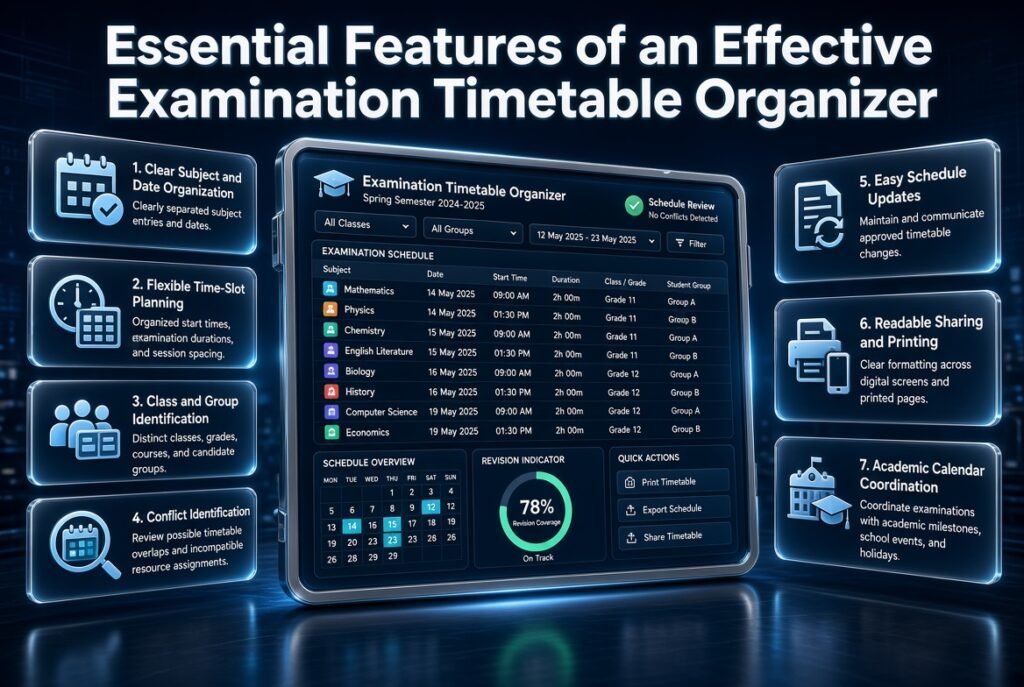
The most useful organizer is one that matches the user’s needs without adding unnecessary complexity. A student may need a simple subject-and-date list, while an institution may need a more detailed scheduling system.
Clear subject and date organization
Every examination should have a distinct entry with a recognizable subject name and date.
Use consistent date formats and avoid unexplained abbreviations. If the timetable covers several grades, identify each group clearly.
Flexible time-slot planning
A useful organizer should make it possible to review examination start times, durations, and gaps between sessions.
For institutions, flexibility is especially important when room capacity or staff availability restricts the available options.
Class and student-group identification
Separating grades, classes, courses, or candidate groups reduces the chance of students following the wrong schedule.
Where different groups have separate papers, label those assessments precisely.
Conflict identification
The organizer should support a review for overlapping examinations and incompatible resource assignments.
Some systems may offer automated checks, while simpler tools require manual inspection. Users should understand which checks are actually supported rather than assuming every organizer automatically detects every problem.
Easy updates
An examination schedule may change after it is drafted. The organizer should make updates manageable and help the responsible person communicate the approved information.
A change process is just as important as the initial schedule.
Readable sharing and printing
The final timetable should be easy to read on a computer, mobile device, or printed page.
Avoid unnecessarily small text, unclear labels, and layouts that split important information across several pages without a clear structure.
Coordination with academic activities
Examinations do not exist in isolation. Their dates may be affected by teaching periods, semester milestones, school events, and holidays.
A broader academic planning process helps administrators review these relationships before finalizing the schedule.
For example, Academic Planning and Scheduling Tools can be explored as a related resource when considering how examination arrangements fit into the institution’s wider planning needs.
Examination Timetable Organizer vs. Manual Spreadsheet
A manual spreadsheet and a dedicated organizer can both be useful. The right choice depends on the number of examinations, the complexity of the constraints, the available staff time, and the institution’s preferred workflow.
| Consideration | Manual spreadsheet | Dedicated organizer or scheduling tool |
|---|---|---|
| Initial setup | Often simple for small schedules | May require configuration |
| Customization | Flexible when users understand the spreadsheet | Depends on available features |
| Conflict checking | Usually requires deliberate checks or formulas | May offer supported scheduling checks |
| Multiple student groups | Possible but can become complex | May provide more structured organization |
| Updates | Can be straightforward in simple files | Depends on editing and approval features |
| Sharing | Requires careful version management | May support a more centralized workflow |
| Best use | Small or relatively simple schedules | More complex or recurring scheduling needs |
A spreadsheet is not inherently unreliable. With accurate data, clear ownership, and proper checks, it can work well for a small examination period.
The difficulty increases when many classes, rooms, and restrictions must be coordinated. In those cases, a structured scheduling workflow can reduce the manual effort required to compare options and review changes.
Before choosing a tool, determine which features are essential. Avoid paying for complexity that is unnecessary, but do not rely on a basic document if the scheduling requirements clearly exceed what it can manage safely.
How to Coordinate Examination Timetables With the Academic Calendar
An examination timetable should be reviewed alongside the institution’s academic calendar. This broader calendar provides the context needed to determine when examinations can take place and which dates may already be committed to other activities.
Check holidays and institutional closures
Before assigning dates, review official holidays, planned closures, and other periods when examinations cannot reasonably take place.
The Academic Holiday Calendar Builder is a related planning resource for organizing holiday information that may affect the examination period.
The relevant holiday information should be verified for the institution’s location and academic year. A calendar entry should not be treated as authoritative merely because it appears in an old template.
Review semester milestones
Examination periods may need to align with semester completion dates, coursework deadlines, results processing, and other academic milestones.
A Semester Milestone Calendar can help place examinations within the wider sequence of academic activities.
This is especially useful when the institution must complete assessments before a reporting deadline or the beginning of the next academic period.
Consider school events
Sports days, school functions, parent meetings, trips, and other activities may affect student availability, room use, or staff commitments.
Review the School Year Event Calendar as a related resource when checking the examination period against planned school activities.
Not every event necessarily prevents an examination. The purpose of the review is to identify genuine conflicts and make deliberate decisions rather than discover them after publication.
Coordinate examinations with regular class timetables
Regular lessons and examination sessions may require different arrangements, but they still share the institution’s time and resources.
A subject timetable can help administrators understand how subjects are normally distributed, while a class timetable shows when different groups use the available periods.
Related resources include the Subject Timetable Maker and the Class Timetable Grid Builder.
These tools serve different planning purposes from an examination timetable. Their value lies in helping users review the wider scheduling context rather than replacing examination-specific checks.
Common Mistakes to Avoid When Creating an Examination Timetable

Many examination scheduling problems arise because administrators focus on filling available dates before confirming whether the complete arrangement is workable.
Recognizing these mistakes early can prevent unnecessary revisions and improve the experience for students and staff.
Mistake 1: Creating the timetable before collecting complete information
Why it happens: Administrators may feel pressure to announce dates quickly.
Why it is harmful: Missing examination durations, student numbers, or room requirements can force major changes later.
How to avoid it: Collect requirements from all relevant departments before assigning the final dates. Identify missing information and resolve it early.
Mistake 2: Ignoring overlapping examinations
Why it happens: The timetable may be reviewed one subject at a time instead of from the perspective of each student group.
Why it is harmful: Students may be assigned two examinations at the same time, or rooms and staff may be double-booked.
How to avoid it: Check the complete schedule for student, room, equipment, and supervision conflicts before approval.
Mistake 3: Scheduling difficult examinations too close together
Why it happens: Available dates are prioritized without considering the combined workload.
Why it is harmful: Students may have limited preparation time between demanding assessments.
How to avoid it: Review examination sequences, subject requirements, and institutional rules. Adjust dates where feasible and appropriate.
Mistake 4: Forgetting holidays and school events
Why it happens: The examination schedule is prepared separately from the academic calendar.
Why it is harmful: An apparently available date may conflict with a closure or important institutional commitment.
How to avoid it: Check the approved academic calendar, holiday information, and relevant school events before assigning dates.
Mistake 5: Using unclear subject labels
Why it happens: Staff rely on familiar abbreviations or assume every student understands departmental terminology.
Why it is harmful: Students may misunderstand which course, class, or paper applies to them.
How to avoid it: Use clear subject names and identify the relevant class or course level. Explain necessary abbreviations.
Mistake 6: Publishing without a final review
Why it happens: A completed-looking timetable is mistaken for an accurate one.
Why it is harmful: Errors in dates, times, rooms, or instructions can affect many people.
How to avoid it: Use a checklist and, where possible, ask a second person to verify the schedule against the original requirements.
Mistake 7: Allowing multiple unofficial versions
Why it happens: Different departments share separate copies or make changes independently.
Why it is harmful: Students and staff may follow conflicting schedules.
How to avoid it: Maintain one approved version and use a defined process for publishing revisions.
Mistake 8: Ignoring accessibility and special arrangements
Why it happens: Standard scheduling requirements are considered before individual approved needs.
Why it is harmful: The resulting arrangements may not be suitable for every candidate.
How to avoid it: Include authorized accommodations and relevant room or timing requirements in the planning process while protecting confidential information.
Mistake 9: Making last-minute changes without reviewing their impact
Why it happens: A date is moved without checking all the other commitments attached to it.
Why it is harmful: A small adjustment may create a new conflict for another class or examination session.
How to avoid it: Review the affected schedule, obtain appropriate approval, update the official version, and communicate the change clearly.
Mistake 10: Treating the timetable as a complete revision plan
Why it happens: Students assume that knowing the examination date is enough to organize preparation.
Why it is harmful: They may underestimate the work required for a subject or leave revision until too late.
How to avoid it: Use the examination timetable as the foundation for a separate study plan that accounts for syllabus coverage, practice, and weaker topics.
Expert Advice for Building a Reliable Examination Timetable
A professional approach does not depend on making the timetable look complicated. It depends on collecting the right information, making defensible scheduling decisions, checking the result, and maintaining clear communication.
Schedule the most constrained examinations first
Not all examinations have the same scheduling flexibility.
An assessment that requires a specialist room, specific equipment, or a limited pool of supervisors may have fewer available time slots than a standard written paper.
Identify these constraints early. Place the least flexible examinations first, then arrange the remaining assessments around the available options.
This approach can reduce the number of changes required later.
Separate mandatory rules from preferences
Some scheduling requirements are non-negotiable. Others represent preferences that may be adjusted if necessary.
For example, a room’s maximum capacity is a practical constraint, while a preferred examination time may be negotiable depending on institutional policy.
Write these requirements down before preparing the timetable. Doing so makes it easier to explain why one arrangement is possible and another is not.
Use a structured review checklist
A checklist reduces reliance on memory and makes the review process repeatable.
Before approving the schedule, confirm:
- Every planned examination appears in the timetable.
- Subject names and class labels are accurate.
- Dates and weekdays match.
- Start times and durations are correct.
- Student-group conflicts have been reviewed.
- Rooms and equipment are suitable.
- Staff availability has been checked where required.
- Holidays and relevant school events have been considered.
- Approved special arrangements are addressed.
- The final version has an identifiable approval status.
The checklist should reflect the institution’s actual requirements. Add any mandatory checks that apply to the relevant examination system.
Keep the timetable and revision plan separate
Administrators need an official schedule that communicates examination arrangements. Students need a personal plan that explains how they will prepare.
Combining both into one crowded document can make each harder to use.
The official timetable should prioritize accuracy, clarity, and essential examination information. A personal revision planner can contain topic lists, practice sessions, revision priorities, and progress notes.
This separation keeps the examination schedule readable while giving students the flexibility to adapt their preparation.
Communicate changes deliberately
A timetable change is not complete simply because someone edits a file.
The responsible person should confirm the change, check its consequences, update the official schedule, and notify the people who need the information.
Where the change affects only one class or examination, communicate the relevant details clearly without creating unnecessary confusion for other groups.
⭐ Expert Tip: Establish a simple change log that records what changed, when it changed, and who approved it. This is particularly helpful when several departments are involved in the examination process.
Review the process after examinations finish
Once the examination period is over, evaluate what worked and what caused difficulty.
Ask teachers and coordinators whether the dates were practical, whether room arrangements were suitable, and whether the published information was easy to follow.
For students, consider whether the schedule allowed adequate preparation and whether any conflicts were reported.
Use the feedback to improve the next examination period. A short review can reveal recurring problems that would otherwise be repeated every term.
How do you create an effective examination timetable for students?
sequence while considering subject difficulty, student workload, available preparation time, and any scheduling restrictions. A well-organized timetable should be easy to understand and provide students with enough information to prepare without confusion.
Before finalizing the schedule, review all examination dates carefully to identify overlapping assessments and unrealistic gaps. Schools should also consider holidays, room availability, and other academic commitments that could affect the examination period.
Important points to consider:
List every subject and confirm its official examination date.
Check for overlapping examinations and scheduling conflicts.
Consider subject difficulty and reasonable preparation intervals.
Include examination times, durations, and relevant instructions.
Review and approve the timetable before sharing it with students.
What is the best way to organize multiple exams without timetable conflicts?
The most effective way to organize multiple examinations is to review the complete schedule rather than assigning dates to individual subjects without considering their relationships. Schools should identify which student groups are taking each examination, how long each assessment will last, and whether the same rooms, equipment, or supervisors are required for different sessions.
For example, if two subjects require the same group of students at the same time, one examination must be rescheduled or an approved alternative must be arranged. Similarly, a room should not be assigned to two examinations that take place simultaneously unless separate suitable spaces are available.
A structured review before publication helps prevent these problems from affecting students and staff.
Practical ways to prevent conflicts:
Check each student’s or class’s complete examination sequence.
Verify room capacity and equipment availability.
Review staff supervision assignments where applicable.
Schedule examinations with limited room or resource options early.
Keep a single approved timetable and review every change before publishing it.
How can students use an examination timetable organizer to improve exam preparation?
Students can use an examination timetable organizer to turn official examination dates into a realistic revision plan. Instead of preparing for subjects randomly, they can identify upcoming assessments, estimate the time needed for each subject, and divide their study sessions according to their preparation needs.
The most effective approach is to consider three factors: how soon the examination takes place, how much syllabus content remains, and how confident the student feels about the subject. A difficult examination scheduled several days later may still require attention now, particularly when the syllabus is extensive.
Students should also leave time for practice questions, reviewing mistakes, and revisiting difficult topics. A timetable works best when it supports consistent preparation rather than creating an unrealistic daily workload.
A practical revision strategy includes:
List examination dates in chronological order.
Identify difficult subjects and topics requiring additional work.
Divide large topics into manageable study sessions.
Include practice tests and regular revision breaks.
Update the personal study plan when preparation progress or official exam dates change.
What information should be included in a school examination timetable?
A school examination timetable should include all the information students and staff need to identify the correct examination and attend it at the appropriate time. At a minimum, this normally includes the examination date, subject name, and starting time. Class or grade details and examination duration should also be included whenever they are relevant.
For larger institutions, the timetable may need examination room assignments, reporting times, course identifiers, and special instructions. These details become particularly important when several grades or departments are taking examinations during the same period.
Clarity matters as much as completeness. Unexplained abbreviations, inconsistent date formats, and missing class labels can cause confusion even when the underlying schedule is correct.
Essential timetable details include:
Examination date and day.
Subject or course name.
Class, grade, or student group.
Starting time and examination duration.
Examination room or venue, where applicable.
Reporting instructions and approved special arrangements, when required.
Before publication, compare these details with the approved examination requirements to ensure that students receive accurate and consistent information.
Should schools use an examination timetable organizer or a manual spreadsheet?
The choice depends on the size of the institution, the number of examinations, and the complexity of the scheduling requirements. A manual spreadsheet can be effective for a small school or a limited examination period because it is flexible and allows staff to arrange dates, subjects, and times in a familiar format.
However, when several grades, rooms, supervisors, and assessment restrictions must be coordinated, maintaining the schedule manually can become more demanding. A dedicated examination scheduling tool may offer a more structured workflow and, depending on its features, support conflict checking and timetable updates.
Schools should evaluate the actual capabilities of a tool instead of assuming that every digital organizer automatically detects scheduling errors. Regardless of the method selected, the timetable must still be reviewed and approved by the responsible staff.
How to choose the right option:
Use a spreadsheet when the schedule is small and straightforward.
Consider a dedicated tool when multiple classes and resources must be coordinated.
Check whether conflict detection and revision tracking are supported.
Make sure the final timetable is easy to read, share, and update.
Establish clear responsibility for approving and communicating changes.
The best solution is the one that meets the institution’s requirements while keeping examination planning accurate, manageable, and easy for students and staff to follow.
Conclusion
An Examination Timetable Organizer is an essential planning resource for students, teachers, and school administrators who want to manage examinations more efficiently. By organizing examination dates, subjects, time slots, and assessment requirements in one clear schedule, it becomes easier to prevent timetable conflicts, improve communication, and help students prepare with greater confidence.
Creating an effective examination timetable requires more than assigning dates to different subjects. Schools must consider the academic calendar, examination duration, student workload, room availability, and other scheduling restrictions before publishing the final version. Regular reviews and clear communication also help ensure that everyone follows the latest approved schedule.
For students, an organized examination timetable provides a practical foundation for building a realistic revision plan, prioritizing difficult subjects, and distributing study time more effectively. For educational institutions, it supports better coordination and reduces the administrative difficulties that often arise during busy examination periods.
The best approach is to start with accurate information, use a clear scheduling format, check for potential conflicts, and keep the timetable updated whenever approved changes occur. By making examination planning a consistent part of academic management, schools can create a more organized and predictable assessment experience.
Explore RTI Scheduler to learn more about academic planning and scheduling resources that can support a structured approach to educational activities. A well-prepared examination timetable is not just a list of dates; it is a practical step toward better preparation, smoother administration, and a more confident examination experience.