
Introduction
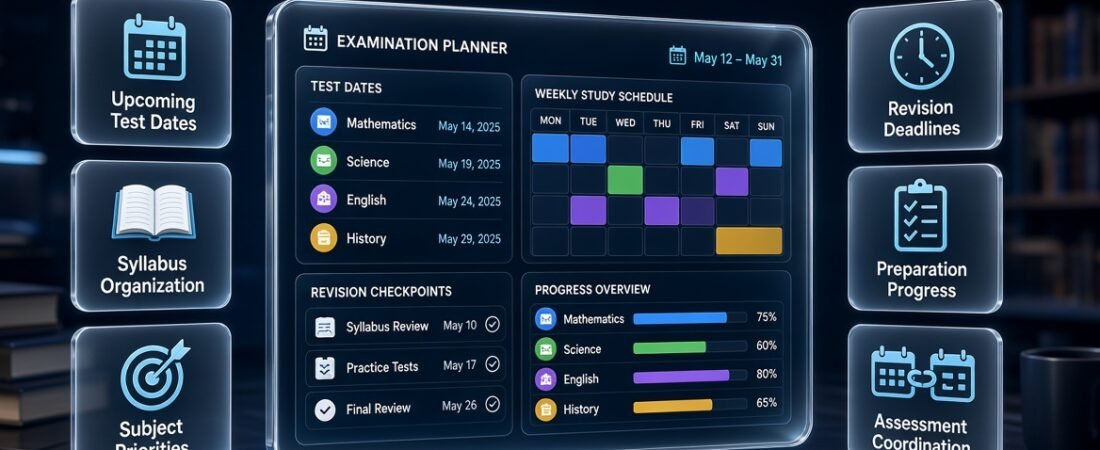
Test Date Timetable Planner | Managing several test dates can become challenging when students huctionave different subjects to study, assignments to complete, and limited time to prepare. A mathematics test may be approaching while a science assessment is scheduled for the following day. Without a clear plan, students can easily spend too much time on one subject and leave another until the last minute. A test date timetable planner helps organize these academic responsibilities into a practical schedule that is easier to understand and follow.
A well-organized planner does more than record examination dates. It connects each test with its syllabus, preparation deadlines, revision sessions, and progress checkpoints. This allows students to understand what needs attention first and helps teachers arrange assessments without creating unnecessary scheduling conflicts.
The process becomes even more useful when the timetable is connected to a wider academic calendar. Students can plan around school holidays, teachers can coordinate classroom assessments, and academic coordinators can monitor important dates throughout the term. For more organized academic planning, RTI Scheduler provides the broader context for managing educational schedules and related planning activities.
This guide explains how to create a practical test date timetable, distribute revision time across multiple subjects, coordinate assessments, avoid common planning mistakes, and maintain a reliable schedule. Whether you are a student preparing for weekly tests or a teacher organizing examinations for several classes, you will learn how to build a timetable that supports preparation instead of adding more pressure.
What Is a Test Date Timetable Planner?
A test date timetable planner is a scheduling tool that organizes upcoming assessments by date, subject, time, and preparation requirements. It helps students and teachers understand when tests will happen, what material needs to be covered, and which academic responsibilities require attention first.
A basic planner may contain only subject names and test dates. A more detailed version can include syllabus information, revision deadlines, priority levels, preparation status, and reminders.
For example, a student preparing for mathematics, English, science, and history tests can use one planner to see which examination comes first and how much time remains before each assessment. Instead of relying on memory or scattered classroom notes, the student has a single reference for upcoming tests.
Teachers can use the same approach for classroom quizzes, monthly assessments, practical examinations, and term tests. However, their planning responsibilities may also include classroom availability, assessment duration, marking arrangements, and coordination with other teachers.
How Is It Different From a Regular Exam Timetable?
A regular exam timetable generally communicates when and where an examination will take place. A test date timetable planner can include that information while also helping users organize the preparation required before each test.
The distinction is important because knowing an examination date does not automatically create a workable study routine.
Consider a student whose science test is scheduled for Thursday. The official exam timetable provides the date, while the planner can assign separate sessions for reviewing concepts, practising questions, and correcting mistakes before Thursday arrives.
The two tools can work together. The official timetable establishes the confirmed assessment details, while the planning document helps the student manage the work leading up to the examination.
How to Organize an Examination Timetable Without Scheduling Conflicts
Schools, colleges, and universities need a reliable examination timetable to coordinate subjects, examination dates, session timings, and student groups. Begin by listing all required examinations and assigning suitable dates based on the academic calendar. Make sure students have sufficient preparation time between papers and avoid overlapping examinations for the same class or group. Administrators should also check classroom availability, examination duration, invigilator assignments, and other institutional activities before finalizing the schedule. A properly organized timetable improves communication between teachers and students, reduces scheduling confusion, and makes examination management more efficient.
For easier examination planning, explore this resource 👉 Examination Timetable Organizer
This tool helps organize examination dates, coordinate subject-wise schedules, manage exam sessions, and maintain a structured timetable throughout the academic term.
Why Is a Test Date Timetable Planner Important?
A test date timetable planner makes academic responsibilities easier to manage by turning scattered deadlines into an organized sequence. It helps students prepare earlier, recognize busy periods, and decide how to use their available study time.
Without a structured schedule, students may concentrate entirely on the nearest test. Although this approach can seem reasonable, it becomes less effective when several assessments are scheduled within the same week.
A planner provides a broader view of the academic workload.
It Helps Students Prepare Before Deadlines Become Urgent
One of the main advantages of planning is the opportunity to begin revision before an assessment becomes an immediate concern.
Suppose a student has a mathematics test on Wednesday and a biology test on Friday. If biology preparation starts only after the mathematics test, the student may have little time to review difficult topics.
A timetable can reserve short biology sessions earlier in the week while keeping mathematics as the main priority. This allows both subjects to receive attention without requiring every revision task to happen at the last minute.
It Makes Priorities Easier to Identify
Students do not always need the same amount of preparation for every subject. A familiar topic may require a brief review, while a difficult chapter may need several sessions of explanation, practice, and correction.
A useful planner helps students consider:
- The number of days remaining before each test.
- The amount of material included in the assessment.
- The student’s current understanding of the subject.
- The difficulty of the topics being tested.
- Other examinations and assignments scheduled nearby.
These details help students make more informed decisions about which tasks deserve the most attention.
It Improves Communication Between Teachers and Students
Teachers can publish assessment dates in a shared calendar so that students know what is expected of them. Parents can also use the schedule to understand upcoming tests and help children establish suitable preparation routines.
For schools, a common assessment calendar reduces the risk of conflicting information being circulated through separate messages or handwritten notes.
The most useful arrangement is one in which everyone knows where to find the latest confirmed dates.
What Information Should a Test Date Timetable Include?
A practical test date timetable should contain enough information to guide preparation without becoming unnecessarily complicated. The exact details depend on whether the planner is intended for one student, a classroom, or an entire school.
| Information | Why it matters |
|---|---|
| Subject name | Identifies the assessment |
| Test date | Establishes the confirmed deadline |
| Test time | Helps students plan around other commitments |
| Syllabus coverage | Clarifies which topics require preparation |
| Preparation start date | Indicates when revision should begin |
| Priority level | Highlights assessments needing extra attention |
| Preparation status | Shows which tasks remain incomplete |
| Location or classroom | Helps students identify where the test will occur |
| Instructions | Records special requirements or permitted materials |
| Notes | Stores useful information that does not fit other fields |
Not every planner requires all these details. A younger student may benefit from a simple weekly calendar, whereas a school administrator coordinating several classes may need more comprehensive assessment records.
Keep Confirmed Information Separate From Tentative Dates
A common source of confusion is treating a proposed test date as final before the school has confirmed it.
If an assessment date is provisional, label it clearly. Once the teacher or school confirms the date, update the planner and communicate the final information through the appropriate channel.
This is especially important when examination arrangements depend on room availability, academic events, or changes to the school calendar.
Pro Tip: Use one consistent date format throughout the planner. Adding the day of the week can also help students recognize scheduling errors before they become a problem.
How to Create a Test Date Timetable Planner Step by Step
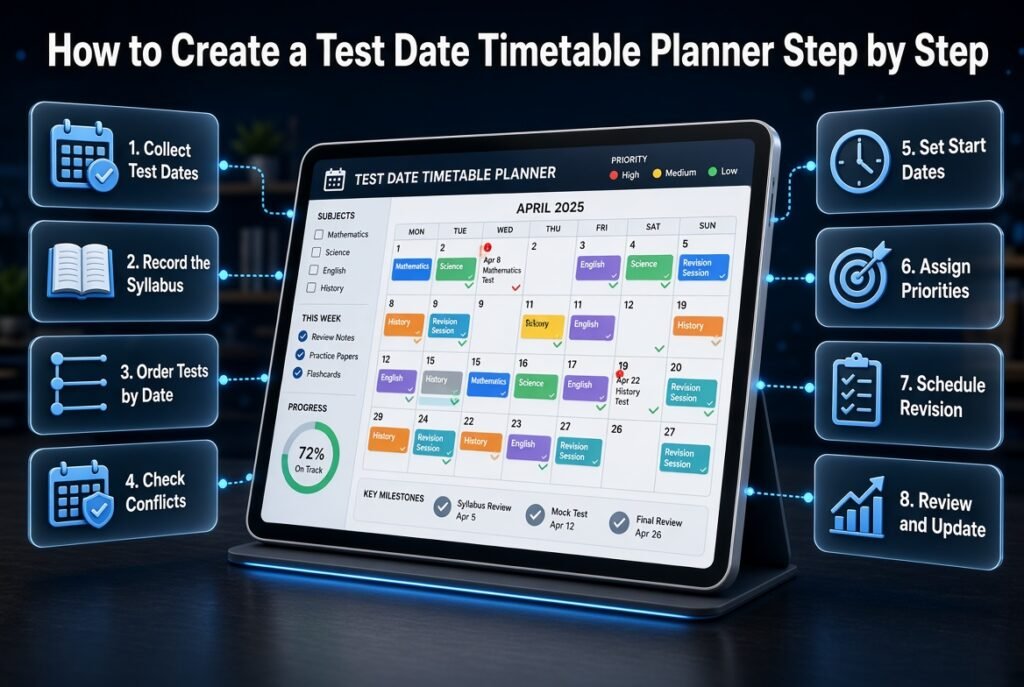
Creating an effective planner begins with accurate assessment information. After collecting the relevant dates, organize the tests, review possible conflicts, and connect each assessment to a realistic preparation plan.
Step 1: Collect Every Known Assessment Date
Start by reviewing the official sources that contain your examination information. These might include classroom announcements, school notices, course outlines, or the school’s established communication system.
Record all relevant assessments before assigning revision sessions. This prevents you from building a study plan around one subject while overlooking another examination scheduled during the same period.
Include the following where applicable:
- Weekly classroom tests.
- Subject quizzes.
- Monthly assessments.
- Midterm examinations.
- Practical tests.
- Mock examinations.
- Final examinations.
- Major assignment deadlines that compete for study time.
If a test date or syllabus has not been confirmed, record the uncertainty rather than making an assumption.
For teachers, this step may also involve collecting assessment plans from colleagues and checking whether the proposed dates fit the school’s academic requirements.
Step 2: Record the Syllabus for Each Test
A test date alone does not tell students how much preparation is necessary. Recording the syllabus helps them estimate the work involved and identify difficult topics early.
For each subject, note the chapters, units, skills, or practical activities that will be assessed.
For example, a science test might cover two chapters and a set of diagrams. A mathematics test may focus on equations and problem-solving methods. Although both assessments take place during the same week, their preparation requirements may be very different.
If the syllabus is unclear, ask the teacher for confirmation before creating a detailed revision plan.
Step 3: Arrange Tests in Chronological Order
Place the earliest assessment first and organize the remaining tests by date.
A chronological schedule makes it easier to see which deadlines are approaching and how assessments are distributed across the week.
You can use a simple list, a weekly calendar, or a monthly view. Choose the format that allows you to identify busy periods quickly.
For larger academic schedules, the Exam Schedule Generator is a relevant resource within a broader examination-planning workflow.
Step 4: Check for Scheduling Conflicts
Review the complete timetable instead of checking each assessment individually.
For students, a conflict might involve two tests scheduled at the same time or several demanding examinations placed on consecutive days.
For schools, the review may also include classroom availability, invigilator assignments, laboratory requirements, and overlapping examinations for different classes.
Suppose a class has major mathematics, science, and history assessments scheduled within three days. The school may need to determine whether the dates are necessary or whether an adjustment would create a more manageable workload.
Not every demanding week can be avoided, but identifying the pressure points early allows better decisions.
Step 5: Set a Preparation Start Date
After confirming the test date, decide when preparation should begin.
The appropriate start date depends on the assessment’s difficulty, the amount of material covered, and how well the student understands the subject.
A short quiz may require a limited review period. A major examination covering several units may need preparation spread across multiple weeks.
For example, a student preparing for a Friday mathematics test could organize the week as follows:
- Monday: Review concepts and formulas.
- Tuesday: Solve practice questions.
- Wednesday: Focus on difficult problems.
- Thursday: Complete a short practice test and correct mistakes.
- Friday: Review key points before the assessment, where appropriate.
This is an example rather than a fixed formula. Students should adjust the schedule according to their individual needs.
Step 6: Assign Priority Levels
Not every assessment should receive equal study time.
A subject with difficult material may deserve more preparation than a familiar subject, even when both tests are scheduled for the same week.
Use a simple priority system:
| Priority | Typical situation | Suggested response |
|---|---|---|
| High | Difficult material or major test approaching | Begin early and schedule focused sessions |
| Medium | Moderate difficulty or partly completed preparation | Maintain regular revision |
| Low | Familiar material or a short assessment | Schedule a brief review |
Priority should reflect both urgency and importance. A difficult test scheduled several days later may require attention before an easy quiz happening tomorrow.
Step 7: Add Specific Revision Activities
Once priorities are clear, assign individual preparation tasks to available study periods.
Instead of writing “study English,” write “review grammar rules and complete ten practice questions.” Instead of writing “prepare science,” specify the chapter or concept you need to understand.
Specific tasks make progress easier to measure and reduce the time spent deciding what to study.
Useful activities include reviewing notes, practising questions, recalling important information without looking at the textbook, completing sample papers, and correcting errors.
Keep each session manageable. If a task repeatedly takes longer than expected, divide it into smaller activities and adjust the remaining schedule.
Step 8: Add Reminders and Progress Checkpoints
Reminders can help students begin preparation at the right time and avoid forgetting important dates.
Depending on the planner, reminders may be digital notifications, written notes, or checklist items.
Useful checkpoints include:
- Preparation start date.
- Completion of the first topic.
- Practice-question session.
- Review of difficult concepts.
- Final readiness check.
- Test date and time.
Avoid adding so many reminders that they become difficult to manage. The purpose is to support attention, not create another source of distraction.
Step 9: Review the Timetable Regularly
A test date timetable should be updated whenever official information changes.
If a test is postponed, move the date and reconsider the related revision sessions. If preparation is completed early, use the remaining time for another priority.
Review the schedule at least once a week and whenever a teacher announces a change.
This keeps the planner connected to actual circumstances rather than allowing it to become an outdated record.
How to Balance Multiple Subjects in One Test Timetable

A balanced timetable distributes preparation across subjects according to their requirements. It should not force students to spend exactly the same amount of time on every subject when their learning needs are different.
The goal is to prepare consistently without allowing one examination to consume all available study time.
Use a Weekly View to Identify Busy Days
A weekly calendar shows where tests, revision sessions, and other commitments overlap.
Consider this illustrative example:
| Day | Main academic responsibility | Additional preparation |
|---|---|---|
| Monday | Mathematics revision | Review science concepts |
| Tuesday | English test | Practise mathematics problems |
| Wednesday | Mathematics test | Prepare history notes |
| Thursday | Science test | Review history questions |
| Friday | History test | Check the following week’s deadlines |
The schedule assumes that these are the student’s actual test days and that the listed activities fit their available time. In practice, preparation for each assessment should begin earlier whenever the syllabus requires it.
The benefit of the weekly view is that students can identify crowded periods before they arrive.
How to Create and Manage an Effective Exam Session Calendar
Schools, colleges, and universities need a structured exam session calendar to coordinate examination dates, subject schedules, session timings, and student groups. Start by listing all planned examinations and assigning suitable dates and time slots according to the academic calendar. Make sure students have enough preparation time between different sessions and avoid overlapping examinations for the same group. Administrators should also consider classroom availability, invigilator assignments, examination duration, and other institutional activities before finalizing the calendar. A well-organized exam schedule improves communication, reduces administrative confusion, and helps teachers and students prepare for upcoming assessments.
For easier examination planning, explore this resource 👉 Exam Session Calendar Builder
This tool helps organize examination dates, coordinate exam sessions, manage academic schedules, and maintain a clear overview of upcoming assessments throughout the academic term.
Avoid Studying Only the Subject Being Tested Tomorrow
Preparing for the nearest test is important, but completely ignoring later assessments can create unnecessary pressure.
Reserve some preparation time for the next demanding examination while maintaining focus on the immediate priority.
For example, a student preparing for a mathematics test on Wednesday might spend most of Monday’s study time on mathematics but use a short session to review science material for Thursday.
The exact balance depends on how much work each subject requires.
Include Breaks and Other Responsibilities
A realistic timetable accounts for school hours, meals, family responsibilities, travel, and sleep.
Do not assume that every hour outside school is available for revision. A schedule that ignores normal daily commitments may look impressive but become difficult to follow.
Use focused sessions that fit the student’s age, concentration, and subject requirements. If the plan repeatedly fails, reconsider the workload instead of treating every unfinished task as a personal failure.
Expert Tip: Leave some unallocated time during the week. A flexible period can accommodate an unexpectedly difficult topic or an assignment that takes longer than expected.
How Teachers Can Use a Test Date Timetable Planner
Teachers need to coordinate assessments with lesson progress, student workload, classroom availability, and school requirements. A shared timetable can make these responsibilities easier to manage.
Coordinate Tests Across Different Subjects
When teachers plan assessments independently, several major tests may end up in the same week.
A shared assessment calendar allows teachers to review proposed dates before finalizing them. If the school has flexibility, they can distribute major assessments more evenly.
For example, a coordinator may discover that mathematics, science, and social studies tests are all planned for Wednesday. Moving one assessment to another suitable date could improve the overall schedule.
The objective is not to remove every challenging week. It is to avoid preventable conflicts when reasonable alternatives exist.
Confirm That Teaching Has Covered the Required Material
An assessment should be scheduled with the intended syllabus and teaching progress in mind.
Before finalizing a date, teachers should verify that students will have a reasonable opportunity to learn the required material. If a unit has fallen behind schedule, the assessment plan may need review.
This does not mean that every student must feel completely confident before a test. It means that the timetable should reflect the actual teaching plan rather than an assumption that all content has already been covered.
Check Rooms, Equipment, and Staff Availability
Some assessments require more preparation than ordinary classroom quizzes.
Practical examinations may need laboratories or specialist equipment. Large examinations may require suitable rooms and invigilators. Computer-based assessments may depend on device availability.
Before confirming a date, check the resources required for the examination.
A scheduling review should consider room availability, test duration, staff responsibilities, student groups, and any relevant accessibility arrangements.
Coordinate Assessments With the Academic Calendar

A school test timetable should fit within the wider academic year.
Holidays, term dates, school events, and non-teaching days can affect when lessons are delivered and when assessments can take place.
Academic Calendar Planning is relevant when organizing major academic dates across a term. The Academic Holiday Calendar Builder can support the process of accounting for holidays and non-teaching days.
For longer planning periods, the Semester Milestone Calendar can help place assessments alongside other important academic milestones.
These resources address different parts of academic planning, so the appropriate approach depends on whether you are organizing individual tests, term-wide dates, or school holidays.
Publish One Clear, Updated Timetable
After dates have been reviewed and approved, communicate the final timetable through the school’s established channels.
Include relevant instructions and make it clear where students can find updates. If a test is postponed, communicate the revised date and identify the affected assessment.
Teachers should avoid relying on several informal messages that may leave students with different versions of the schedule.
Digital vs. Paper Test Date Timetable Planners
Digital and paper planners can both support effective assessment planning. The best option depends on how frequently dates change, how many people need access, and whether reminders or shared updates are important.
| Feature | Digital planner | Paper planner |
|---|---|---|
| Updating dates | Usually quick to edit | Requires manual changes |
| Reminders | May support notifications | Usually relies on visual checking |
| Sharing | Can support shared access | Copies may need distribution |
| Internet access | Depends on the application | Not required |
| Customization | Depends on available features | Easy to personalize by hand |
| Best use | Shared schedules and frequent updates | Simple personal organization |
When Should You Use a Digital Planner?
Digital planning can be useful when assessments change frequently or when several teachers need access to a common calendar.
Depending on the software, digital calendars may offer notifications, recurring events, and sharing options. Users should verify the available features rather than assuming every application supports the same functions.
For a wider approach to educational scheduling, Academic Planning and Scheduling Tools is relevant to the organization of academic activities beyond individual tests.
When Is a Paper Planner More Suitable?
A paper planner can be convenient for students who prefer writing tasks by hand or keeping a visible timetable near their study area.
It can include subject names, test dates, revision tasks, and checkboxes for completed work. Students can also use simple colours to distinguish subjects or highlight important assessments.
The main limitation is that updates require manual changes. Students should check their paper planner against the official school schedule whenever a test date changes.
Can You Use Both Methods Together?
Yes. A combined approach can work well when the school publishes confirmed dates digitally but the student prefers planning revision on paper.
Use the official calendar as the source of confirmed assessment information. Then use a personal planner to organize study sessions.
Whenever a date changes, update the personal schedule as well. This prevents two planning systems from gradually becoming inconsistent.
How to Connect a Test Date Planner With a Weekly Class Schedule
Test preparation does not happen separately from ordinary school activities. Students also attend lessons, complete homework, participate in practical sessions, and manage other commitments.
Connecting assessment dates with a weekly class schedule makes it easier to identify realistic study periods.
Identify Available Study Periods
Begin by reviewing the student’s regular weekly routine.
Record school hours, travel time, recurring activities, and other fixed commitments. The remaining periods can then be considered for revision.
Avoid filling every available period automatically. Some flexibility is necessary because difficult topics, assignments, and unexpected changes may require additional time.
A Weekly Lesson Period Planner can support the organization of recurring lesson periods. A Subject Timetable Maker can help organize subjects within a weekly schedule.
These tools have different planning purposes from an assessment calendar, but the information can complement the student’s test preparation routine.
Organize Subjects According to Their Needs
A weekly class timetable helps students see when each subject is taught, but the amount of independent revision required may differ.
If a student struggles with a mathematics topic introduced during the week, a short review soon after the lesson may be useful. A subject requiring extensive memorization may need separate review sessions across several days.
Use the test timetable to identify upcoming priorities and the weekly class schedule to locate suitable preparation periods.
How to Organize an Effective Assessment Sitting Schedule
Schools, colleges, and universities need a well-structured assessment sitting schedule to manage examination sessions, student groups, room assignments, and invigilation responsibilities. Start by identifying all assessments, assigning suitable dates and time slots, and organizing students according to their classes or examination groups. Administrators should also consider room capacity, assessment duration, invigilator availability, and possible scheduling conflicts before finalizing the arrangements. A properly planned schedule helps students know when and where to attend their assessments while allowing examination staff to manage their duties efficiently. It also reduces confusion and improves coordination throughout the examination period.
For better assessment planning, explore this resource 👉 Assessment Sitting Schedule
This tool helps organize assessment sessions, coordinate student groups, manage examination arrangements, and maintain a clear schedule throughout the academic term.
Keep the Daily Plan Manageable
A student may have several hours between school and bedtime, but not all of that time should be assigned to academic tasks.
Choose a small number of meaningful study activities and estimate how long they are likely to take. If the workload is too large, prioritize the tasks that most directly support upcoming assessments.
A consistent routine is easier to maintain when it reflects the student’s real schedule.
Common Mistakes to Avoid When Creating a Test Date Timetable
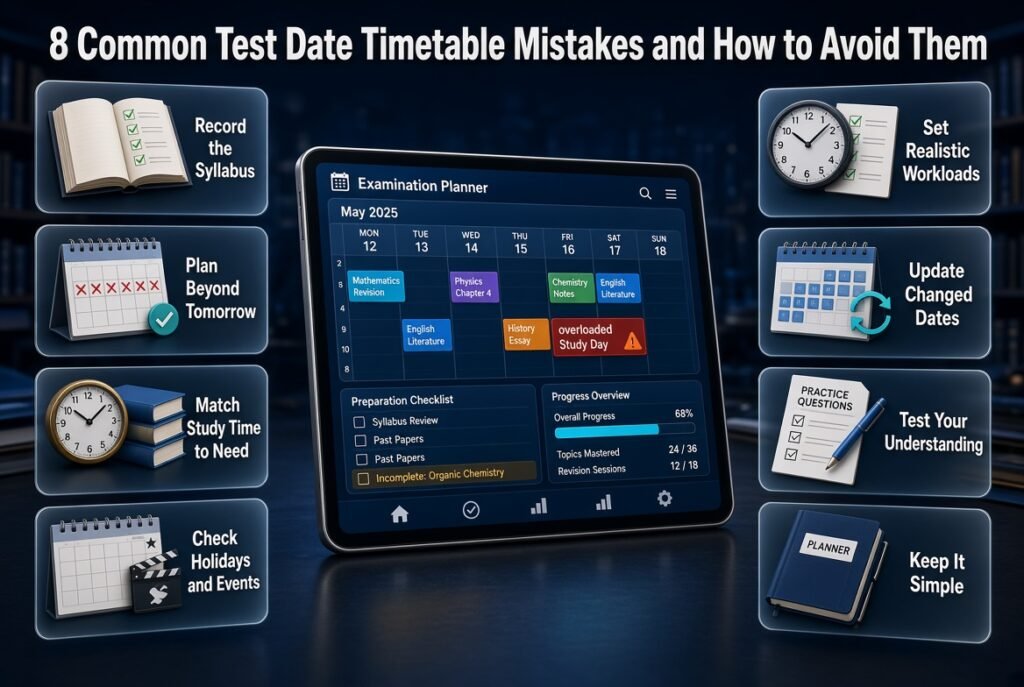
A planner can appear organized while still failing to support preparation. The most common problems arise when users record dates but overlook syllabus details, realistic workload estimates, or regular updates.
Mistake 1: Recording Test Dates Without the Syllabus
Why it happens: Test dates are often announced before students have collected all the syllabus details.
Why it causes problems: Students may underestimate how much material they need to prepare and begin revision too late.
How to avoid it: Record the confirmed topics for each assessment. If the syllabus is unavailable, mark it for confirmation rather than guessing.
Mistake 2: Preparing Only for the Nearest Test
Why it happens: The closest deadline naturally attracts attention.
Why it causes problems: Later assessments may become urgent while the student is still recovering from the first examination.
How to avoid it: Give the nearest test the appropriate priority while scheduling initial preparation for later, demanding assessments.
Mistake 3: Giving Every Subject Identical Study Time
Why it happens: Equal time allocations seem fair and easy to organize.
Why it causes problems: Subjects differ in difficulty, syllabus length, and the student’s current understanding.
How to avoid it: Allocate time according to actual learning needs and review progress as the test approaches.
Mistake 4: Ignoring Holidays and School Activities
Why it happens: The planner is created from examination dates without checking the wider academic calendar.
Why it causes problems: Preparation periods may be unavailable, and assessments may conflict with closures or school events.
How to avoid it: Review the academic calendar before finalizing the timetable and adjust the plan around confirmed commitments.
Mistake 5: Creating an Unrealistic Daily Workload
Why it happens: Students try to fit every unfinished task into a limited period.
Why it causes problems: Repeatedly missing tasks can make the timetable frustrating and difficult to maintain.
How to avoid it: Estimate task duration, reduce unnecessary activities, and leave space for unexpected delays.
Mistake 6: Forgetting to Update Changed Dates
Why it happens: Students continue using an older timetable after a teacher announces a change.
Why it causes problems: They may prepare for the wrong date or miss an examination.
How to avoid it: Check the official announcement, update the main timetable, and correct any personal copies.
Mistake 7: Assuming That Finishing a Chapter Means Being Ready
Why it happens: Completing the reading creates a sense of progress.
Why it causes problems: Students may discover gaps when they attempt examination questions.
How to avoid it: Include practice questions, self-testing, and error correction. Use the results to decide whether a topic requires additional review.
Mistake 8: Making the Planner Too Complicated
Why it happens: Users add too many colours, categories, reminders, and tracking fields.
Why it causes problems: Maintaining the planner becomes a task in itself.
How to avoid it: Begin with the essential information and add features only when they solve a specific planning problem.
Expert Tips for Maintaining a Reliable Test Date Timetable
A dependable timetable requires accurate information, realistic preparation goals, and regular review. The following practices can make the schedule more useful over an entire term.
Schedule Restricted Assessments First
Some examinations have limited scheduling flexibility. Laboratory assessments, tests requiring specialist rooms, and externally scheduled examinations may need to be arranged before more flexible classroom quizzes.
Identify these requirements early so that flexible assessments do not occupy time slots needed for restricted examinations.
Review the Timetable From the Student’s Perspective
Teachers may consider their individual assessments manageable without seeing the full workload across all subjects.
Before finalizing a school timetable, review how many major assessments students face during the same week. Consider project deadlines, practical tests, and other demanding academic activities.
Where possible, distribute major assessments across suitable dates.
Build Preparation Buffers Into the Plan
A preparation buffer is extra time reserved for difficult topics, unexpected delays, or changes to the schedule.
For example, a student might aim to complete a difficult chapter two days before an examination rather than on the evening immediately before it.
If the topic takes longer than expected, the student still has time to ask questions or practise additional problems.
Use Assessment Results to Improve Future Planning
After each test, identify which topics were understood well and which caused difficulty.
Use that information when preparing for future assessments in the same subject. If a student consistently struggles with particular concepts, those topics may need earlier attention in the next study cycle.
The purpose is to improve how preparation time is used rather than simply increasing the total number of study hours.
Keep the Planner Connected to the Class Schedule
Assessment preparation should take account of ordinary lesson periods and teaching progress.
A Student Class Period Organizer can help organize a student’s class periods, while the Class Timetable Grid Builder can support the creation of a structured class timetable.
These resources are relevant when the planning challenge extends beyond test dates to the organization of the student’s broader academic routine.
Coordinate Tests With Other School Events
School events can affect teaching time, classroom availability, and student preparation.
A School Year Event Calendar can help schools organize important events across the academic year so assessment dates can be reviewed in the context of other commitments.
This is particularly useful when planning several weeks or months ahead.
Use a Reliable Source for Final Dates
Choose one official location where students can check confirmed test dates. Personal study planners should be updated from that source whenever changes occur.
A shared reference reduces confusion and makes it easier for students, teachers, and parents to work from consistent information.
For a broader view of the available planning approach, visit RTI Scheduler when reviewing how assessment scheduling fits into wider academic organization.
How to Choose the Right Test Date Timetable Planner
The best planner is one that suits the user’s workload and can be maintained consistently. A student with a few weekly quizzes may need only a simple calendar, while a school coordinating assessments across multiple classes may require a more detailed system.
Ease of Use
The planner should make it straightforward to add a test, identify upcoming deadlines, and update information.
If the layout is difficult to understand, users may stop maintaining it. Begin with essential fields and introduce additional details only when they provide practical value.
Flexibility
Test dates can change because of school closures, staffing issues, or administrative decisions.
Choose a format that allows dates and preparation tasks to be updated without unnecessary effort. Consider how you will communicate changes if several people rely on the same timetable.
Visibility
Students should be able to see upcoming assessments quickly.
A weekly view may work well for a personal revision plan, while a monthly or term-wide view may be more useful for teachers and academic coordinators.
Reminder Requirements
If users regularly forget deadlines, reminders may be helpful. Digital notifications can support preparation, while a visible paper timetable may work better for students who prefer handwritten planning.
The method matters less than whether users check it consistently.
Suitability for Individual or Shared Use
A personal planner can be managed by one student. A shared school timetable requires clearer responsibility for updates, consistent communication, and access to the latest information.
Consider how many users need the schedule and how often changes are expected before deciding which format is appropriate.
What Is a Test Date Timetable Planner, and How Does It Help Students Prepare for Exams?
A test date timetable planner is a planning tool that helps students organise upcoming tests, assignment deadlines, revision sessions, and examination dates in one clear schedule. Instead of relying on memory or keeping important dates in scattered notes, students can see what is coming next and decide how much preparation each assessment requires. A well-organised planner also makes it easier to balance several subjects without leaving difficult topics until the last minute.
The main benefit is that it connects each test date with a practical preparation plan. For example, if a mathematics test is scheduled for Friday and a science test is scheduled for the following Monday, a student can divide revision time between both subjects rather than studying only the nearest test. Teachers can also use a timetable planner to coordinate class tests, avoid unnecessary clashes, and communicate assessment dates more clearly.
Key benefits include:
Clear exam visibility: Keep test dates, subjects, and deadlines organised in one place.
Better preparation: Divide the syllabus into manageable revision tasks before each test.
Improved time management: Balance schoolwork, homework, revision, and personal commitments.
Fewer scheduling conflicts: Identify overlapping tests and heavily loaded assessment days early.
Reduced last-minute pressure: Build in time for practice questions, review, and unfinished topics.
A planner works best when students update it regularly and use it as a guide for daily preparation, not simply as a list of dates.
How Do I Create an Effective Test Date Timetable for Multiple Subjects?
Creating an effective test date timetable starts with collecting accurate assessment information. List every upcoming test, the subject, the confirmed date, the syllabus or chapters included, and any special instructions from the teacher. Once the details are recorded, arrange the tests chronologically so you can identify which assessments are approaching first and which subjects need additional preparation.
The next step is to estimate the amount of work required for each subject. A test covering two familiar chapters may need less preparation than a science assessment involving several difficult concepts or a mathematics test requiring extensive problem-solving practice. Give more preparation time to subjects where your understanding is weaker, but continue reviewing other subjects so that earlier learning is not forgotten.
After setting priorities, divide the available days into realistic study sessions. Avoid scheduling every subject for long periods on the same day. Shorter, focused sessions with breaks are often easier to maintain, particularly when students also have regular classes and homework. Leave some time for practice questions and a final review before each test.
A practical planning method is to:
Record all confirmed test dates and syllabus requirements.
Rank subjects according to urgency, difficulty, and preparation needs.
Divide large topics into smaller revision tasks.
Assign specific subjects or topics to individual study sessions.
Reserve time for practice tests and reviewing mistakes.
Keep a buffer session for unfinished work or unexpected changes.
Review the timetable weekly and adjust it according to actual progress.
For example, if a student has tests in English, mathematics, and biology during the same week, the timetable should not allocate equal time automatically. Mathematics may need more problem-solving practice, while biology may require diagrams, definitions, and active recall. The most effective schedule reflects the work each subject genuinely requires.
How Can a Test Date Timetable Planner Prevent Exam Clashes and Scheduling Problems?
A test date timetable planner can help identify potential conflicts before they become difficult to manage. When assessment dates are recorded together, students and teachers can quickly see whether two tests are planned for the same time, whether several demanding assessments fall on consecutive days, or whether a class has too many tests scheduled within a short period.
For teachers and academic coordinators, this is particularly useful when multiple subjects, classes, or year groups are involved. A test that appears convenient for one teacher may overlap with another subject’s assessment or create an unreasonable workload for students. Reviewing the complete schedule before confirming dates helps staff make better-informed decisions.
However, a planner can only identify conflicts based on the information entered. Schools should verify dates, class groups, examination periods, and any institutional rules before publishing a final timetable. If a clash is found, the responsible teacher or coordinator should confirm the revised date and communicate the change to everyone affected.
To reduce timetable conflicts:
Enter all known tests before finalising individual subject schedules.
Check for two assessments assigned to the same date or time.
Review whether students face several demanding tests on consecutive days.
Confirm room, class, or supervision requirements when relevant.
Coordinate changes with the teachers or administrators responsible.
Share the final version clearly and identify which timetable is current.
Recheck the schedule after any date or assessment change.
For students, it is also important to distinguish between an official test timetable and a personal revision timetable. The official timetable records when assessments will take place; the personal timetable explains when and how to prepare. Keeping both aligned helps students organise their work without accidentally confusing a revision target with the actual examination date.
How Far in Advance Should I Make a Test Date and Revision Timetable?
The ideal time to prepare a test date timetable depends on the number of subjects, the size of the syllabus, and how much notice students receive. For a major examination period, planning several weeks in advance usually provides more flexibility than waiting until the final few days. For a short classroom quiz, a simpler plan covering the days before the test may be enough.
The most important principle is to begin planning as soon as assessment dates are confirmed. Early planning gives students time to identify weak areas, divide the syllabus into manageable sections, and arrange revision around normal classes and other responsibilities. It also allows teachers to spot crowded assessment periods and make adjustments before students have built their preparation around the original dates.
A useful timetable should include more than the day immediately before a test. Students need time to understand difficult concepts, practise relevant questions, check their progress, and revisit material they previously found challenging. Leaving all revision until the last evening can create unnecessary pressure and may leave important topics unfinished.
For better advance planning:
Start with the official test dates and work backwards from each assessment.
Set weekly targets for large syllabuses and daily targets for specific topics.
Begin difficult subjects earlier instead of relying on last-minute revision.
Schedule practice questions before the final review session.
Keep the day before a test relatively flexible for revision and preparation.
Review the timetable every week, especially when teachers announce changes.
Avoid filling every available hour; realistic plans need breaks and spare time.
There is no single timetable that suits every student. Someone who already understands most of the syllabus may need a shorter revision period than someone learning unfamiliar material. The right schedule is one that provides enough preparation time while remaining realistic alongside school, work, rest, and other commitments.
What Features Should I Look for in a Digital Test Date Timetable Planner?
A useful digital test date timetable planner should make assessment dates easy to record, review, and update. Its purpose is not simply to display a calendar; it should help users understand upcoming deadlines and organise preparation around them. The best choice depends on whether the planner is intended for an individual student, a teacher managing one class, or a school coordinating assessments across multiple groups.
For individual students, a clear calendar view, subject labels, revision notes, and editable study sessions can make daily planning easier. Teachers may need additional options for managing class groups, checking overlapping assessments, and sharing timetable changes. Schools with more complex requirements may also need to coordinate test dates with the academic calendar, holidays, school events, and examination periods.
Ease of use matters as much as the number of features. A complicated tool that takes too long to update may become another task students avoid. Choose a planner that makes it straightforward to correct dates, add new assessments, review the schedule, and maintain an accurate version.
Useful features to consider include:
Editable test dates: Make corrections when an assessment is rescheduled.
Subject and class organisation: Identify which subject or student group each test belongs to.
Calendar or timetable views: Review upcoming assessments by day, week, or examination period.
Revision planning: Connect test dates with study tasks and preparation milestones.
Conflict checking: Make it easier to spot overlapping assessments or crowded test periods.
Academic calendar coordination: Account for holidays, closures, and other school commitments.
Clear sharing and updates: Help students and teachers work from the latest confirmed timetable.
Simple navigation: Make the planner easy to maintain throughout the academic term.
Before choosing a digital planner, consider the actual problem you need to solve. A student preparing for five tests may only need a simple date-and-revision schedule, while a school coordinating several classes may require a more structured approach. Select features that support your workflow, verify important dates independently, and review the timetable whenever circumstances change.
Conclusion
A well-organized test date timetable planner makes exam preparation more manageable by bringing important assessment dates, revision tasks, and study priorities into one clear schedule. Whether students are preparing for weekly tests or major examinations, planning ahead helps them use their available time effectively, identify challenging subjects early, and avoid the pressure of last-minute preparation.
Teachers and academic coordinators can also benefit from structured test scheduling. By reviewing assessment dates alongside the academic calendar, school events, and holidays, they can reduce scheduling conflicts and create a more balanced assessment plan. Using a suitable academic planning and scheduling tool can make it easier to organise these responsibilities and maintain an updated schedule.
The most effective timetable is not necessarily the most complicated one. It is a realistic plan that reflects actual deadlines, available study time, and individual learning needs. Review it regularly, adjust it when test dates change, and leave enough room for revision and unexpected tasks.
With consistent planning and a clear view of upcoming assessments, students can approach their tests with greater confidence, while teachers can manage examination schedules more efficiently. Start with confirmed dates, set achievable preparation goals, and use your test date timetable planner as a practical guide throughout the academic term.