

Introduction
Coursework Due Date Manager | Have you ever remembered an important coursework deadline only a few days before submission? Perhaps you have several assignments due in the same week, an examination approaching, and a research project that requires more time than expected. When every academic task feels urgent, it becomes difficult to decide what to work on first. Missed deadlines, rushed assignments, unnecessary stress, and lower-quality work can quickly become serious problems.
A coursework due date manager helps students organize assignments, monitor upcoming deadlines, plan their workload, and complete academic tasks on time. Instead of relying on memory, scattered notes, or messages from teachers, students can maintain a clear record of what needs to be completed, when it is due, and which tasks require immediate attention.
Effective coursework management is not simply about recording submission dates. It also involves breaking large assignments into smaller activities, estimating how long each activity will take, setting personal completion targets, and leaving enough time for research, editing, and final checks.
Students, teachers, academic advisors, and educational institutions can all benefit from a more organized approach to deadline management. A reliable system makes academic responsibilities easier to understand and helps prevent avoidable last-minute pressure.
In this guide, you will learn how a coursework due date manager works, which features matter most, how to prioritize competing assignments, how to build a practical study schedule, and how to avoid common deadline-management mistakes. You will also discover how coursework planning connects with academic calendars, semester milestones, examination schedules, and other educational planning tools.
For students who want a more organized academic planning process, RTI Scheduler provides a starting point for exploring academic scheduling resources and related planning workflows.
What Is a Coursework Due Date Manager?
A coursework due date manager is a planning system that helps students record assignment deadlines, organize academic tasks, monitor progress, and prepare submissions before their official due dates. It may be a digital application, spreadsheet, calendar, task list, or a structured combination of these tools.
The main purpose is to turn a collection of academic responsibilities into an actionable plan. Students can see which assignments are approaching, what work remains unfinished, and how much time is available to complete each task.
For example, a student might have an essay due on Monday, a science report due on Wednesday, and a presentation scheduled for Friday. A simple deadline manager records all three commitments and helps the student distribute research, writing, preparation, and revision across the available days.
A useful system usually includes:
- Assignment names and course subjects.
- Official submission dates and times.
- Assignment instructions and submission requirements.
- Task priorities and estimated workloads.
- Progress indicators or completion statuses.
- Personal milestones and preparation dates.
- Reminders for important deadlines.
- Links or notes that help students locate their coursework materials.
The system does not necessarily need advanced automation. A well-maintained spreadsheet can be more effective than an expensive application that a student rarely updates.
Why Is Coursework Deadline Management Important?
Coursework deadlines influence how students distribute their time, manage competing responsibilities, and maintain the quality of their work. When deadlines are visible and tasks are planned in advance, students can identify workload conflicts before they become emergencies.
Poor deadline management often creates a predictable cycle: a student postpones an assignment, underestimates the remaining work, rushes to finish it, and sacrifices proofreading or research quality. Repeating this cycle across several subjects can make an entire semester difficult.
A consistent management system helps students:
- Recognize busy weeks before they arrive.
- Start demanding assignments earlier.
- Allocate sufficient time for difficult subjects.
- Reduce forgotten tasks and avoidable late submissions.
- Maintain a healthier balance between study and personal commitments.
- Identify assignments that need clarification or additional support.
The most important benefit is visibility. When students can see their complete academic workload, they can make better decisions about what to do next instead of reacting to whichever deadline feels most urgent.
Who Should Use a Coursework Due Date Manager?
A coursework due date manager can support learners at different educational levels, although the most useful setup depends on the complexity of their responsibilities.
School Students
School students may manage homework, projects, reading assignments, classroom assessments, and examination preparation. A simple weekly overview helps them understand what must be completed after school and which tasks require more preparation.
Younger students may benefit from a parent or teacher helping them establish a routine. The goal should be to develop independent planning skills rather than create an unnecessarily complicated tracking system.
College and University Students
University students often manage several modules, essays, laboratory reports, presentations, research projects, and group assignments simultaneously. Each task may have different instructions, grading criteria, and submission requirements.
A coursework manager helps these students compare deadlines across subjects and distribute work according to complexity, importance, and available study time.
Students Completing Online Courses
Online learners may have more flexibility over when they study, but flexibility can make deadlines easier to overlook. A centralized tracker helps them balance asynchronous lessons, weekly assignments, quizzes, discussion participation, and final projects.
Teachers and Academic Coordinators
Teachers can use deadline-planning methods to review assignment distribution across a class or department. Academic coordinators can identify weeks when multiple subjects have major submissions and discuss whether the overall workload is reasonable.
However, a personal student tracker and an institutional assignment-management system serve different purposes. A student tracker organizes individual responsibilities, while an institutional system may also require permissions, official records, reporting, and communication workflows.
Essential Features of an Effective Coursework Due Date Manager
Not every student needs a complicated platform. The right features are those that solve genuine planning problems without adding unnecessary administrative work.
1. Centralized Assignment Tracking
Every assignment should have one clearly defined record. Students should not have to search through emails, messaging applications, notebooks, and course portals every time they want to confirm a deadline.
A centralized tracker should identify the assignment, subject, official due date, expected deliverable, and current status. Adding the location of the assignment instructions can also save time.
For example, instead of recording only “History essay,” use “History essay: compare two historical interpretations, 1,500 words, submit through the course portal.” This description makes the task easier to recognize and act on.
2. Accurate Due Dates and Submission Times
Recording the correct deadline is more important than adding numerous optional features. Some institutions specify a date only, while others require submission before a precise time.
Students should record the official date, time, and applicable time zone where relevant. They should also distinguish between the submission deadline and their personal completion target.
A personal target gives the student a buffer for unexpected problems. If coursework is officially due Friday at 5 p.m., completing the final checks on Thursday may be a sensible goal.
3. Priority and Workload Indicators
A deadline alone does not explain how difficult an assignment will be. A short worksheet due tomorrow may require less effort than a research paper due next week.
A useful manager considers both urgency and workload. Students can label tasks as high, medium, or low priority and estimate the hours needed to complete them.
Priority should reflect real constraints, including the deadline, task complexity, academic importance, and dependencies. It should not simply reflect which assignment the student finds most enjoyable.
4. Progress Tracking
Progress indicators help students understand whether they are moving toward completion.
Useful statuses include:
- Not started.
- Planning.
- Researching.
- In progress.
- Awaiting feedback or clarification.
- Ready for review.
- Submitted.
These statuses should represent meaningful stages rather than become another task to maintain. For a small assignment, three statuses may be enough. A major dissertation or project may need more detailed milestones.
5. Reminders and Notifications
Reminders can help students notice approaching deadlines, but they work best when connected to specific actions.
A reminder seven days before submission might ask the student to confirm the assignment requirements. A reminder three days before could focus on completing the first draft. A final reminder might prompt the student to verify the file and submission confirmation.
Too many generic alerts can create notification fatigue. Students may begin ignoring every reminder if the system repeatedly announces deadlines without explaining what action is needed.
6. Calendar and Weekly View
A calendar shows when assignments are due, while a weekly view reveals how those assignments fit alongside classes, employment, family commitments, and study sessions.
The calendar should make crowded periods easy to identify. A week containing three major submissions deserves more preparation than a week with one short exercise.
Students who need help organizing their wider academic schedule can explore Academic Planning and Scheduling Tools to understand how assignment planning fits into a broader academic workflow.
7. Flexible Notes and Supporting Information
Assignment instructions may contain details that are easy to forget, such as required sources, formatting rules, marking criteria, word limits, or group responsibilities.
A manager should provide a practical place to record these details or identify where the official instructions are stored. Students should avoid copying confidential information into tools that have not been approved for that purpose.
8. Reliable Updates and Clear Completion Records
Deadlines sometimes change. Teachers may extend submission dates, clarify requirements, or announce revised assessment arrangements.
When this happens, students should update their records promptly and verify that the revised date is official. Keeping the original date in a note can be helpful when an extension changes the schedule.
After submission, mark the assignment as submitted and retain any available confirmation. A completed status should reflect actual submission, not merely the completion of the written work.
How to Set Up a Coursework Due Date Manager Step by Step
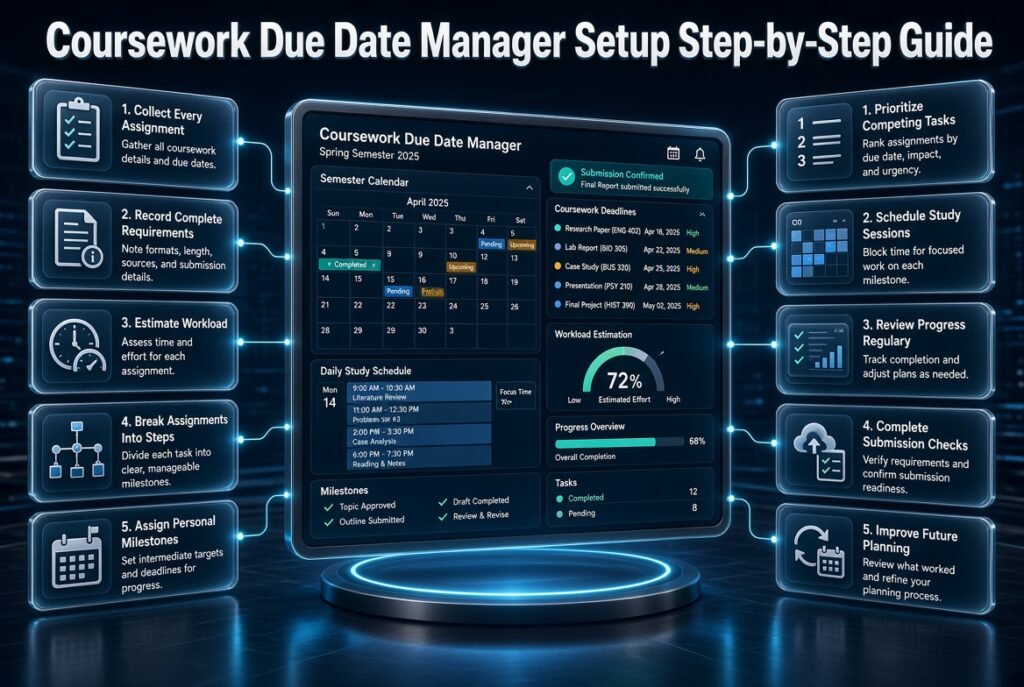
A useful deadline-management system begins with accurate information and a realistic plan. The following process works with a spreadsheet, paper planner, calendar, or digital task-management application.
Step 1: Collect Every Current Assignment
Start by reviewing the official course portals, assignment sheets, emails, learning management systems, and teacher announcements relevant to your courses.
Record every confirmed assignment, including smaller tasks that may be easy to overlook. Include quizzes, presentations, reading responses, laboratory reports, and group-project milestones where applicable.
Do not rely on memory or assume that every assignment appears in one place.
Professional advice: Separate confirmed deadlines from provisional dates. If a date is uncertain, mark it for verification rather than treating it as final.
Step 2: Record the Complete Requirements
For each assignment, record the title, subject, official deadline, submission method, expected format, and any important instructions.
A short description can prevent mistakes later. For example, a presentation may require slides, a written summary, and participation from every group member. Recording only the presentation date would leave important work unplanned.
Where necessary, include the marking rubric, reference style, file type, or minimum research requirements.
Step 3: Estimate the Workload
Estimate the amount of time required for research, planning, drafting, calculations, preparation, editing, and submission.
These estimates do not need to be perfect. Their purpose is to make the workload visible before the deadline becomes urgent.
A 2,000-word essay might require several hours of reading and outlining, multiple writing sessions, and additional time for revision. A laboratory report may require time to analyze results before writing can begin.
If you are unsure, use an initial estimate and adjust it as you gain experience.
Step 4: Break Large Assignments Into Smaller Tasks
Large assignments are easier to manage when they become a sequence of specific actions.
For a research essay, the sequence might include:
- Read the question and marking criteria.
- Identify the main research questions.
- Find and evaluate relevant sources.
- Create an outline.
- Draft the main sections.
- Check evidence and citations.
- Edit the language and structure.
- Verify formatting and submission requirements.
- Submit the final document and confirm receipt.
Each task should have a realistic completion target. This makes progress measurable and reveals delays early.
Step 5: Assign Personal Milestones
Work backward from the official deadline to establish preparation dates.
If an assignment is due in ten days, the student might finish research within three days, complete an outline by day four, draft by day seven, and reserve the remaining time for revision and submission.
The exact schedule depends on the assignment and the student’s availability. A short task may need only one intermediate milestone, while a major research project may require many.
Avoid placing every milestone on the final day. Doing so recreates the same pressure that deadline management is supposed to reduce.
Step 6: Prioritize Competing Assignments
Review all upcoming work and identify which tasks need attention first.
A useful approach is to consider three factors:
- Urgency: How soon is the deadline?
- Effort: How many hours or sessions will the task require?
- Importance: How significant is the assessment, and are there consequences for missing it?
A high-effort assignment due soon may deserve immediate attention even if a smaller task has an earlier deadline. At the same time, small tasks should not be ignored until they accumulate into a larger problem.
Step 7: Put Work Sessions on Your Calendar
Turn the task list into a realistic schedule by assigning actual periods for study.
Instead of writing “work on biology,” choose a specific activity such as “review laboratory results and draft the results section.”
Consider class hours, commuting, meals, employment, rest, and other responsibilities. A schedule that assumes every free hour is available for studying is unlikely to remain realistic.
For students who also need to coordinate lessons and study periods, a Weekly Lesson Period Planner can provide a useful reference for structuring the academic week.
Step 8: Review Progress Regularly
Spend a few minutes each day checking urgent tasks and conduct a more complete review once a week.
Ask yourself:
- Which assignments have approaching deadlines?
- Which milestones are overdue?
- Are my workload estimates still realistic?
- Have any official deadlines changed?
- Do I need clarification, resources, or help?
- What should I complete next?
The purpose is not to punish yourself for unfinished work. It is to identify problems early enough to make a useful adjustment.
Step 9: Check and Submit Properly
Finishing the content is not always the final step. Students may still need to check citations, verify the correct file, confirm formatting, upload supporting documents, and complete a submission process.
Create a short final checklist for important assignments. Submit before the official deadline whenever possible and retain the confirmation if the platform provides one.
Step 10: Improve the System After Each Deadline
After submission, compare your estimated workload with the time actually required.
If research consistently takes longer than expected, allow more time for research in future assignments. If you repeatedly forget to proofread, schedule revision as a separate task rather than assuming it will happen automatically.
Small improvements make the system more accurate throughout the semester.
Coursework Due Date Manager Example: A Practical Assignment Tracker
Consider a university student managing four assessments during the same week. The student has an essay, a laboratory report, a presentation, and a short online quiz.
A basic tracker might look like this:
| Coursework | Official deadline | Estimated work | Personal target | Current status |
|---|---|---|---|---|
| Research essay | Monday | 8 hours | Saturday | Drafting |
| Laboratory report | Wednesday | 5 hours | Tuesday | In progress |
| Group presentation | Thursday | 4 hours | Wednesday | Preparing slides |
| Online quiz | Friday | 2 hours | Thursday | Not started |
This example illustrates why official deadlines and personal targets should be recorded separately. The student aims to complete each task before the final submission date to allow time for checking and unexpected problems.
The next step is to divide the available study time among these tasks. If the essay requires eight hours, completing it in one evening may be unrealistic. Four two-hour sessions could be more manageable, provided they fit around classes and other responsibilities.
The student should also check dependencies. If the laboratory report depends on results that are not yet available, its schedule may need to account for that delay.
A good tracker is not a guarantee that every deadline will be met. Its value is that it makes the work, timing, and potential conflicts visible enough to support better decisions.
How to Prioritize Assignments When Several Deadlines Are Close
When multiple assignments are due together, students often make one of two mistakes: they work only on the nearest deadline, or they start with the easiest task because it feels satisfying to finish.
Neither approach is always correct. The best decision depends on urgency, effort, importance, and the consequences of delay.
Use an Urgency and Effort Matrix
| Priority | Typical situation | Recommended action |
|---|---|---|
| High | Major assignment due soon with substantial work remaining | Schedule focused work immediately |
| High | Short, compulsory task due today | Complete it promptly if the workload is manageable |
| Medium | Important project due later with a clear milestone approaching | Reserve time and begin early |
| Medium | Routine assignment with adequate time remaining | Add it to the weekly schedule |
| Low | Optional improvement with no immediate deadline | Complete it after essential work is secure |
This matrix is a guide, not a rigid formula. An assignment with a strict submission window or an important prerequisite may need attention sooner than its apparent workload suggests.
Consider Deadline Clusters
A deadline cluster occurs when several assignments fall within a short period. The problem is not only the number of deadlines but also the combined effort required before they arrive.
If three essays each require eight hours and are due within four days, the student needs to recognize the workload well in advance. Waiting until the final four days may leave insufficient time for all three.
Review the next two to three weeks rather than looking only at today’s tasks. Early visibility creates opportunities to start research, draft sections, and complete smaller activities before the busiest period begins.
Protect Time for Difficult Work
Tasks that require concentration often need longer, uninterrupted sessions. Schedule these periods when you are most likely to focus effectively.
Short administrative tasks can fit into smaller gaps, but do not let them consume the time reserved for demanding assignments.
Expert tip: At the start of each study session, decide what a successful session will produce. “Write 400 words for the discussion section” is more actionable than “study for two hours.”
How to Connect Coursework Deadlines With an Academic Calendar
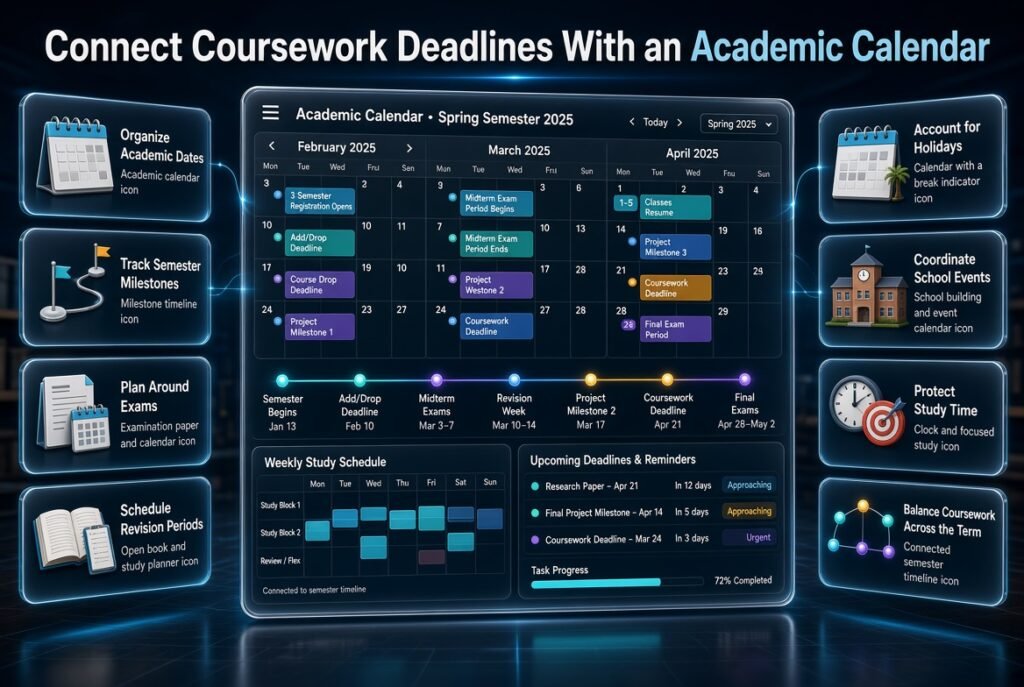
An assignment tracker works best when it reflects the wider academic calendar. Term dates, holidays, examination periods, teaching weeks, and institutional events can all affect the amount of time available for coursework.
An academic calendar provides the broader structure, while a coursework manager records individual assignments and preparation activities.
Students and academic planners can explore Academic Calendar Planning to understand how academic dates can be organized within a larger schedule.
Account for Semester Milestones
A semester may include registration deadlines, project checkpoints, assessment periods, revision weeks, and final submissions. These milestones help students recognize when their workload is likely to change.
A Semester Milestone Calendar can be relevant when organizing these larger academic checkpoints.
For example, a student who knows that final examinations begin in six weeks can avoid scheduling every major project to finish during the same revision period. Planning across the semester encourages earlier preparation and a more balanced workload.
Include Holidays and Breaks
Academic breaks can create useful study opportunities, but students should not assume that every holiday is completely free. Family commitments, travel, work, and personal rest may reduce the available study time.
A Academic Holiday Calendar Builder may help with organizing holiday dates as part of an academic planning process.
Use confirmed holiday dates when planning. If teaching resumes immediately after a break, completing important coursework before the holiday may be more practical than relying on last-minute work during the break.
Coordinate Assignments With School Events
School events, departmental activities, and scheduled institutional commitments can affect when students and teachers have time to complete academic work.
A School Year Event Calendar can be relevant when these events need to be considered alongside coursework dates.
The aim is not to put every personal activity into the assignment tracker. It is to recognize major commitments that could interfere with planned study sessions or submission preparation.
Coursework Deadline Management for Different Assignment Types
Different assignments require different planning methods. A useful manager should accommodate the actual work involved instead of treating every deadline as an identical task.
Essays and Research Papers
Essays require time for interpreting the question, finding credible sources, developing an argument, drafting, referencing, and revision.
Start by reviewing the marking criteria. Identify what the assignment expects you to explain, compare, evaluate, or demonstrate.
Set separate milestones for research, outlining, drafting, and editing. This reduces the risk of spending so much time collecting sources that there is insufficient time to construct the argument.
For longer projects, schedule periodic reviews to check whether the research still supports the original question.
Laboratory Reports and Technical Coursework
Laboratory reports may depend on practical sessions, collected data, calculations, or results that become available only at particular times.
Record these dependencies when building the schedule. Do not assign the entire report to the day before submission if essential analysis must happen first.
Divide the report into relevant stages, such as data checking, calculations, methods, results, discussion, references, and final formatting.
Presentations and Group Projects
Group projects require coordination between several people. In addition to the official deadline, track internal deadlines for assigning responsibilities, sharing research, reviewing content, and rehearsing.
Make sure every participant understands the agreed deliverables. A shared task list can help, but someone should also be responsible for checking that the final submission is complete.
Leave time for technical issues, unavailable group members, and changes to the presentation structure.
Quizzes and Short Assignments
Small assignments can appear less important because they require fewer hours. However, several short tasks can accumulate and compete with major projects.
Record these tasks in the same system as larger assignments. If an online quiz requires preparation, create a separate study task rather than recording only its closing time.
For learners managing subject-specific work, a Subject Timetable Maker can be a useful reference for organizing subjects and their associated study periods.
Weekly Coursework and Class Activities
Recurring assignments become easier to manage when students create a repeatable routine. For example, they might review weekly instructions every Monday, plan tasks on Tuesday, and check upcoming submissions each evening.
Students who want to organize lessons and class periods can explore a Student Class Period Organizer as a related academic scheduling resource.
The key is to distinguish scheduled lessons from independent coursework. Attending a class does not automatically complete the reading, writing, or practice required outside it.
How to Manage Coursework Alongside Examinations
Coursework deadlines can become more challenging when examinations approach. Students may need to complete assignments while revising several subjects, attending classes, and preparing for practical assessments.
The solution is to plan both types of work within the same overall view.
Map the Examination Period
Start by recording confirmed examination dates, subjects, preparation requirements, and any relevant institutional restrictions. Compare those dates with coursework submission deadlines.
An Exam Schedule Generator is a relevant resource for understanding examination scheduling, while students can use their personal coursework tracker to manage the work that must be completed before those examinations.
Plan Revision as a Real Task
Do not record “exam revision” as one enormous activity. Break it into subjects, topics, practice questions, and review sessions.
For example, a student preparing for a mathematics examination might schedule one session for algebra practice and another for reviewing past questions. The schedule should reflect the topics that need the most attention.
Coordinate Tests and Assessments
Students may also need to prepare for smaller tests or subject assessments before final examinations.
A Test Date Timetable Planner can provide a related planning reference for organizing test dates.
Use these dates to determine when revision should begin and which coursework tasks must be completed earlier. Do not assume that a test is unimportant simply because it is shorter than a final examination.
Understand Examination Sessions
Institutional examination planning may involve different rooms, candidate groups, time slots, and supervision arrangements. These administrative details differ from a student’s personal revision plan, but they influence the official schedule students must follow.
An Exam Session Calendar Builder is relevant to organizing examination sessions, while an Assessment Sitting Schedule relates to arranging assessment sittings.
For students, the practical lesson is to rely on confirmed examination instructions and promptly update personal plans when official arrangements change.
Keep the Official Timetable Accessible
A Examination Timetable Organizer is another relevant resource for understanding how examination schedules can be organized.
Students should always verify their own examination details through the institution’s official communication channels. A personal planner is useful for preparation, but it should not replace the official timetable or serve as proof that an examination date has been confirmed.
Choosing the Right Coursework Deadline Management Method
The best system is the simplest one that reliably supports your workload. A tool should make academic planning easier, not require so much maintenance that it becomes another source of stress.
Spreadsheet
A spreadsheet works well for students who want a customizable assignment list. Columns can include the subject, task, official deadline, personal target, estimated hours, priority, and status.
Advantages: Flexible, easy to organize, and suitable for custom calculations.
Limitations: Reminders may require additional setup, and the spreadsheet may not be convenient to update on every device.
Digital Calendar
A calendar is useful for visualizing deadlines and reserving study sessions. It works particularly well when students need to coordinate coursework with classes, employment, and personal commitments.
Advantages: Clear time-based overview and useful scheduling structure.
Limitations: A calendar event alone may not provide enough detail to track research, drafting, or other multi-step tasks.
Task Management Application
A task manager can organize assignments into projects, subtasks, statuses, and reminders.
Advantages: Helpful for large assignments, recurring activities, and progress tracking.
Limitations: Excessive customization can consume time, and notification settings may become distracting.
Paper Planner
A paper planner suits students who prefer writing by hand and want a simple overview without digital notifications.
Advantages: Easy to personalize and available without relying on an electronic device.
Limitations: Changes require manual updates, and a paper planner may be less convenient when managing numerous subjects or group projects.
Combined System
Many students benefit from combining a calendar with a task list. The calendar holds official deadlines and scheduled work sessions, while the task list records the steps needed to complete each assignment.
| Method | Best use | Main consideration |
|---|---|---|
| Spreadsheet | Flexible assignment tracking | Requires consistent updates |
| Calendar | Deadlines and study sessions | Needs task details elsewhere |
| Task manager | Multi-stage coursework | Avoid unnecessary complexity |
| Paper planner | Simple personal planning | Updates are manual |
| Combined system | Complex academic workloads | Keep information synchronized |
Choose one primary location for deadline records. If several tools are used, decide which one is the authoritative source so conflicting dates do not create confusion.
Common Coursework Due Date Manager Mistakes to Avoid

Even a well-designed tracker can fail if the student records incomplete information, creates unrealistic schedules, or stops reviewing progress. Recognizing these mistakes helps turn a basic deadline list into a dependable management routine.
Mistake 1: Recording Only the Final Deadline
Why it happens: Students believe they will remember when to begin working.
Why it causes problems: A deadline may be several weeks away, creating a false sense that there is plenty of time. When research and drafting are postponed, the remaining workload can become overwhelming.
How to avoid it: Add personal milestones for important assignments. Divide major tasks into stages and assign each stage a realistic target date.
Mistake 2: Underestimating Assignment Duration
Why it happens: Students estimate only the time needed to write the final answer and overlook research, planning, referencing, and editing.
Why it causes problems: The calendar appears manageable even when the actual workload exceeds the available time.
How to avoid it: Estimate the main stages separately. Compare estimates with previous assignments and adjust future plans according to actual experience.
Mistake 3: Treating Every Task as Equally Important
Why it happens: A simple list displays tasks without explaining their urgency, complexity, or consequences.
Why it causes problems: Students may spend hours on a low-priority task while a demanding assessment approaches.
How to avoid it: Consider due dates, workload, importance, and dependencies before deciding what to do next.
Mistake 4: Planning Every Hour Without Flexibility
Why it happens: Students try to solve a busy semester by filling every available time slot.
Why it causes problems: Unexpected commitments, fatigue, or tasks that take longer than expected can disrupt the entire plan.
How to avoid it: Leave some unscheduled time for delays and adjustments. Build a schedule that allows for normal life rather than assuming perfect conditions.
Mistake 5: Ignoring Small Assignments
Why it happens: Short quizzes, reading tasks, and routine submissions seem less urgent than major projects.
Why it causes problems: Several small tasks can accumulate and create unexpected pressure during an already busy week.
How to avoid it: Record small assignments alongside major assessments. Estimate their combined workload and reserve time for them.
Mistake 6: Relying on Reminders Without Checking Progress
Why it happens: Students assume that receiving a notification means they are managing the assignment.
Why it causes problems: A reminder can announce an approaching deadline without ensuring that the required research, drafting, or preparation has been completed.
How to avoid it: Connect reminders to specific milestones and review the actual status of each assignment.
Mistake 7: Forgetting to Update Changed Deadlines
Why it happens: A teacher announces an extension, but the student updates only one of several calendars or notes.
Why it causes problems: Conflicting dates can lead to missed submissions or wasted effort.
How to avoid it: Verify the official change and update the primary tracker immediately. If another tool is used, synchronize it as well.
Mistake 8: Failing to Verify Submission
Why it happens: Students assume that finishing or uploading a file automatically completes the process.
Why it causes problems: The wrong document, incomplete upload, missing attachment, or unfinished submission confirmation may leave the assignment unsubmitted.
How to avoid it: Use a final checklist and confirm that the correct work has been accepted by the official platform.
Mistake 9: Creating an Overcomplicated System
Why it happens: Students add numerous labels, categories, dashboards, and tracking fields before establishing a consistent routine.
Why it causes problems: Maintaining the system takes time away from the actual coursework.
How to avoid it: Begin with the assignment name, deadline, workload, status, and next action. Add features only when they solve a recurring problem.
Expert Tips for Better Coursework Deadline Management
Effective deadline management depends more on consistent habits than on the number of features available in a tool.
Use a Weekly Planning Session
Set aside a regular time to review upcoming assignments and plan the next week. Check official announcements, compare deadlines, estimate remaining work, and schedule the most important tasks.
A weekly review helps identify conflicts early. It also prevents students from discovering a major assignment only when the deadline is close.
Create Personal Submission Buffers
Whenever possible, aim to finish important coursework before the official deadline. The appropriate buffer depends on task complexity and the likelihood of unexpected problems.
For a short assignment, a few hours may be enough. For a major project, completing the draft several days early can provide time for meaningful revision.
A personal target should be realistic rather than so ambitious that missing it immediately discourages further planning.
Use the Next-Action Method
Every active assignment should have a clear next action.
Instead of writing “complete dissertation,” record “review three sources for the literature review” or “revise the research question based on supervisor feedback.”
Clear next actions reduce the mental effort required to begin studying and make progress easier to measure.
Identify Dependencies Early
Some tasks cannot begin until other work is complete. A group presentation may depend on teammates providing research, while a laboratory report may depend on receiving results.
Record these dependencies and follow up before they threaten the final deadline. If another person controls an important step, create an earlier check-in date.
Ask for Clarification Before Problems Escalate
If assignment instructions are unclear, contact the appropriate teacher or academic advisor early. Waiting until the submission date can leave insufficient time to respond to the answer.
Similarly, if circumstances make a deadline difficult to meet, review the institution’s official extension or support process. Do not assume that an extension has been granted until it is confirmed.
Review Patterns, Not Just Individual Failures
If several assignments are late, investigate the underlying cause. The problem might be unrealistic workload estimates, competing commitments, unclear instructions, or a tendency to delay starting.
Addressing the recurring cause is more effective than simply adding more reminders.
How Coursework Deadline Management Supports Academic Success
A coursework due date manager cannot replace subject knowledge, effective study techniques, or appropriate academic support. However, it can create the conditions in which students are more likely to use their time effectively.
Better Work Quality
Starting early creates opportunities to improve arguments, check calculations, correct references, and respond to feedback. Rushed work often leaves little room for these improvements.
More Consistent Study Habits
Breaking assignments into manageable sessions encourages regular progress rather than depending on occasional long study periods.
Consistency is particularly useful when students must manage several subjects with different requirements.
Reduced Avoidable Stress
A visible plan does not remove every academic challenge, but it can reduce uncertainty about what needs to happen next. Students can distinguish between work that requires immediate attention and tasks that can wait.
Improved Awareness of Workload
Tracking estimates and completion times helps students understand how long different types of coursework actually take. This knowledge supports more realistic planning in future semesters.
Stronger Personal Responsibility
Maintaining an accurate tracker encourages students to check instructions, monitor changes, communicate when necessary, and confirm submissions.
These habits are useful beyond school or university because many professional responsibilities also involve deadlines, multi-stage projects, and competing priorities.
A Simple Daily and Weekly Coursework Management Routine
A routine makes the tracker useful without requiring students to spend excessive time organizing it.
Daily Routine
At the beginning of a study session, review upcoming deadlines and select the most important task. Check whether any milestone has been missed or any official date has changed.
Work on a specific activity, record meaningful progress, and identify the next action before finishing. If the planned work cannot be completed, adjust the schedule rather than leaving the tracker inaccurate.
At the end of the day, confirm that completed tasks are marked correctly and that urgent unfinished work has a realistic next step.
Weekly Routine
Once a week, review all assignments due over the next two to three weeks. Check for deadline clusters, examination conflicts, group-project dependencies, and tasks that require external information.
Estimate the available study time and distribute demanding work across suitable sessions. Include time for revision and submission checks, not just initial drafting.
The routine should remain flexible. A new assignment, an extension, or an unexpected commitment may require adjustments, but the tracker should continue to show the current situation accurately.
Monthly or Semester Review
For longer academic periods, review broader milestones and identify busy assessment windows.
Use the review to adjust study habits, workload estimates, and preparation buffers. Students who consistently underestimate research time should change their planning assumptions rather than repeating the same schedule.
Academic deadline management becomes more effective when each semester teaches you something useful about how you work.
How to Keep Your Coursework Tracker Accurate and Reliable
Accuracy is essential because an organized list with incorrect dates can be more misleading than an incomplete one.
Use official course information as the source of truth. When a deadline is announced verbally, confirm the details through an approved channel if there is any uncertainty.
Distinguish between confirmed, provisional, and personal target dates. These categories prevent a planned milestone from being mistaken for an official requirement.
Keep assignment instructions accessible, but avoid storing unnecessary sensitive information in unapproved applications. For group work, share only the information that relevant participants need.
If you use multiple tools, establish a simple update rule. For example, change the main tracker first and then synchronize the calendar. Check for conflicts during the weekly review.
Finally, maintain a record of completed submissions where appropriate. Submission confirmations, receipts, or official status indicators can help resolve questions about whether work was received.
For broader planning needs, the Academic Deadline Management resource is relevant to understanding how academic deadlines fit into a wider management process.
What Is the Best Coursework Due Date Manager for Students?
The best coursework due date manager is one that helps students organize assignments, track submission deadlines, prioritize important tasks, and monitor progress without making academic planning complicated. The right choice depends on the number of subjects a student takes, the complexity of their assignments, and whether they prefer a digital calendar, spreadsheet, or task-management tool.
For students managing multiple courses, a centralized tracker with deadlines, estimated workloads, progress statuses, and reminders can make a significant difference. Rather than choosing a tool solely because it offers many features, students should look for one they can update consistently throughout the semester.
Important features to look for:
A clear overview of upcoming assignment deadlines.
Separate records for official due dates and personal completion targets.
Task prioritization based on urgency and workload.
Progress tracking for research, drafting, editing, and submission.
Flexible reminders and weekly planning options.
A simple, regularly maintained tracker is often more effective than a complicated system that becomes difficult to manage.
How Can I Manage Multiple Coursework Deadlines Without Missing Assignments?
Managing multiple coursework deadlines requires a complete overview of your academic workload, realistic time estimates, and a consistent planning routine. Start by recording every assignment and its confirmed submission date. Then estimate how much work each task requires and divide larger assignments into smaller activities with individual target dates.
The next step is to identify deadline conflicts. For example, if two essays and a presentation are due within the same week, beginning research and preparing presentation materials early can prevent all three tasks from becoming urgent simultaneously.
A weekly review helps you adjust your schedule when assignments take longer than expected or teachers announce changes.
Practical strategies include:
Review all upcoming deadlines at the beginning of each week.
Start demanding assignments before they become urgent.
Schedule separate sessions for research, writing, and proofreading.
Use reminders for important milestones rather than relying on memory.
Keep some flexible time available for unexpected academic responsibilities.
The key is to manage the workload before deadlines become emergencies, rather than trying to complete everything at the last minute.
How Far in Advance Should I Start Coursework Before the Due Date?
The ideal time to start coursework depends on its length, difficulty, research requirements, and your existing commitments. A short assignment may need only a few days of preparation, while a research paper, technical report, or major project may require several weeks. Students should estimate the time needed for each stage instead of treating the entire assignment as a single task.
For example, a research essay might require separate periods for understanding the question, finding sources, developing an outline, writing the first draft, checking references, and proofreading. Beginning early creates opportunities to improve the quality of the work rather than focusing only on meeting the submission deadline.
A practical approach is to:
Review the assignment instructions as soon as they become available.
Set an early target for completing research and planning.
Establish a realistic date for finishing the first draft.
Reserve time for editing, formatting, and checking requirements.
Aim to finish before the official deadline whenever possible.
Starting early does not mean working on every assignment every day. It means creating enough time to complete the necessary stages without unnecessary pressure.
How Can I Prioritize Coursework When Several Assignments Are Due at the Same Time?
When several assignments have similar deadlines, prioritize them according to urgency, workload, academic importance, and any dependencies that could delay completion. The assignment due first is not automatically the only task that deserves attention. A larger project due a few days later may require earlier preparation than a short task due tomorrow.
Begin by listing all outstanding assignments and estimating the time needed for each one. Identify tasks that require research, feedback, group coordination, or access to particular resources. These activities may need to start early even when their official deadlines are still several days away.
Use these prioritization principles:
High urgency: Address tasks with approaching deadlines and unfinished essential work.
High workload: Begin substantial assignments early instead of postponing them.
High importance: Give appropriate attention to major assessments and compulsory requirements.
Dependencies: Complete activities that other tasks or group members rely on.
Available time: Match demanding work to realistic, focused study sessions.
If the combined workload cannot reasonably fit into the available time, contact the relevant academic staff early to discuss possible support or approved options. A clear priority system helps you make informed decisions instead of switching randomly between assignments.
How Can a Coursework Due Date Manager Help Improve Academic Performance?
A coursework due date manager can support academic performance by helping students allocate their time more effectively, prepare for assessments earlier, and reduce avoidable mistakes caused by rushed submissions. When assignments are planned in manageable stages, students have more opportunities to review their research, strengthen their arguments, check calculations, and correct referencing or formatting problems.
The system also helps students recognize workload patterns. If several major assignments consistently become difficult during the same period, reviewing the academic calendar and setting earlier milestones can help prevent similar problems in future semesters.
However, a deadline manager does not automatically improve grades. Students still need to understand course material, follow assignment instructions, use appropriate sources, and produce work that meets the assessment criteria.
To get the most benefit:
Review progress regularly instead of checking deadlines only when they approach.
Break major assignments into specific, achievable tasks.
Reserve time for proofreading and final submission checks.
Compare estimated and actual completion times to improve future planning.
Coordinate coursework with examination dates, classes, and other academic commitments.
Used consistently, a coursework due date manager can help students develop stronger organization habits, work more confidently, and maintain better control over their academic responsibilities.
Conclusion
A coursework due date manager is an essential planning resource for students who want to organize assignments, manage competing deadlines, and complete academic work without unnecessary last-minute pressure. By keeping submission dates, task priorities, progress updates, and personal milestones in one place, students can develop a clearer understanding of their workload and make better decisions about how to use their time.
The most effective approach is to start with a simple system and maintain it consistently. Record every confirmed assignment deadline, break larger projects into manageable tasks, estimate the time required for each stage, and reserve time for proofreading and final submission checks. Reviewing your schedule regularly also helps you identify deadline conflicts early and adjust your study plan when circumstances change.
For better results, connect coursework planning with your wider academic schedule, including semester milestones, classroom activities, holidays, and examination dates. This broader perspective makes it easier to prepare for busy academic periods instead of reacting when several deadlines arrive together.
Ultimately, successful deadline management is not about completing more tasks in less time. It is about working strategically, maintaining consistent progress, and giving each assignment the attention it deserves. Start organizing your coursework today, establish realistic completion targets, and turn deadline management into a reliable habit throughout your academic journey.