
Introduction
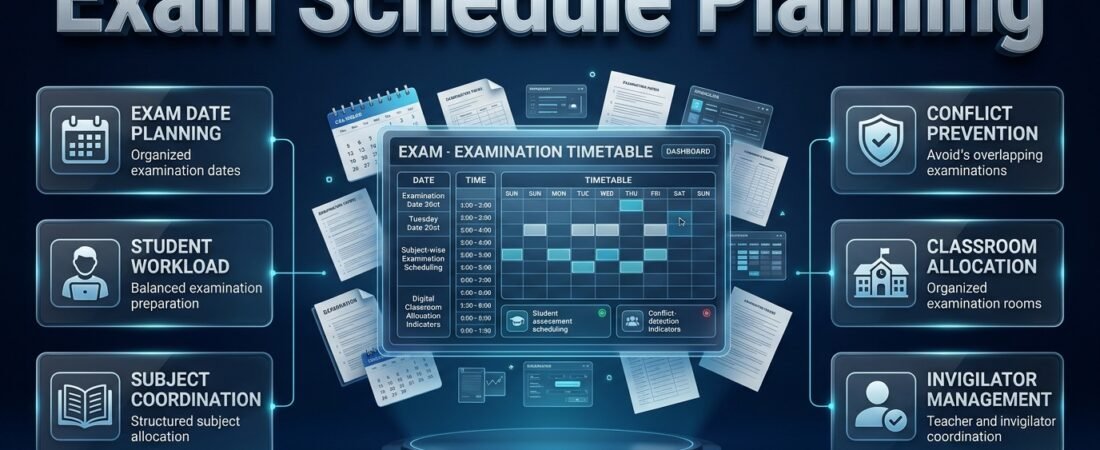
Exam Schedule Planning | Imagine a school preparing for its final examinations. Students are waiting for their examination dates, teachers are organizing assessment materials, and administrators are trying to coordinate several classes, subjects, and examination rooms. Everything appears ready until someone discovers that two examinations have been scheduled for the same group of students at the same time.
Suddenly, the administration must change dates, contact teachers, update classroom arrangements, and inform students about the revised timetable. What should have been a straightforward academic process becomes an unnecessary administrative problem.
This situation explains why Exam Schedule Planning requires careful preparation, accurate information, and a structured approach. Creating an effective examination timetable is not simply about selecting dates and assigning subjects. It involves coordinating students, teachers, examination periods, classrooms, resources, and institutional requirements.
A well-organized examination schedule helps students prepare with confidence, allows teachers to manage their responsibilities, and gives administrators better control over academic assessments.
Whether you manage a small school, a college, a university, or multiple academic departments, the right planning process can make examination management considerably easier.
Institutions can also explore RTI Scheduler as part of a broader approach to organizing academic schedules and related planning activities.
This comprehensive guide explains how to develop a practical examination timetable, prevent scheduling conflicts, balance student workloads, allocate examination rooms, coordinate invigilators, and improve the entire process. It also covers common mistakes, practical examples, digital scheduling methods, and professional recommendations for managing examinations more efficiently.
What Is Exam Schedule Planning?
Exam schedule planning is the process of organizing examination dates, subjects, time slots, student groups, examination locations, and supervision arrangements into a coordinated timetable.
Its primary objective is to ensure that every examination takes place at an appropriate time and location without creating unnecessary conflicts for students, teachers, or institutional resources.
An effective examination schedule normally contains:
- Examination dates and days.
- Subject names and course identifiers.
- Starting and finishing times.
- Examination duration.
- Student classes or candidate groups.
- Assigned examination rooms.
- Invigilator responsibilities.
- Special examination arrangements.
- Important instructions for candidates.
For example, a secondary school may organize Mathematics examinations on Monday, English on Wednesday, and Science on Friday. This arrangement gives students opportunities to prepare between major assessments while allowing administrators to organize classrooms and supervision.
However, examination planning becomes more complicated when several classes share teachers, examination halls, laboratories, or other resources.
That is why administrators should consider the complete academic environment rather than preparing a separate list of examination dates without checking how different assignments interact.
How to Plan Test Dates and Create a Balanced Academic Timetable
Planning test dates requires careful coordination to ensure students have enough preparation time and teachers can manage assessments without unnecessary scheduling conflicts. Schools should begin by identifying the subjects that require testing, reviewing the academic calendar, and assigning suitable dates according to classroom availability and teaching schedules. It is also important to avoid placing multiple difficult tests too close together, as this can create additional pressure on students and affect their preparation. A balanced test timetable helps teachers distribute assessments effectively, keeps students informed about upcoming tests, and supports a more organized academic environment.
For better assessment planning, explore this resource 👉 Test Date Timetable Planner
This tool helps organize test dates, coordinate subject-wise assessments, manage examination schedules, and maintain a clear testing plan throughout the academic term.
What Makes an Examination Schedule Effective?
An effective examination schedule should satisfy several important requirements.
Accuracy: Every examination must have the correct subject, date, time, and student group.
Fairness: Students should receive reasonable preparation opportunities, particularly when multiple demanding examinations are involved.
Practicality: Examination sessions must fit available classrooms, staff schedules, and institutional resources.
Clarity: Students and teachers should understand the timetable without needing repeated explanations.
Flexibility: Administrators should have a reliable procedure for managing unavoidable changes.
A timetable that looks organized but ignores these requirements may still create serious problems during examination week.
How to Generate an Organized Exam Schedule for Educational Institutions
Creating an effective exam schedule requires careful planning to ensure that subjects, examination dates, student groups, and available resources are properly coordinated. Schools and colleges should begin by listing all required examinations, checking student and teacher availability, and assigning suitable time slots for each subject. It is equally important to provide sufficient preparation gaps between papers, avoid overlapping examinations, and consider classroom capacity and invigilator availability. A properly organized exam schedule reduces administrative confusion, improves communication, and gives students a clear understanding of their upcoming examinations.
For easier examination planning and scheduling, explore this resource 👉 Exam Schedule Generator
This tool helps organize examination dates, coordinate subject-wise schedules, manage exam timings, and create a more structured examination plan throughout the academic term.
Why Is Exam Schedule Planning Important for Educational Institutions?
Examination scheduling affects academic performance, administrative coordination, staff responsibilities, and the overall student experience.
Without a structured planning process, even a relatively small institution can experience avoidable scheduling problems.
1. It Prevents Overlapping Examinations
One of the most important purposes of examination scheduling is preventing students from receiving two examinations at the same time.
Consider a student enrolled in Mathematics, Physics, and Computer Science. If Mathematics and Physics are scheduled simultaneously, the student cannot participate in both examinations.
This situation becomes especially complicated in universities where students may select different combinations of optional courses.
Administrators should therefore examine candidate groups and course registrations before approving examination assignments.
2. It Improves Student Preparation
Students need enough time to prepare for assessments, review course materials, and organize their study activities.
Scheduling several demanding examinations within a short period may create unnecessary academic pressure.
A balanced timetable distributes assessments more reasonably and gives students a clearer understanding of their upcoming responsibilities.
For example, placing Mathematics on Monday, English on Wednesday, and Science on Friday may provide a more manageable arrangement than scheduling all three subjects on consecutive days.
3. It Supports Better Classroom Management
Examinations require suitable spaces, adequate seating, and appropriate facilities.
A room assigned to one examination cannot automatically be used for another examination during the same period.
Administrators must also consider special requirements such as laboratory equipment, computer access, accessibility arrangements, and examination security.
A structured schedule helps institutions use available spaces more efficiently.
4. It Improves Teacher and Invigilator Coordination
Teachers may have regular teaching responsibilities, assessment duties, and examination supervision assignments.
Without advance coordination, staff members can receive overlapping responsibilities.
An examination schedule should therefore be reviewed alongside staff availability to ensure that every examination session has appropriate supervision.
5. It Reduces Administrative Work
Repeated timetable changes require additional communication, documentation, and coordination.
A properly prepared schedule reduces these problems by identifying potential conflicts before the timetable is published.
Administrators can spend less time correcting preventable errors and more time preparing examination materials and supporting academic departments.
6. It Creates Better Communication
Students, teachers, parents, and academic departments all need reliable examination information.
A clear timetable provides one reference point for assessment dates, subjects, examination locations, and important instructions.
This reduces uncertainty and makes it easier for everyone to understand the examination process.
What Information Should Be Collected Before Creating an Exam Schedule?
The quality of an examination timetable depends heavily on the accuracy of the information collected during the preparation stage.
Starting the scheduling process without understanding institutional requirements often leads to repeated revisions.
Before assigning examinations, administrators should collect the following information.
| Information | Purpose | Example |
|---|---|---|
| Subject list | Identifies assessments | Mathematics, English, Science |
| Student groups | Identifies candidates | Grade 9, Section A |
| Examination duration | Determines time requirements | 90 or 120 minutes |
| Academic calendar | Identifies available dates | Examination week |
| Room capacity | Supports room allocation | 35 candidates |
| Staff availability | Coordinates supervision | Available teachers |
| Special requirements | Identifies additional needs | Computer laboratory |
| Course registrations | Identifies shared candidates | Optional subjects |
Review the Academic Calendar
Begin by identifying the dates available for examinations.
Check institutional holidays, semester deadlines, scheduled events, teaching periods, and other academic commitments.
An examination should not be placed on a date when the institution is officially closed or when essential facilities are unavailable.
Academic administrators can use Academic Calendar Planning to understand how examination periods fit into the wider educational calendar.
This connection is important because examination dates rarely operate independently of the rest of the academic year.
Prepare an Accurate Subject List
Create a complete list of subjects that require examinations.
Include compulsory subjects, optional courses, practical assessments, and any additional academic requirements.
Do not assume that every class follows the same subject structure.
For example, Grade 10 students may take Biology while another group studies Computer Science. A university department may have several elective courses with different candidate groups.
Accurate subject information prevents missing assessments and unnecessary timetable changes.
Identify Student Groups and Candidate Numbers
Record which students are taking each examination.
Where possible, include class identifiers, sections, course combinations, and candidate numbers.
This information becomes especially important when students from different classes share the same examination.
A Mathematics examination may involve several sections, while a specialized course assessment may involve only a small group.
Administrators should understand these differences before allocating examination sessions.
Confirm Examination Duration
Different assessments require different amounts of time.
A short written test may need 60 minutes, while a comprehensive final examination may require two or three hours.
Practical examinations may also require additional preparation, equipment setup, or supervised activities.
Record the expected duration of every assessment before assigning time slots.
Identify Room and Equipment Requirements
Some examinations can take place in ordinary classrooms, while others require specialized facilities.
For example:
- Computer examinations require suitable computers.
- Science practical assessments may require laboratories.
- Large candidate groups may require examination halls.
- Specialized assessments may require additional equipment.
Collecting this information early helps administrators avoid unsuitable room assignments.
How to Manage Exam Session Planning and Academic Scheduling
Effective exam session planning helps educational institutions organize examinations without creating unnecessary pressure for students, teachers, or administrative staff. Start by preparing a complete list of upcoming assessments, grouping examinations according to subjects or academic departments, and assigning suitable dates and time slots. Schools and colleges should also consider student availability, examination room capacity, invigilator responsibilities, and sufficient intervals between different papers. Regularly reviewing the calendar helps administrators identify scheduling conflicts early and communicate important updates before examination periods begin.
For a more organized examination management process, explore this resource 👉 Exam Session Calendar Builder
This resource helps organize examination sessions, coordinate academic dates, manage assessment schedules, and maintain a structured overview of examination activities throughout the academic term.
How to Create an Effective Exam Schedule Step by Step

A reliable examination timetable should be developed through a consistent process.
The following approach can help educational institutions move from initial preparation to final timetable publication.
Step 1: Establish the Examination Period
The first step is to decide when examinations will take place.
Review the academic calendar and identify suitable examination dates.
Consider:
- The final teaching day.
- Semester completion requirements.
- Institutional holidays.
- Public holidays.
- Required assessment deadlines.
- Available examination days.
- Time required for marking and results processing.
For example, if a school has ten subjects to assess over two weeks, administrators should distribute examinations across the available days instead of placing too many assessments together.
Why it matters: Establishing the examination period provides a clear framework for every later scheduling decision.
Professional advice: Keep some flexibility for unexpected circumstances, particularly when managing large institutions.
Common mistake: Selecting examination dates before checking the academic calendar.
Step 2: Organize Subjects and Student Groups
After establishing the examination period, identify all subjects and the students taking each examination.
Prepare a subject-to-group record.
For example:
| Subject | Student group | Candidate count |
|---|---|---|
| Mathematics | Grade 8 | 32 |
| English | Grade 8 | 32 |
| Physics | Grade 9 | 28 |
| Chemistry | Grade 9 | 28 |
| Biology | Grade 10 | 35 |
These numbers are illustrative and should be replaced with actual institutional records.
This step helps administrators identify shared subjects, combined classes, and possible candidate conflicts.
Professional advice: Confirm candidate registrations with the relevant departments rather than relying on old class lists.
Step 3: Evaluate Subject Difficulty and Workload
Not all subjects create the same preparation requirements.
Mathematics, Physics, and Chemistry may involve extensive problem-solving, while language examinations may focus on reading, writing, and comprehension.
The scheduling team should consider:
- Subject complexity.
- Examination duration.
- Amount of course content.
- Practical requirements.
- Student workload.
- Previous assessment arrangements.
Try to distribute demanding examinations throughout the available examination period.
Common mistake: Assigning subjects according to alphabetical order without considering student workload.
Step 4: Assign Examination Dates
Once the available dates and subject requirements are understood, begin assigning examinations.
A sample schedule could look like this:
| Day | Subject | Starting time | Duration |
|---|---|---|---|
| Monday | Mathematics | 9:00 AM | 2 hours |
| Tuesday | English | 9:00 AM | 2 hours |
| Wednesday | Science | 9:00 AM | 2 hours |
| Thursday | History | 9:00 AM | 90 minutes |
| Friday | Computer Studies | 9:00 AM | 2 hours |
This is a simplified example rather than a universal examination pattern.
Institutions should adapt the dates according to their subjects, student groups, and academic policies.
Step 5: Select Appropriate Examination Time Slots
Examination sessions should be arranged according to the institution’s daily operating hours and resource availability.
For example:
- Morning session: 9:00 AM–11:00 AM.
- Midday session: 12:00 PM–2:00 PM.
- Afternoon session: 2:30 PM–4:00 PM.
Administrators should also consider the time required for students to enter examination rooms, receive instructions, and submit their answer scripts.
Avoid assigning consecutive examinations when the same student group cannot reasonably attend both sessions.
Professional advice: Include appropriate transition time between sessions, especially when the same room or staff members are involved.
Step 6: Allocate Examination Rooms
Room allocation should be based on candidate numbers, available seating, and examination requirements.
Suppose an examination involves 45 students.
If the available classroom has 30 suitable seats, assigning the entire group to that room is not practical.
Administrators may need to select a larger hall or divide candidates into separate rooms.
Room allocation should consider:
- Maximum seating capacity.
- Available furniture.
- Suitable examination conditions.
- Accessibility.
- Equipment requirements.
- Room availability.
- Supervision arrangements.
Maintain a separate room allocation record so that simultaneous bookings can be checked easily.
Step 7: Coordinate Teachers and Invigilators
Every examination session needs suitable supervision.
Create an invigilation plan that identifies staff members, assigned examination rooms, session times, and relevant responsibilities.
Before confirming assignments, check whether any teacher has already been allocated to another examination during the same period.
Consider institutional rules about staff availability and supervision requirements.
Common mistake: Assigning invigilators only after completing the examination timetable.
A better approach is to coordinate staff availability during the planning process.
Step 8: Check Examination Conflicts
This is one of the most important stages.
Review the entire timetable to identify overlapping assignments.
Check:
- Whether any student group has two examinations at the same time.
- Whether examination rooms have multiple bookings.
- Whether invigilators have overlapping assignments.
- Whether examination durations fit the allocated sessions.
- Whether dates conflict with holidays or institutional events.
- Whether specialized facilities are available.
- Whether students have reasonable preparation opportunities.
Do not assume that a timetable is correct simply because every subject has been assigned a date.
Step 9: Prepare a Draft Examination Timetable
Once the main assignments have been completed, prepare a draft.
The draft should contain all essential examination information.
Share it with relevant academic departments, examination coordinators, and administrators.
Ask them to verify subject names, dates, student groups, room assignments, and supervision arrangements.
A structured review helps identify problems before the timetable becomes official.
Step 10: Approve and Publish the Final Schedule
After completing the review, make the required corrections and obtain formal approval.
Publish the final timetable through official institutional communication channels.
These may include:
- Student portals.
- Institutional websites.
- Notice boards.
- Email announcements.
- Learning management systems.
- Printed examination documents.
Include a publication date and revision number when appropriate.
This helps students distinguish the current timetable from previous versions.
How to Prevent Conflicts in an Examination Timetable
Examination conflicts occur when two or more scheduling assignments overlap in a way that prevents students, staff, rooms, or required resources from being used correctly.
A reliable conflict-checking process must examine all important scheduling elements together.
Student Examination Conflicts
A student conflict happens when the same candidate is assigned two examinations during overlapping periods.
For example, a university student may be registered for both Economics and Statistics.
If both examinations are scheduled at 10:00 AM on the same day, the timetable creates a direct conflict.
To prevent this problem, administrators should compare course registrations and candidate lists before approving the schedule.
Classroom and Examination Hall Conflicts
A room conflict occurs when two examinations are assigned to the same location at the same time.
This can happen when separate departments prepare their schedules independently.
Maintain one central room availability record to prevent duplicate assignments.
Teacher and Invigilator Conflicts
Staff members cannot supervise two examinations in different locations simultaneously.
Review staff assignments against the complete examination schedule.
Where institutional policies require specific supervision arrangements, ensure those requirements are considered before confirming assignments.
Examination Duration Conflicts
A time conflict may occur when an examination extends beyond its assigned period.
For example, a two-hour examination starting at 10:00 AM cannot finish at 11:30 AM.
Always calculate the full session duration and include any required transition time.
Resource Conflicts
Some examinations require laboratories, computers, specialist equipment, or other limited resources.
If two assessments need the same facility simultaneously, administrators must adjust the arrangements.
A separate resource allocation record can help identify these problems.
Examination Conflict Prevention Table
| Conflict type | Example | Recommended solution |
|---|---|---|
| Student conflict | Two exams for one candidate | Compare registrations |
| Room conflict | Duplicate hall assignment | Check room bookings |
| Staff conflict | One invigilator assigned twice | Review staff availability |
| Duration conflict | Session ends too early | Verify examination length |
| Calendar conflict | Exam on a holiday | Review academic dates |
| Resource conflict | Two exams need one laboratory | Coordinate facilities |
A conflict-free timetable should be checked as a complete system rather than as separate subject lists.
How to Prepare a Well-Structured Examination Timetable
Preparing an effective examination timetable requires proper coordination of subjects, examination dates, class groups, available rooms, and invigilation duties. Educational institutions should begin by collecting examination requirements from each department and assigning suitable dates according to the academic calendar. Administrators must also provide sufficient preparation gaps between papers, avoid overlapping examinations for the same students, and check teacher and classroom availability before confirming the final schedule. Reviewing the timetable in advance helps identify potential conflicts, improves communication, and ensures that students and staff understand their examination responsibilities.
To simplify examination planning and scheduling, explore this resource 👉 Examination Timetable Organizer
This resource helps schools and colleges organize examination dates, coordinate subject-wise schedules, manage exam sessions, and maintain a clear timetable throughout the academic term.
How to Balance Student Workload During Examination Periods
An examination schedule should not focus exclusively on administrative convenience.
Students are directly affected by the order, frequency, and timing of assessments.
A well-balanced timetable provides a more manageable examination experience.
Distribute Demanding Subjects
Avoid placing several difficult subjects together whenever the examination period allows alternatives.
For example, scheduling Mathematics on Monday, English on Wednesday, and Chemistry on Friday can create a more balanced arrangement than assigning Mathematics, Physics, and Chemistry on three consecutive days.
However, subject difficulty should be evaluated according to the actual curriculum and student group rather than assuming that every student finds the same subjects equally challenging.
Consider Examination Duration
Long examinations may require additional preparation and can be mentally demanding.
Administrators should consider assessment length when deciding how closely examinations can be scheduled.
A three-hour examination may require a different planning approach from a short classroom assessment.
Avoid Unnecessary Examination Clustering
Examination clustering occurs when several assessments are concentrated within a short period.
It can create difficulties for students who need to prepare for multiple subjects simultaneously.
Where possible, distribute major examinations across different days.
Provide Sufficient Notice
Students should receive examination information early enough to organize their revision activities.
A late timetable announcement can create unnecessary uncertainty, particularly for students preparing for several subjects.
Consider Different Student Needs
Some students may require approved examination accommodations.
Institutions should follow their established policies and arrange suitable spaces, timing, or other approved adjustments.
These requirements should be considered during planning rather than handled as last-minute exceptions.
Manual Exam Schedule Planning vs Digital Scheduling Tools
Educational institutions can organize examination schedules manually or through digital scheduling tools.
The right approach depends on the number of subjects, student groups, available resources, and administrative complexity.
Manual Scheduling
Manual planning commonly uses spreadsheets, printed records, or structured documents.
It may be suitable for smaller schools with relatively simple examination arrangements.
Advantages:
- Low initial cost.
- Familiar working environment.
- Flexible document formatting.
- Easy to begin with basic information.
Limitations:
- Repeated data entry.
- Time-consuming revisions.
- Greater dependence on manual checking.
- Difficult coordination across departments.
- Increased risk of inconsistent records.
Digital Scheduling
Digital scheduling systems help institutions organize academic information in a more structured environment.
Depending on the available features, these tools may support timetable organization, calendar management, record updates, and scheduling coordination.
Advantages:
- Centralized information.
- Easier record updates.
- Better visibility of scheduling assignments.
- Reduced repetitive administrative work.
- More convenient coordination.
- Potential support for automated conflict checking.
Limitations:
- Initial setup may require time.
- Staff may need training.
- Some systems require paid subscriptions.
- Features differ between platforms.
- Incorrect source information can still create scheduling problems.
Comparison Table
| Feature | Manual planning | Digital scheduling |
|---|---|---|
| Initial setup | Usually simple | May require configuration |
| Information storage | Separate documents | Centralized records may be available |
| Timetable updates | Often repetitive | Generally easier |
| Conflict checking | Manual review | May include automated checks |
| Staff coordination | Separate records | May be integrated |
| Large institutions | More difficult | Better suited to complex workflows |
| Training | Usually limited | May be required |
When Should an Institution Use Manual Planning?
Manual scheduling can be practical when an institution has a limited number of classes, subjects, and examination sessions.
A spreadsheet may be enough to record dates, examination periods, classrooms, and invigilator assignments.
However, administrators should still perform a complete conflict review before publication.
When Is Digital Scheduling More Practical?
Digital scheduling becomes increasingly useful when institutions manage several departments, multiple candidate groups, shared facilities, and frequent timetable changes.
The most important consideration is not whether a system is digital.
It is whether the chosen approach helps the institution maintain accurate information and coordinate its examination requirements reliably.
How to Plan Assessment Sitting Arrangements for Students
Organizing assessment sitting arrangements requires careful attention to student groups, examination rooms, session timings, and invigilation responsibilities. Educational institutions should begin by preparing accurate candidate lists, assigning students to suitable examination rooms, and checking the available seating capacity. It is also important to allocate appropriate time slots, avoid overlapping assessments, and ensure that invigilators understand their assigned duties. Reviewing these arrangements before examination day helps administrators identify potential issues, reduce confusion, and create a smoother assessment experience for students and examination staff.
For better assessment coordination, explore this resource 👉 Assessment Sitting Schedule
This resource helps institutions organize assessment sessions, coordinate student groups, manage examination arrangements, and maintain a clear sitting schedule throughout the academic term.
How to Organize Examination Information More Efficiently
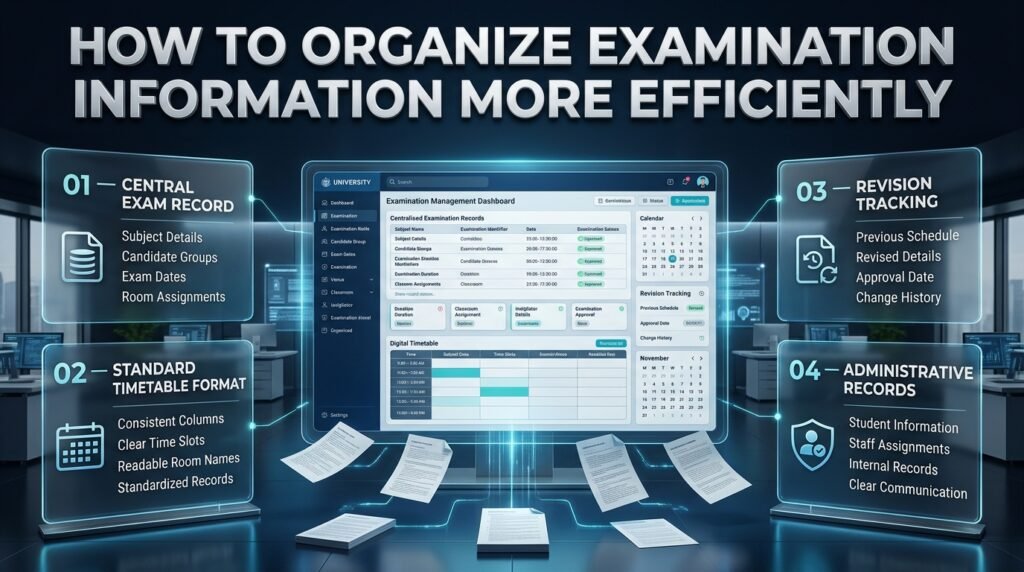
An examination schedule becomes easier to manage when its information is organized into clear categories.
Administrators should avoid storing every detail in unrelated documents.
Create a Central Examination Record
Maintain one main record containing:
- Examination identifiers.
- Subject names.
- Candidate groups.
- Examination dates.
- Starting and finishing times.
- Examination duration.
- Assigned locations.
- Invigilator details.
- Approval status.
Separate records may be maintained for specialized requirements, but the main examination schedule should remain consistent.
Use a Standard Timetable Format
A consistent format makes examination information easier to read.
For every examination, include the same essential fields.
| Date | Day | Subject | Class | Time | Room |
|---|---|---|---|---|---|
| 10 May | Monday | Mathematics | Grade 9 | 9–11 AM | Hall A |
| 11 May | Tuesday | English | Grade 9 | 9–11 AM | Hall B |
| 12 May | Wednesday | Science | Grade 9 | 9–11 AM | Hall A |
The dates and details are illustrative.
Avoid unnecessary abbreviations and make sure room identifiers are understandable.
Maintain Clear Revision Records
When an examination date changes, update the official record.
Include:
- The previous arrangement.
- The revised arrangement.
- The reason for the change.
- The approval date.
- The communication date.
This makes it easier to identify the latest approved information.
Separate Internal Administrative Information
Some examination details are intended for students, while others are primarily for staff.
For example, students need their examination dates and locations.
Administrators may also need internal supervision assignments and room preparation information.
Keeping these records organized reduces confusion and prevents unnecessary information from being included in student-facing documents.
How Digital Academic Planning Supports Examination Management
Examination scheduling is closely connected to other academic responsibilities.
Schools and universities must coordinate teaching periods, semester milestones, holidays, institutional events, and assessment dates.
If these activities are managed without considering their relationship, the institution may experience scheduling inconsistencies.
Digital academic planning provides a structured way to organize these connected responsibilities.
Coordinate Examination Dates With Semester Milestones
Semester milestones identify important academic stages, such as teaching completion, assessment periods, project deadlines, and results preparation.
Connecting examination dates with these milestones helps administrators understand the wider academic schedule.
The Semester Milestone Calendar provides a related academic planning resource.
Consider School Events and Institutional Activities
Schools often organize meetings, extracurricular activities, academic events, and other institutional responsibilities.
These activities can affect examination room availability and staff schedules.
The School Year Event Calendar is relevant when coordinating examination periods with wider school activities.
Review Holiday Arrangements
Institutional holidays should be identified before examination dates are finalized.
Administrators should also consider unexpected closures and approved changes to the academic calendar.
The Academic Holiday Calendar Builder is a related resource for organizing academic holiday information.
Understand Weekly Teaching Commitments
Regular teaching schedules provide important information about staff availability, classroom use, and subject organization.
Reviewing these commitments before scheduling examinations can help administrators avoid unnecessary resource conflicts.
The Weekly Lesson Period Planner is relevant to organizing weekly academic periods.
Organize Subjects and Class Periods
Subject-based schedules help institutions understand how courses are distributed across classes and teaching periods.
The Subject Timetable Maker and Student Class Period Organizer are related resources for organizing subject and student scheduling information.
A structured class timetable can also help administrators understand regular classroom arrangements before allocating examination sessions.
The Class Timetable Grid Builder supports this broader timetable organization process.
These tools address related academic planning activities. Administrators should evaluate their actual features and suitability rather than assume that every scheduling requirement is automatically supported.
Practical Example: Planning an Examination Schedule for a Secondary School
Consider a secondary school with three student groups:
- Grade 8.
- Grade 9.
- Grade 10.
Each group has five subjects to complete during a one-week examination period.
The administration must coordinate subjects, examination dates, rooms, and supervision arrangements.
A simplified timetable could look like this:
| Day | Grade 8 | Grade 9 | Grade 10 |
|---|---|---|---|
| Monday | Mathematics | English | Science |
| Tuesday | English | Mathematics | Biology |
| Wednesday | Science | Chemistry | Mathematics |
| Thursday | History | Physics | English |
| Friday | Computer Studies | History | Computer Studies |
This example demonstrates how different student groups can have separate examination assignments during the same period.
However, the administration must still check shared resources.
Suppose one teacher is assigned to supervise the Grade 8 Mathematics examination and Grade 10 Science examination at the same time.
This creates a supervision conflict.
The administration must reassign the teacher or change one of the examination arrangements.
Similarly, if the same examination hall is assigned to two groups simultaneously, the room allocation must be revised.
What Should Administrators Check in This Example?
Student assignments: Confirm that each group has the correct subjects and no overlapping examinations.
Classroom capacity: Ensure that every group has sufficient seating.
Invigilator availability: Verify that staff members can supervise their assigned examinations.
Examination duration: Confirm that all sessions fit within their allocated time periods.
Academic requirements: Check that all required subjects are included.
Communication: Ensure that students receive the approved schedule.
The important lesson is that an examination timetable should be evaluated as a complete scheduling system rather than as a simple list of subjects and dates.
How to Manage Last-Minute Examination Schedule Changes
Even a carefully planned examination timetable may require changes.
Unexpected circumstances can affect staff availability, room access, institutional operations, or examination arrangements.
Administrators should establish a clear process for handling such situations.
Identify the Reason for the Change
First, determine why the original arrangement cannot continue.
Possible reasons include:
- Institutional closure.
- Unavailable examination facilities.
- Staff absence.
- Incorrect candidate information.
- Unexpected academic requirements.
- Approved student accommodations.
Understanding the reason helps administrators identify the most suitable alternative.
Evaluate the Impact
Before changing one examination, examine its effect on the rest of the timetable.
A new examination date may conflict with another subject or require additional room arrangements.
Do not correct one problem by creating another.
Obtain Approval
Follow institutional procedures before changing official examination arrangements.
The appropriate academic authority should approve significant changes.
Update All Relevant Records
Revise the main timetable, room allocation records, invigilation assignments, and any affected documents.
Ensure that every record contains consistent information.
Inform Students and Staff Promptly
Communicate approved changes through official channels.
Clearly identify what has changed and which previous arrangement is no longer valid.
A reliable communication process prevents students from following outdated examination information.
Common Mistakes in Exam Schedule Planning and How to Avoid Them

Even experienced administrators can overlook important details during examination preparation.
Understanding common mistakes helps institutions improve their scheduling process.
1. Preparing the Timetable Without Accurate Candidate Information
Why it happens: Administrators use outdated class lists or incomplete registration records.
Why it is harmful: Some students may be assigned overlapping examinations or missing assessments.
How to avoid it: Confirm student registrations with the relevant departments before creating the final schedule.
2. Ignoring Room Capacity
Why it happens: Administrators focus on examination dates and forget to check available seating.
Why it is harmful: Examination rooms may not accommodate the assigned candidates.
How to avoid it: Maintain updated room capacity records and verify every assignment before approval.
3. Scheduling Too Many Difficult Subjects Together
Why it happens: Subjects are distributed according to administrative convenience.
Why it is harmful: Students may have insufficient time to prepare for demanding assessments.
How to avoid it: Consider subject workload and distribute major examinations across the available period.
4. Assigning Invigilators Too Late
Why it happens: Staff coordination is treated as a separate activity.
Why it is harmful: Teachers may receive overlapping examination responsibilities.
How to avoid it: Include invigilator availability in the initial scheduling process.
5. Forgetting Practical Examination Requirements
Why it happens: Administrators use one standard timetable structure for every subject.
Why it is harmful: Practical assessments may require specialized facilities or additional setup time.
How to avoid it: Identify laboratories, computers, equipment, and other requirements before assigning sessions.
6. Publishing an Unverified Timetable
Why it happens: The first draft is distributed without a complete review.
Why it is harmful: Incorrect information can spread quickly among students and staff.
How to avoid it: Introduce a formal review and approval stage.
7. Making Changes Without Updating Every Record
Why it happens: Different departments maintain separate documents.
Why it is harmful: Some staff members may continue using outdated information.
How to avoid it: Maintain one official examination record and communicate approved revisions consistently.
8. Ignoring Communication Requirements
Why it happens: Administrators assume that publishing a timetable automatically informs everyone.
Why it is harmful: Students or parents may not receive important changes.
How to avoid it: Use established communication channels and confirm that updated information is accessible.
Professional Recommendations for Better Examination Scheduling
Professional examination planning requires more than assigning dates and rooms.
It involves managing academic information, understanding resource limitations, and maintaining a reliable process throughout the examination period.
The following recommendations can help institutions improve their approach.
1. Start Planning Before the Examination Period
Do not wait until the final teaching week to organize the examination timetable.
Begin collecting subject information, candidate registrations, room requirements, and staff availability well in advance.
Early preparation provides more time to identify problems and review alternative arrangements.
2. Involve Academic Departments
Different departments understand their subject requirements better than a central administrator working without departmental input.
Ask departments to verify their subject lists, examination duration, candidate groups, and special requirements.
This reduces the likelihood of missing important information.
3. Maintain One Official Source of Information
Avoid allowing several departments to publish different versions of the examination schedule.
Maintain one approved timetable and make sure everyone knows where to find the latest version.
4. Use a Consistent Approval Process
Establish clear responsibility for preparing, reviewing, and approving the examination schedule.
This prevents unauthorized changes and makes the process more transparent.
5. Review Previous Examination Problems
After each examination period, record the difficulties that occurred.
For example:
- Which rooms were difficult to allocate?
- Were there student timetable conflicts?
- Did invigilator assignments create problems?
- Were examination instructions communicated clearly?
- Did any assessment require unexpected facilities?
Use these findings to improve the next examination schedule.
6. Keep Examination Workload Reasonable
Administrative efficiency should not come at the expense of students.
Consider the examination sequence, subject requirements, and available preparation time when distributing assessments.
7. Prepare a Backup Arrangement
Identify alternative rooms, staff arrangements, and communication procedures for situations that may disrupt the original timetable.
A backup plan helps institutions respond more efficiently without creating unnecessary uncertainty.
8. Evaluate Scheduling Tools Carefully
Before selecting digital scheduling software, identify the institution’s actual requirements.
Consider whether the system supports the required subjects, student groups, examination periods, rooms, and administrative workflows.
Do not choose software simply because it offers many features. Choose an approach that solves the institution’s real scheduling problems.
How to Evaluate the Quality of an Examination Timetable
Once a timetable has been prepared, administrators should evaluate its quality before publication.
A useful review should examine more than whether every subject has been assigned a date.
Accuracy
Check that examination dates, subject names, candidate groups, and session times are correct.
Conflict Prevention
Confirm that no student group, room, or invigilator has overlapping assignments.
Workload Distribution
Review the sequence of examinations and identify unnecessary concentrations of demanding assessments.
Resource Availability
Verify that all required rooms, laboratories, equipment, and staff members are available.
Communication Clarity
Check whether students can easily identify their subjects, dates, times, and examination locations.
Administrative Flexibility
Confirm that the institution has a clear process for handling approved changes.
A useful final review should involve the examination coordinator and relevant academic departments.
Examination Schedule Planning Checklist
Before publishing the final examination timetable, administrators can use this practical checklist.
Academic Information
- All examination subjects are included.
- Candidate groups are correctly identified.
- Student registrations have been verified.
- Examination durations are recorded.
- Practical assessment requirements are identified.
Scheduling Arrangements
- Examination dates match the academic calendar.
- Subjects are distributed appropriately.
- Examination time slots are suitable.
- No student group has overlapping examinations.
- Necessary preparation intervals have been considered.
Resources and Staff
- All rooms have sufficient seating.
- Specialized facilities are available.
- Invigilators have been assigned.
- Staff schedules have been checked.
- Room assignments have been verified.
Publication and Communication
- The draft timetable has been reviewed.
- Required approval has been obtained.
- The final version has a clear publication date.
- Students can access the approved schedule.
- Staff members have received relevant information.
- A process exists for communicating future changes.
Completing these checks makes the timetable more reliable and reduces the likelihood of avoidable examination problems.
How Can Schools Create an Effective Exam Schedule Without Conflicts?
Creating an effective exam schedule requires more than assigning subjects to different dates. Schools must coordinate student groups, examination durations, classroom availability, teacher responsibilities, and academic requirements before finalizing the timetable. The best approach is to collect accurate information first and review every examination assignment to identify possible overlaps.
Administrators should maintain a centralized examination record so that different departments can check their arrangements against the same information. This makes it easier to identify problems before students receive the final timetable.
Important planning considerations:
Check student groups: Make sure students enrolled in multiple subjects do not receive overlapping examinations.
Verify classroom availability: Confirm that each examination room has sufficient seating and is not already assigned.
Coordinate invigilators: Check staff availability before confirming examination sessions.
Review examination duration: Ensure that every assessment has enough time to be completed.
Conduct a final conflict check: Review the complete timetable before publishing it.
What Is the Best Way to Distribute Exams to Give Students Enough Preparation Time?
The best way to distribute examinations is to consider subject difficulty, examination duration, student workload, and the total number of available assessment days. Scheduling several demanding subjects consecutively can create unnecessary pressure and make it difficult for students to prepare properly.
Academic coordinators should aim for a balanced examination sequence that provides reasonable preparation opportunities between major assessments. For example, placing Mathematics on Monday, English on Wednesday, and Science on Friday can create a more manageable arrangement than scheduling all three subjects on consecutive days.
Factors to consider when distributing examinations:
Subject difficulty: Avoid concentrating several demanding subjects within a short period.
Examination duration: Longer assessments may require additional preparation.
Student workload: Consider the number of examinations each group must complete.
Available examination days: Distribute assessments according to the institution’s academic calendar.
Special assessment requirements: Consider practical examinations and subjects requiring additional preparation.
How Can Administrators Manage Multiple Classes and Subjects in One Examination Schedule?
Managing multiple classes and subjects requires a centralized scheduling approach that connects candidate groups, subjects, examination dates, rooms, and staff assignments. Preparing separate timetables without checking their relationship can create overlapping examinations and resource conflicts.
For example, a school with Grades 8, 9, and 10 may conduct different examinations on the same day. However, administrators must ensure that shared teachers, examination halls, and other facilities are not assigned to multiple sessions simultaneously.
Professional management practices:
Create separate class records: Maintain accurate subject lists for each grade and section.
Identify shared subjects: Check whether multiple classes take the same examination.
Organize room assignments: Allocate examination halls according to candidate numbers.
Coordinate staff responsibilities: Prevent overlapping invigilation assignments.
Maintain one master timetable: Keep all class schedules connected through a central examination record.
How Can Digital Scheduling Tools Improve Exam Schedule Planning?
Digital scheduling tools can improve examination management by helping administrators organize academic information, update timetable records, and coordinate multiple scheduling responsibilities. Instead of managing several disconnected documents, institutions can use a more structured system to maintain examination-related information.
Depending on the software’s available features, digital tools may also support conflict checking, calendar organization, and easier communication between academic departments. However, administrators should still verify the accuracy of examination assignments before publishing the final timetable.
Key benefits of digital scheduling:
Centralized information: Keep examination dates, subjects, and related records organized.
Simpler updates: Make approved timetable changes without repeatedly editing disconnected documents.
Better coordination: Improve visibility across classes and academic departments.
Conflict identification: Use available scheduling checks to identify overlapping assignments.
Improved administration: Reduce repetitive manual work and make examination information easier to manage.
What Should Administrators Check Before Publishing the Final Examination Timetable?
Before publishing an examination timetable, administrators should conduct a complete review of academic information, examination assignments, available resources, and communication arrangements. A timetable should not be approved simply because every subject has been assigned a date. Each assignment must also be practical and suitable for the students and staff involved.
A final verification process helps prevent incorrect examination dates, duplicate room bookings, overlapping student assessments, and last-minute administrative changes.
Final examination timetable checklist:
Subject verification: Confirm that all required subjects are included.
Date and time accuracy: Check every examination’s starting time, duration, and date.
Student conflict review: Ensure that candidate groups have no overlapping assessments.
Room confirmation: Verify seating capacity and examination facilities.
Staff availability: Confirm invigilator assignments and supervision arrangements.
Academic calendar review: Check holidays and institutional events.
Final approval: Obtain authorization from the responsible academic department.
Communication: Distribute the approved timetable through official channels and communicate any later changes.
Conclusion
Effective exam schedule planning is essential for creating an organized, fair, and stress-free examination process. A well-prepared timetable does more than assign subjects to specific dates; it considers student preparation time, teacher availability, classroom capacity, examination resources, and potential scheduling conflicts. When these factors are managed carefully, schools and educational institutions can conduct examinations smoothly while reducing confusion for students, teachers, and administrators.
The most reliable approach is to begin planning early, collect accurate academic information, distribute examinations thoughtfully, and review the complete timetable before publication. Administrators should also establish a clear communication process so students and teachers can receive updates whenever an examination date, time, or venue changes. Using structured academic planning methods can make this process easier and help institutions maintain consistency throughout the examination period.
Digital planning solutions can further support administrators by organizing academic dates, managing scheduling information, and improving coordination between different classes and subjects. By connecting exam schedules with broader academic activities, institutions can develop a more balanced and manageable academic calendar. Tools such as RTI Scheduler can support a more organized approach to academic scheduling and help institutions manage their planning responsibilities efficiently.
Ultimately, successful exam schedule planning depends on accuracy, preparation, flexibility, and clear communication. Institutions that follow a systematic process can reduce timetable conflicts, improve examination management, and create a more reliable experience for everyone involved.