

Introduction
Teacher Workflow Apps | A teacher’s working day rarely ends when the final classroom lesson is completed. Behind every successful lesson, there is preparation, scheduling, assignment checking, student communication, examination planning, attendance management, and a long list of administrative responsibilities. When these activities are managed through separate notebooks, spreadsheets, and reminders, keeping everything organized can become a challenge.
The problem becomes even more complicated for teachers who handle multiple subjects, different grade levels, and several classroom schedules. A missed deadline, an unprepared lesson, or an overlapping activity can affect the entire teaching routine.
This is why Teacher Workflow Apps are becoming an important part of modern educational organization. These digital solutions help teachers structure their responsibilities, coordinate academic activities, manage daily tasks, and maintain better control over their working time.
Instead of relying entirely on memory or manually checking different records, educators can use digital workflow systems to organize their professional activities in a more consistent way. The objective is not to replace teaching experience with technology. It is to reduce avoidable organizational work so teachers can concentrate more effectively on instruction and student development.
For educators interested in understanding structured academic planning, RTI Scheduler provides a starting point for exploring digital scheduling and educational organization.
This comprehensive guide explains how teacher workflow applications work, which features matter, how different tools support classroom responsibilities, how to build an effective teaching routine, and how to choose a suitable solution for individual or institutional requirements.
What Are Teacher Workflow Apps?
Teacher workflow apps are digital tools that help educators organize and manage the activities connected with their professional responsibilities. These activities may include lesson preparation, classroom scheduling, assignment tracking, grading, meetings, academic deadlines, and communication.
A workflow application creates a more organized process for handling recurring responsibilities. Instead of remembering every task separately, teachers can record activities, assign priorities, schedule working periods, and monitor their progress.
For example, a secondary school teacher responsible for Mathematics, Science, and English may need to prepare several lessons, review assignments from different classes, attend department meetings, and complete assessment records. A digital workflow system can help organize these responsibilities according to subject, class, deadline, and priority.
How Does a Teacher Workflow System Operate?
A teacher workflow system generally follows a simple sequence: record responsibilities, organize them, assign suitable time periods, complete activities, and review progress.
A practical workflow may look like this:
- Task identification: Record everything that needs to be completed.
- Task organization: Separate responsibilities by subject, class, or activity.
- Priority assignment: Identify urgent and important work.
- Schedule creation: Allocate realistic time for each responsibility.
- Progress monitoring: Update tasks as work is completed.
- Routine evaluation: Review unfinished activities and adjust the next schedule.
Consider a teacher who has to prepare a weekly Science lesson, check two sets of assignments, and attend a staff meeting. Rather than keeping these responsibilities in memory, the teacher records them in a digital system and assigns each activity an appropriate time.
This simple process creates visibility. The teacher can identify what has been completed, what remains unfinished, and which responsibilities require immediate attention.
Who Can Benefit From Teacher Workflow Apps?
These applications are useful for different education professionals, although their requirements may vary.
Individual classroom teachers: They can organize lessons, teaching materials, classroom tasks, and grading responsibilities.
Subject teachers: They can separate activities according to subjects and manage preparation across multiple classes.
Homeroom teachers: They can coordinate class-related activities, student communication, and administrative responsibilities.
Department coordinators: They can organize departmental schedules, meetings, shared deadlines, and academic activities.
Academic administrators: They can use broader scheduling and coordination systems to manage institutional requirements.
Substitute teachers: They can benefit from clear daily schedules, lesson information, and organized classroom instructions.
The important point is that the same application will not necessarily meet every user’s requirements. An individual educator may need a straightforward task organizer, whereas a school administrator may need a more comprehensive academic scheduling solution.
Why Are Teacher Workflow Apps Important in Modern Education?
Teaching involves several connected responsibilities that must be managed within limited working hours. Digital workflow applications help educators coordinate these responsibilities without depending entirely on manual records.
1. Managing Increasing Teaching Responsibilities
Teachers often handle more than classroom instruction. They may prepare learning materials, update academic records, communicate with parents, participate in meetings, evaluate student performance, and complete reporting requirements.
When all these responsibilities are recorded separately, it becomes difficult to maintain a complete picture of the workload.
A digital workflow provides a central organizational structure. Teachers can identify responsibilities, group related tasks, and plan their working periods more effectively.
For example, an educator teaching four different classes can maintain separate preparation tasks for each class while reviewing all upcoming responsibilities through one weekly overview.
2. Reducing Last-Minute Lesson Preparation
Preparing a lesson immediately before entering the classroom can create unnecessary pressure.
Teachers need sufficient time to review learning objectives, select teaching resources, prepare examples, and consider possible student difficulties.
A workflow application helps distribute lesson preparation across the week.
A teacher may prepare Monday’s lessons on Friday afternoon, organize Tuesday’s classroom activities on Monday, and review the remaining teaching materials before the next instructional period.
This approach makes preparation more predictable and allows educators to identify missing materials before a lesson begins.
3. Improving Academic Deadline Management
Academic responsibilities often have fixed deadlines. These may include assignment submissions, examination preparation, progress reports, department meetings, and institutional documentation.
A missed deadline can create additional work for teachers and administrators.
Digital deadline tracking makes upcoming responsibilities easier to identify. Teachers can record important dates, set reminders, and arrange preparation activities before the final submission period.
For more detailed planning approaches, Academic Deadline Management is relevant to understanding how educational deadlines can be organized systematically.
4. Supporting Better Classroom Preparation
An organized workflow allows teachers to prepare classroom activities according to learning requirements rather than relying on last-minute decisions.
For instance, a teacher preparing a practical Science lesson may need equipment, worksheets, safety instructions, and assessment questions.
Recording these requirements as separate preparation tasks helps ensure that the necessary materials are available before students enter the classroom.
5. Creating a Better Work-Life Balance
When professional responsibilities are poorly organized, teachers may continue thinking about unfinished work after their scheduled working hours.
A clear task system helps educators understand what has been completed and what should be handled later.
It cannot remove every workload challenge, but it can reduce the mental effort involved in remembering numerous responsibilities.
💡 Pro Tip: Avoid treating every free minute as working time. Include reasonable breaks and flexible periods in your schedule. A realistic workflow is easier to maintain over an entire academic year.
Essential Features of an Effective Teacher Workflow App
A useful teacher workflow application should solve everyday organizational problems without introducing unnecessary complexity. The right features depend on the teacher’s workload, school environment, and preferred working method.
1. Lesson Planning and Teaching Preparation
Lesson planning is one of the most important responsibilities in education. Teachers must organize instructional objectives, topics, teaching materials, classroom activities, and assessment methods.
An effective lesson planning feature should make it possible to:
- Create lesson records for individual subjects.
- Organize lessons by grade and class.
- Add learning objectives and teaching notes.
- Record required instructional materials.
- Schedule preparation activities.
- Review upcoming teaching topics.
- Reuse suitable lesson structures.
For example, a Grade 8 Mathematics teacher may prepare a lesson on algebraic expressions by recording the learning objective, examples, practice questions, and homework activity.
The advantage is that lesson preparation becomes a structured process rather than an isolated activity.
2. Daily and Weekly Calendar Management
A calendar helps teachers understand how their responsibilities fit into available working hours.
A useful scheduling feature should support daily, weekly, and monthly planning. It should also make important academic dates visible without requiring teachers to check several different records.
Important capabilities include:
- Daily activity scheduling.
- Weekly teaching schedules.
- Monthly academic overviews.
- Recurring events.
- Meeting reminders.
- Examination dates.
- Holiday and school event records.
Teachers who want to structure classroom periods can explore the Weekly Lesson Period Planner for a related approach to organizing teaching periods.
3. Task Creation and Priority Management
A task management feature allows teachers to record responsibilities and identify their importance.
For example, preparing tomorrow’s lesson may be urgent, while organizing next month’s optional reading activity may be less immediate.
A practical priority system can use three levels:
| Priority | Meaning | Example |
|---|---|---|
| High | Requires immediate attention | Finalizing an examination paper |
| Medium | Important but can be scheduled | Checking weekly assignments |
| Low | Flexible or non-urgent | Organizing optional teaching resources |
Teachers should avoid assigning high priority to every activity. If everything is marked urgent, the system stops helping them make decisions.
4. Subject and Class Organization
Teachers working with multiple groups need a clear way to separate their responsibilities.
A subject-based organizational structure can prevent lesson plans, assignments, and preparation notes from becoming mixed together.
For example:
- Grade 6 Mathematics.
- Grade 7 Mathematics.
- Grade 8 Science.
- Grade 9 English.
- Grade 10 Social Studies.
Each category can contain relevant teaching activities, preparation tasks, and academic deadlines.
A Subject Timetable Maker is a related resource for understanding how subject-based teaching schedules can be structured.
5. Assignment and Grading Tracking
Assignment management becomes complicated when several classes submit work at different times.
A teacher workflow system should make it easier to record submission dates, identify pending assignments, and organize grading periods.
Useful information may include:
- Class or subject name.
- Assignment title.
- Submission deadline.
- Number of expected submissions.
- Grading status.
- Feedback requirements.
- Return or publication date.
Consider a teacher receiving Mathematics assignments from three classes on Wednesday. The teacher can organize separate review tasks for each group instead of recording one general reminder.
This improves visibility and makes it easier to identify unfinished assessment work.
6. Reminders and Notifications
Reminders help teachers remain aware of upcoming activities.
They can be useful for parent meetings, lesson preparation, assignment deadlines, examinations, and administrative submissions.
However, notification management is equally important.
A system that sends too many unnecessary alerts can become distracting. Teachers should configure reminders around genuinely important activities and review their calendars regularly.
7. Collaboration and Communication
Teaching is often a collaborative activity. Educators coordinate with colleagues, administrators, parents, and students.
Depending on the platform, collaboration features may support shared calendars, activity updates, group responsibilities, and communication records.
Teachers should check whether the platform provides appropriate permission controls before sharing information.
Student records and confidential educational information should only be managed through suitable, approved systems.
8. Progress Monitoring and Reporting
Progress monitoring helps teachers understand the status of their responsibilities.
A useful dashboard may show completed tasks, upcoming deadlines, outstanding activities, and general workload patterns.
For example, if a teacher regularly postpones grading until Friday, a weekly activity review may reveal that grading time needs to be distributed more evenly.
The value of progress monitoring is not simply counting completed tasks. It is identifying practical changes that make the next working period more manageable.
Different Types of Apps Teachers Can Use

Not every educational application performs the same function. Understanding the differences between tool categories helps teachers select appropriate solutions.
Lesson Planning Applications
Lesson planning tools focus on organizing instructional content and classroom preparation.
They are particularly useful for teachers who regularly prepare lessons for multiple subjects or grade levels.
Their main benefit is consistency. Reusable templates and organized lesson records help educators prepare instruction without rebuilding the entire structure every time.
A possible limitation is that a lesson planner may not provide advanced examination or institutional scheduling features.
Teacher Calendar Applications
Calendar applications focus on dates, time periods, events, and reminders.
They are useful when teachers need to coordinate classroom schedules, meetings, examinations, academic deadlines, and school events.
For example, a teacher may use a calendar to identify an examination week and plan revision lessons before the assessment period.
A calendar is not necessarily a complete task management solution, so teachers may need another system for detailed activity tracking.
Task Management Applications
Task management tools focus on recording responsibilities and monitoring completion.
They are useful for managing lesson preparation, grading, administrative work, professional development, and recurring responsibilities.
Their biggest advantage is flexibility. Teachers can organize tasks according to importance and adjust deadlines when circumstances change.
However, task lists alone may not provide enough information about classroom periods or institutional schedules.
Classroom Management Applications
Classroom management platforms support the organization of student-related activities.
Depending on their capabilities, they may include attendance, assignment distribution, announcements, classroom communication, and student progress records.
These systems are particularly relevant when the main challenge involves classroom coordination rather than personal productivity.
Assessment and Grading Applications
Assessment tools help educators organize student evaluation activities.
They may support grading records, feedback, assessment schedules, and performance summaries.
Teachers should distinguish between assessment management and general task management. Recording a grading deadline does not necessarily mean an application can calculate grades or securely manage academic records.
Academic Scheduling Applications
Academic scheduling tools focus on coordinating structured educational activities.
These may include teaching periods, subject timetables, academic calendars, examination schedules, holidays, and institutional milestones.
They are especially useful for departments and administrators who coordinate multiple classes or school-wide activities.
The Academic Planning and Scheduling Tools topic provides a relevant starting point for understanding broader academic organization.
Teacher Workflow Apps Compared With Traditional Planning Methods
Paper notebooks, printed calendars, and spreadsheets remain common in educational environments. Each method has advantages, and digital applications should be selected according to actual working requirements.
| Planning Factor | Paper-Based Method | Digital Workflow |
|---|---|---|
| Recording tasks | Handwritten notes | Digital task entries |
| Schedule changes | Manual corrections | Usually easier editing |
| Reminders | Manual checking | Configurable notifications |
| Information organization | Physical sections | Digital categories and filters |
| Progress tracking | Manual marking | Digital status updates |
| Sharing information | Physical copies | Supported digital sharing |
| Access | Requires the notebook | Depends on device and platform |
| Data backup | Physical protection | Depends on backup facilities |
When Is Manual Planning More Suitable?
Manual planning can be useful when teachers prefer handwriting, have limited access to technology, or work in environments where digital systems are restricted.
A paper lesson planner may also be convenient for making quick notes during classroom discussions.
When Is Digital Planning More Suitable?
Digital systems are useful when teachers need to manage several classes, recurring activities, multiple deadlines, or frequent schedule changes.
They can also make it easier to maintain a searchable record of responsibilities.
Can Both Methods Work Together?
Yes. A hybrid approach can be practical.
For example, a teacher may write instructional ideas in a notebook while maintaining academic deadlines and weekly teaching schedules digitally.
The important requirement is to avoid maintaining two conflicting versions of the same information. Choose one reliable source for important dates and task status.
How to Build a Complete Teacher Workflow Step by Step
Selecting an application is only the beginning. Teachers need a clear process for organizing their responsibilities and using the application consistently.
Step 1: Review Your Current Teaching Responsibilities
Begin by writing down the activities you perform during a typical week.
Separate them into meaningful categories:
- Classroom instruction.
- Lesson preparation.
- Assignment checking.
- Assessment and grading.
- Parent communication.
- Staff meetings.
- Administrative reporting.
- Professional development.
This review helps identify where most organizational difficulties occur.
Why it matters: A workflow should be built around actual responsibilities rather than around the features advertised by an application.
Professional advice: Observe your normal working routine for several days before making major changes. This gives you a more realistic understanding of your workload.
Step 2: Identify Your Biggest Organizational Problem
Do not attempt to solve every problem simultaneously.
Identify the issue that creates the most difficulty.
For one teacher, it may be remembering assignment deadlines. For another, it may be preparing lessons for several classes. A department coordinator may struggle with overlapping meetings and academic activities.
Choose an application according to this primary requirement.
Step 3: Create a Central Task Structure
Create categories for the major areas of your work.
A useful structure might look like this:
| Main Category | Example Activities |
|---|---|
| Teaching | Daily lessons and classroom activities |
| Preparation | Lesson materials and instructional resources |
| Assessment | Tests, assignments, and grading |
| Communication | Parent messages and staff discussions |
| Administration | Reports and attendance records |
| Development | Training and professional learning |
Keep the structure simple. Too many categories can make routine organization more difficult.
Step 4: Build Your Weekly Teaching Schedule
Add fixed responsibilities first.
These may include classroom teaching periods, department meetings, examination sessions, and scheduled institutional activities.
Then allocate time for flexible work, such as lesson preparation and grading.
For example:
| Day | Fixed Responsibilities | Flexible Work |
|---|---|---|
| Monday | Classroom teaching | Weekly lesson preparation |
| Tuesday | Teaching and staff meeting | Assignment review |
| Wednesday | Classroom teaching | Parent communication |
| Thursday | Teaching periods | Grading and feedback |
| Friday | Revision activities | Next-week planning |
This example should be adapted to the actual school timetable.
Step 5: Add Deadlines and Important Dates
Record all significant academic dates.
These may include assignment submissions, examination periods, report deadlines, holidays, and school events.
Use reminders for activities that require preparation before their final deadline.
For example, if an examination takes place on the 20th of the month, create an earlier preparation task rather than waiting until the examination date.
Step 6: Assign Realistic Time to Each Task
A task list should reflect the amount of work involved.
Preparing one lesson may require 30 minutes, while grading assignments from several classes may require considerably longer.
Estimate the required time and avoid placing too many demanding activities into a single working period.
⚠ Common Mistake: Scheduling tasks according to available calendar space without considering how long the activities actually take.
A schedule that looks organized but cannot be followed is not a useful workflow.
Step 7: Use Reminders Selectively
Set reminders for activities that are important, time-sensitive, or easy to overlook.
Avoid creating alerts for every small task.
A daily calendar review can provide a second layer of organization without creating unnecessary notification pressure.
Step 8: Track Completion and Pending Work
Update task status after completing an activity.
If a task remains unfinished, decide whether it should be rescheduled, divided into smaller steps, or removed because it is no longer necessary.
This prevents old tasks from accumulating without a clear purpose.
Step 9: Review Your Workflow Every Week
At the end of the week, evaluate your organizational system.
Consider:
- Which activities were completed on time?
- Which responsibilities were repeatedly delayed?
- Were preparation periods sufficient?
- Did classroom schedule changes create conflicts?
- Were reminders useful?
- Did any category contain unnecessary tasks?
Make small adjustments rather than completely rebuilding the system every week.
How to Manage Multiple Classes and Subjects Without Confusion
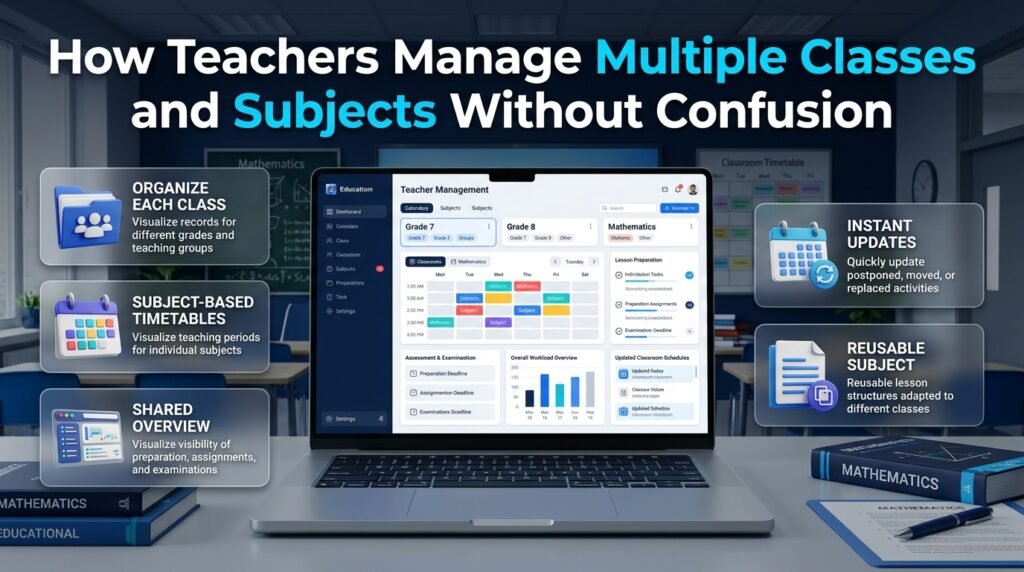
Managing multiple classes requires more than a general task list. Teachers need an organizational structure that separates classroom information while providing a complete view of their workload.
Organize Each Class Independently
Create separate records for different grades or teaching groups.
For example, Grade 7 Mathematics should have its own lesson preparation activities, assessment deadlines, and teaching notes.
This prevents information from being mixed with Grade 8 Mathematics.
Use Subject-Based Timetables
Subject-based organization helps teachers identify when each subject is scheduled and which preparation activities are connected to it.
A Student Class Period Organizer is a related resource for understanding how class periods can be arranged.
Maintain a Shared Overview of Your Workload
Separate class records are useful, but teachers should also maintain an overall view.
This makes it easier to identify situations where several assignments, examinations, or preparation tasks fall within the same period.
Record Schedule Changes Immediately
If a class is postponed, moved, or replaced with another activity, update the relevant schedule as soon as possible.
Depending on memory or informal messages can create confusion, especially when several teachers share classroom responsibilities.
A Class Timetable Grid Builder relates to the structured organization of class periods and timetable information.
Prepare Reusable Subject Templates
Teachers who teach similar topics across different classes can save time by using reusable lesson structures.
However, templates should not be copied without reviewing the needs of each class.
Students may have different learning levels, available classroom time, and instructional requirements.
Coordinating Teacher Workflows With the Academic Calendar
Daily teaching responsibilities are connected to the wider academic calendar.
Teachers need to consider semester dates, institutional holidays, school events, examination periods, and academic milestones when preparing their schedules.
A weekly workflow that ignores these larger dates may become difficult to maintain.
Understanding the Role of Academic Calendar Planning
Academic calendar planning provides a broader view of educational activities across a term or school year.
It helps teachers understand when important academic periods begin and end, when holidays occur, and when major activities require preparation.
The Academic Calendar Planning resource relates to this broader scheduling process.
Organizing Holidays and Teaching Periods
School holidays affect lesson delivery, revision schedules, assessment preparation, and institutional activities.
Teachers should review holiday dates before preparing long-term lesson plans.
The Academic Holiday Calendar Builder is relevant to organizing holiday information within an academic planning structure.
Managing Semester Milestones
A semester often contains several important stages.
These may include:
- Semester opening activities.
- Curriculum progress reviews.
- Assignment submission periods.
- Midterm examinations.
- Revision periods.
- Final assessments.
- Semester closing responsibilities.
A Semester Milestone Calendar provides a related planning topic for organizing these academic stages.
Coordinating School-Wide Events
School events may influence classroom schedules and teacher availability.
Sports days, parent meetings, educational trips, staff development activities, and school celebrations should be considered when planning teaching responsibilities.
A School Year Event Calendar is relevant to organizing these events across the academic year.
Managing Rotating Teaching Schedules
Some schools use rotating timetables because of shared facilities, laboratory availability, staffing arrangements, or alternating classroom periods.
These schedules require careful coordination.
Teachers should understand which periods apply on different days and how changes affect their lesson preparation.
The School Rotation Scheduling resource relates to these more specialized academic scheduling requirements.
Managing Examinations, Assignments, and Assessment Workflows
Assessment responsibilities require careful organization because they involve fixed dates, preparation activities, student submissions, grading, and feedback.
Teachers should treat these as connected processes rather than isolated calendar entries.
Organizing Examination Preparation
Examination preparation begins before the actual assessment date.
Teachers may need to review curriculum coverage, prepare examination materials, coordinate with colleagues, and organize revision activities.
A structured workflow can separate these responsibilities into manageable tasks.
The Exam Schedule Planning resource is relevant to the wider organization of examination activities.
Tracking Assignment Submission Dates
Assignment deadlines should be recorded according to subject and class.
For example, a teacher handling three classes may have different submission dates for each group.
Separate task records make it easier to identify outstanding submissions and plan grading activities.
Connecting Assessments With Lesson Planning
Assessment schedules should reflect the progress of classroom instruction.
If a topic has not been covered adequately, the teacher may need to adjust revision activities or discuss schedule changes with the relevant department.
A connected workflow helps educators identify these relationships earlier.
Scheduling Grading and Feedback
Grading should be treated as a separate professional responsibility.
Teachers should allocate enough time to evaluate work carefully, prepare useful feedback, and update relevant records.
Avoid placing all grading responsibilities at the end of an already demanding week.
Avoiding Examination Scheduling Conflicts
When teachers coordinate several classes or departments, overlapping examination arrangements can create difficulties.
Institutions should check subject schedules, classroom availability, student groups, and staff responsibilities before finalizing an examination timetable.
Teacher Workflow Apps and Student Productivity Systems

Teachers and students have different responsibilities, but their daily routines are closely connected.
Teachers organize instruction, academic deadlines, and assessment activities. Students manage study periods, homework, assignments, and personal learning goals.
A well-coordinated academic environment considers both sides.
Understanding Educational Productivity Apps
Educational productivity applications support the organization of learning and academic responsibilities.
They may include planning, reminders, study organization, and productivity features.
Teachers can understand the wider category through Educational Productivity Apps.
Why Student Productivity Tools Matter to Teachers
Students who organize their work effectively may find it easier to follow classroom expectations, prepare assignments, and manage academic deadlines.
However, teachers should not assume that every student has the same level of digital access or organizational skills.
Providing clear instructions and realistic deadlines remains essential.
Student Productivity Apps
Student productivity applications generally focus on managing individual learning activities.
Students may use them to record assignments, prepare revision plans, organize study sessions, and track personal progress.
The Student Productivity Apps topic provides a related perspective on student-centered digital organization.
Student Productivity App
A student productivity app can help learners manage their academic responsibilities independently.
Teachers may encourage appropriate planning habits by explaining how students can break larger assignments into smaller tasks and monitor completion.
The Student Productivity App resource relates to this individual learning approach.
Student Daily Workflow App
A student’s daily workflow differs from a teacher’s professional schedule.
Students need to balance classroom periods, homework, independent study, revision, and personal activities.
A Student Daily Workflow App relates to organizing these recurring activities.
Student Workspace Organizer App
An organized workspace helps students keep their learning materials, tasks, and study information accessible.
Teachers can encourage students to separate subjects, maintain clear assignment records, and avoid unnecessary digital distractions.
The Student Workspace Organizer App topic explores this type of organization.
Digital Student Routine App
A consistent study routine helps students understand when to complete homework, revise lessons, and prepare for upcoming assessments.
A Digital Student Routine App relates to building structured student routines.
The connection between teacher and student workflows is important: teachers create clear academic expectations, while students develop the organizational habits needed to meet them.
Common Mistakes Teachers Make When Using Workflow Apps
Digital applications can improve organization, but poor implementation can create additional work.
Teachers should understand common mistakes before making workflow management a regular part of their teaching routine.
1. Installing Too Many Applications
Why it happens: Teachers look for separate solutions for lesson planning, reminders, notes, calendars, communication, and task tracking.
Why it is harmful: Information becomes scattered, and the teacher has to check multiple platforms to understand what needs attention.
How to avoid it: Begin with one primary organizational system. Add specialized applications only when they solve a problem that the existing system cannot handle.
2. Creating an Overloaded Schedule
Why it happens: Teachers assume that filling every available time period will make them more productive.
Why it is harmful: Unexpected student needs, meetings, and schedule changes can disrupt the entire day.
How to avoid it: Include realistic preparation periods, breaks, and flexible time.
3. Mixing Information From Different Classes
Why it happens: Teachers record activities in general lists without adding class or subject details.
Why it is harmful: It becomes difficult to identify which lesson, assignment, or deadline belongs to which group.
How to avoid it: Use consistent class names, subject labels, and task descriptions.
4. Ignoring Long-Term Academic Dates
Why it happens: Teachers concentrate on daily activities without checking semester schedules or school events.
Why it is harmful: Important examinations, holidays, and institutional activities may conflict with lesson preparation.
How to avoid it: Review the academic calendar before preparing weekly and monthly schedules.
5. Depending Entirely on Automated Reminders
Why it happens: Teachers believe that reminders will automatically prevent missed deadlines.
Why it is harmful: Notifications may be disabled, overlooked, or delayed.
How to avoid it: Combine reminders with a regular daily and weekly schedule review.
6. Failing to Protect Student Information
Why it happens: Teachers may use convenient digital tools without checking how student information is handled.
Why it is harmful: Confidential records may be exposed or shared with unauthorized individuals.
How to avoid it: Use approved educational platforms, appropriate permissions, secure accounts, and responsible data-sharing practices.
7. Creating Unnecessary Task Categories
Why it happens: Teachers attempt to organize every small activity into a separate category.
Why it is harmful: Maintaining the organizational structure becomes another administrative responsibility.
How to avoid it: Keep categories broad enough to remain practical while maintaining separate records for genuinely different classes or subjects.
8. Not Reviewing Completed and Unfinished Work
Why it happens: Teachers create tasks but forget to update their status.
Why it is harmful: Old activities remain in the system, making it difficult to understand current responsibilities.
How to avoid it: Review outstanding tasks regularly and close, reschedule, or remove activities when appropriate.
9. Using Templates Without Adapting Them
Why it happens: Reusable lesson structures save time, so teachers copy them without considering the needs of a particular class.
Why it is harmful: Students may have different learning requirements, and the same instructional approach may not work equally well for every group.
How to avoid it: Treat templates as starting points. Adapt lesson objectives, examples, activities, and assessment methods according to student needs.
10. Expecting Technology to Solve Every Teaching Problem
Why it happens: Teachers expect a new application to automatically improve their productivity.
Why it is harmful: Technology cannot replace professional judgment, instructional experience, classroom relationships, or effective teaching practices.
How to avoid it: Use digital systems to support organization while keeping educational decisions centered on students and learning objectives.
Expert Recommendations for Creating a Sustainable Teaching Workflow

An effective workflow should remain useful throughout the academic year, including periods when responsibilities increase.
The following recommendations focus on sustainable organizational habits rather than complicated productivity systems.
1. Build Your Workflow Around Teaching Priorities
Start with the activities that directly support classroom learning.
Lesson preparation, instructional materials, student assessment, and feedback should receive appropriate attention.
Administrative tasks are important, but they should not automatically consume every available preparation period.
2. Use Time Blocking for Demanding Activities
Time blocking means reserving specific working periods for particular responsibilities.
For example, a teacher may reserve Monday afternoon for lesson preparation and Thursday afternoon for grading.
The purpose is to reduce unnecessary switching between unrelated activities.
Time blocks should remain flexible enough to accommodate urgent classroom requirements.
3. Prepare for the Following Week in Advance
A short weekly planning session can prevent many organizational problems.
Review upcoming lessons, identify important deadlines, check school events, and confirm whether necessary materials are available.
This creates a more informed starting point for the next working week.
4. Keep Daily Tasks Manageable
Avoid creating excessively long daily task lists.
Identify the most important responsibilities and arrange additional activities around them.
A short, realistic plan is easier to follow than a large list that cannot be completed within available working hours.
5. Establish Clear Naming and Record-Keeping Standards
Use consistent names for subjects, classes, assessments, and academic activities.
This is particularly important for teachers working in departments where multiple educators share information.
Consistent records reduce misunderstandings and make collaboration easier.
6. Review Digital Tools Before Introducing Them to a School
An application that works for one educator may not be suitable for institutional use.
Schools should evaluate:
- User access and permissions.
- Data protection requirements.
- Compatibility with existing systems.
- Training requirements.
- Technical support.
- Costs and subscription conditions.
- Reporting and collaboration capabilities.
A planned introduction is generally more effective than asking every teacher to adopt a new system without guidance.
7. Maintain a Backup of Important Academic Information
Teachers should understand how their chosen platform stores and protects information.
Where supported and permitted, keep appropriate backups of essential planning records.
Do not assume that every application automatically provides complete data recovery.
8. Measure Improvements Through Practical Results
Do not judge a workflow solely by the number of tasks completed.
Consider whether lessons are better prepared, deadlines are more manageable, grading is organized, and unnecessary administrative effort has decreased.
These outcomes provide a more meaningful indication of whether the system is working.
How Schools Can Introduce Teacher Workflow Apps Successfully
Individual teachers can organize their own responsibilities, but school-wide adoption requires additional planning.
A school may have several departments, different teaching schedules, administrative procedures, and technology requirements.
Introducing a new workflow system without considering these differences can create confusion.
Identify Institutional Requirements
Before selecting a platform, administrators should understand how teachers currently manage lesson plans, schedules, assignments, and academic communication.
The goal should be to identify practical improvements rather than introduce technology simply because it is available.
Start With a Small Pilot Group
A pilot program allows a limited number of teachers to test the application before wider implementation.
Their feedback can reveal usability issues, missing features, and training requirements.
Provide Practical Training
Teachers should understand how to create tasks, organize schedules, manage permissions, and review progress.
Training should focus on everyday responsibilities rather than explaining every advanced feature.
Establish Clear Usage Guidelines
Schools should explain which activities should be recorded digitally and which platforms are approved for student information.
This prevents duplicate records and inconsistent practices.
Evaluate Adoption and Feedback
After implementation, administrators should review feedback and determine whether the system has improved organization.
The best digital workflow is one that teachers can use consistently without unnecessary technical difficulty.
Choosing the Right Teacher Workflow App: A Practical Decision Guide
There is no single application that is ideal for every educator. The right choice depends on the complexity of the teaching environment and the problems that need to be solved.
Before selecting a solution, compare your requirements against the following criteria.
| Evaluation Factor | What to Check | Why It Matters |
|---|---|---|
| Ease of use | Clear interface and simple navigation | Reduces learning time |
| Scheduling | Calendar and timetable features | Supports academic organization |
| Task management | Priorities and progress tracking | Helps manage workload |
| Lesson planning | Subject and class organization | Improves preparation |
| Notifications | Adjustable reminders | Prevents missed activities |
| Collaboration | Sharing and permissions | Supports teamwork |
| Privacy | Data handling and security | Protects student information |
| Compatibility | Available devices and systems | Supports daily access |
| Pricing | Free and paid capabilities | Controls costs |
| Support | Documentation and assistance | Helps resolve problems |
Questions to Ask Before Choosing
Does the application solve my main problem?
If your biggest challenge is lesson preparation, a tool focused on grading may not be the best starting point.
Can I use it without extensive training?
An application should make ordinary responsibilities easier, not introduce another complicated process.
Will it work with my existing school system?
Compatibility matters when teachers already use institutional calendars, communication platforms, or learning management systems.
Can I manage information securely?
Privacy and access permissions are essential when handling student-related information.
Will I continue using it after the first few weeks?
Choose a system that fits your actual working habits. Long-term consistency is more valuable than a collection of advanced features that rarely get used.
Practical Example: A Teacher’s Organized Weekly Workflow
Consider a teacher responsible for two subjects and three different classroom groups.
The teacher needs to prepare lessons, deliver instruction, check assignments, attend a staff meeting, and complete examination preparation.
Without a clear system, these responsibilities may overlap.
A structured weekly workflow could look like this:
| Day | Teaching Work | Preparation and Administration |
|---|---|---|
| Monday | Mathematics and Science lessons | Review weekly priorities |
| Tuesday | Mathematics classes | Prepare Science resources |
| Wednesday | Science and revision | Check submitted assignments |
| Thursday | Mathematics and Science | Grading and student feedback |
| Friday | Classroom revision | Review next week’s schedule |
The teacher can use separate class categories to maintain lesson records and assignment information.
The weekly calendar provides an overview of scheduled activities, while task tracking identifies outstanding work.
At the end of Friday, the teacher reviews completed activities and records important dates for the following week.
This example demonstrates how a simple organizational structure can connect classroom instruction, lesson preparation, and administrative responsibilities without requiring a complicated productivity system.
What Are the Best Features to Look for in Teacher Workflow Apps?
The best teacher workflow apps offer practical features that help educators manage lesson preparation, classroom schedules, assignments, grading, and daily administrative responsibilities. Rather than choosing an application simply because it has many tools, teachers should focus on features that solve their actual organizational problems. A well-designed workflow system should make everyday activities easier to manage while keeping important academic information accessible.
Some of the most valuable features include:
Lesson Planning: Organize teaching topics, learning objectives, classroom activities, and instructional materials.
Task Management: Create daily responsibilities, assign priorities, and monitor unfinished work.
Calendar Scheduling: Manage teaching periods, examinations, meetings, holidays, and academic deadlines.
Assignment Tracking: Keep submission dates and grading responsibilities organized.
Notifications and Reminders: Receive timely alerts about important activities.
Progress Monitoring: Review completed tasks and identify responsibilities that need attention.
Class Organization: Maintain separate records for different subjects, grades, and student groups.
Professional advice: Prioritize ease of use, reliable scheduling, and clear task organization. An application that supports your everyday teaching routine is more valuable than one with complicated features you rarely use.
How Can Teacher Workflow Apps Help Teachers Save Time and Reduce Daily Workload?
Teacher workflow apps can save time by reducing repetitive organizational activities and making professional responsibilities easier to track. Teachers often spend considerable time remembering deadlines, preparing lesson materials, checking assignments, and coordinating classroom activities. A structured digital workflow helps bring these responsibilities into an organized system, reducing the need to repeatedly search through notebooks, messages, and separate records.
For example, a teacher managing three classes can create separate lesson preparation tasks, record assignment deadlines, and schedule grading periods in advance. Instead of remembering every activity, the teacher can review an organized weekly schedule and focus on the most important responsibilities.
The main time-saving benefits include:
Less Repetitive Planning: Reusable lesson templates reduce repeated preparation work.
Better Deadline Control: Digital reminders help teachers prepare before important submission dates.
Faster Task Organization: Categories make it easier to locate classroom and administrative responsibilities.
Improved Scheduling: Teachers can distribute demanding activities across different working periods.
Easier Progress Tracking: Completed and unfinished responsibilities remain visible.
Professional advice: Start by organizing the three activities that consume most of your working time. Improving these areas first is more effective than trying to automate your entire teaching routine immediately.
Are Teacher Workflow Apps Suitable for Managing Multiple Classes and Subjects?
Teacher workflow apps are particularly useful for educators who manage multiple classes, subjects, and grade levels because they provide a structured way to separate responsibilities without losing sight of the overall teaching schedule. When information is maintained in one general list, it becomes easy to confuse lesson plans, assignment deadlines, and classroom activities belonging to different groups.
A better approach is to create individual categories for each subject and class while maintaining a shared weekly overview.
For example, a teacher responsible for Grade 7 Mathematics, Grade 8 Mathematics, and Grade 9 Science can maintain separate records for lesson preparation, classroom activities, and assessment deadlines.
A practical organizational structure includes:
Separate subject and class categories.
Individual lesson preparation records.
Class-specific assignment deadlines.
Separate grading and feedback tasks.
A shared calendar for teaching periods and meetings.
Weekly reviews of overlapping responsibilities.
Professional advice: Use consistent naming conventions, such as “Grade 8 – Mathematics – Chapter 4 Preparation.” This makes information easier to find and reduces confusion when several classes have similar activities.
How Should Teachers Choose Between Free and Paid Workflow Apps?
Teachers should choose between free and paid workflow applications according to their actual teaching requirements, available budget, and the features they need regularly. Free applications can be sufficient for educators who mainly require basic task lists, digital calendars, reminders, and simple lesson organization. Paid options may become useful when teachers need advanced collaboration, additional storage, reporting, automation, or institutional management capabilities.
Before purchasing a subscription, compare the available features rather than focusing only on the advertised price.
Consider these factors:
Free Features: Check whether basic scheduling, task creation, and reminders are available.
Usage Limits: Review restrictions on storage, projects, users, or activities.
Collaboration: Determine whether multiple teachers can share information.
Data Security: Understand how student-related information is stored and protected.
Compatibility: Check whether the application works on your desktop, mobile device, and existing school systems.
Subscription Costs: Compare recurring expenses with the practical benefits provided.
Professional advice: Begin with a free plan whenever it meets your requirements. Upgrade only when you encounter a specific limitation that affects your teaching workflow. This prevents unnecessary spending on features that provide little practical value.
How Can Teachers Create an Effective Daily Workflow Using Digital Planning Apps?
Teachers can create an effective daily workflow by combining a realistic teaching schedule with organized task lists, preparation periods, and clearly defined priorities. The most successful approach is to plan around actual classroom responsibilities instead of filling every available hour with activities. A balanced workflow should include lesson delivery, grading, administrative work, communication, and sufficient flexibility for unexpected situations.
A practical daily organization process can follow these steps:
Review the Daily Schedule: Check classroom periods, meetings, and important academic activities.
Identify Essential Tasks: Select the responsibilities that must be completed during the day.
Organize Lesson Preparation: Confirm that teaching materials and classroom resources are ready.
Allocate Grading Time: Reserve suitable periods for checking assignments and providing feedback.
Set Important Reminders: Add alerts for deadlines and scheduled activities.
Track Completed Work: Update task progress as responsibilities are finished.
Prepare for Tomorrow: Review unfinished activities and organize the next day’s priorities.
Professional advice: Keep your daily task list manageable and reserve a small flexible period for unexpected responsibilities. A realistic schedule that can be followed consistently is far more effective than an ambitious plan that becomes difficult to maintain.
Conclusion
Teacher workflow apps have become valuable tools for managing the many responsibilities involved in modern teaching. From preparing lesson plans and organizing class schedules to tracking assignments, monitoring academic deadlines, and managing daily administrative tasks, these digital tools help teachers bring their work into one organized system. Instead of relying on scattered notes, separate calendars, and repeated reminders, educators can use a structured workflow to understand what needs attention and when it should be completed.
However, an effective workflow is not simply about using more applications or adding more tasks to a digital calendar. It is about choosing practical features that support real teaching needs. Teachers should prioritize easy scheduling, clear task management, flexible reminders, subject organization, and reliable progress tracking. A simple system that is reviewed regularly is often more useful than a complicated setup that becomes difficult to maintain.
Schools and educators can also connect daily teaching activities with broader academic planning. Lesson preparation, classroom routines, examination schedules, semester milestones, and assignment deadlines should work together rather than operate as separate responsibilities. Exploring the tools and resources available through RTI Scheduler can help educators understand how different scheduling and productivity needs fit into a more organized academic workflow.
Ultimately, teacher workflow apps should make teaching more manageable, not create additional pressure. When educators use them consistently and realistically, they can reduce avoidable administrative work, improve time management, maintain better control over responsibilities, and protect more time for lesson delivery and student support. The most effective approach is to start with the tasks that consume the most time, build a practical daily routine, and improve the system as teaching requirements change.