

Introduction
Student Daily Workflow App | Managing everyday academic responsibilities is not always as simple as attending classes and completing homework. Students often have to balance lectures, assignments, examination preparation, reading activities, group projects, personal commitments, and unexpected academic changes. When these responsibilities are managed separately, even a relatively simple academic routine can become difficult to control.
A student may remember an upcoming examination but forget an assignment submission date. Another may spend considerable time deciding which subject to study instead of following a clear plan. These situations are common because academic responsibilities are connected, yet students often organize them through different notebooks, reminders, calendars, and applications.
A student daily workflow app helps bring these activities into a more organized system. It allows students to understand their daily responsibilities, arrange tasks according to importance, coordinate study sessions with class schedules, and maintain a clearer view of upcoming academic commitments.
However, an effective workflow involves more than recording activities in a digital planner. Students need a practical method for deciding what to do, when to do it, how much time to allocate, and how to adjust their plans when something changes.
The RTI Scheduler homepage provides a starting point for exploring academic scheduling and planning resources that support more organized educational routines.
This guide explains how students can develop a daily workflow, which features matter most, how to manage different academic responsibilities, and how to build a planning system that remains useful throughout the school or university year.
What Is a Student Daily Workflow App?
A student daily workflow app is a digital planning system that helps learners organize, prioritize, and monitor their everyday academic responsibilities. It brings activities such as class preparation, assignments, homework, revision, examinations, and personal study sessions into a structured routine.
Its purpose is not simply to show students what they need to complete. It helps them understand how different responsibilities fit together and how their available time should be distributed.
For example, a university student may have three lectures, a mathematics assignment, a laboratory report, and an upcoming English presentation. Managing these activities independently can make it difficult to identify the most important responsibility.
A daily workflow system allows the student to organize these activities according to their schedule, deadlines, and expected workload.
How Does a Daily Workflow System Actually Work?
A daily workflow begins with collecting academic responsibilities and converting them into manageable activities.
The student first records fixed commitments, such as lectures and scheduled classes. Next, they add flexible responsibilities, including homework, assignments, examination preparation, and independent learning.
The system then helps organize these activities into a practical sequence.
A simple workflow may look like this:
- Review the day’s academic commitments.
- Identify important assignments and deadlines.
- Select the highest-priority activities.
- Allocate suitable study periods.
- Complete tasks according to the plan.
- Review progress at the end of the day.
- Adjust unfinished activities when necessary.
This process creates a connection between planning and actual academic work.
How to Manage Study Materials in a Digital Student Workspace
Keeping study materials organized is essential for students who regularly work with lecture notes, assignments, research files, presentations, and online learning resources. Instead of saving everything in one location, learners should create separate subject folders, arrange documents by semester or topic, and use descriptive file names for quick identification. It is also useful to maintain a dedicated section for upcoming assignments, important notes, and frequently accessed resources. Reviewing and updating these folders regularly prevents unnecessary clutter and makes academic information easier to access.
Students looking to improve their digital organization can explore this resource 👉 Student Workspace Organizer App
It helps learners arrange academic files, organize subject-related resources, manage study documents, and maintain a more efficient digital learning environment.
How Is a Daily Workflow App Different From a Student Planner?
A traditional student planner usually focuses on recording schedules, important dates, homework, and general reminders. A daily workflow system places additional attention on task organization, activity sequences, priorities, and progress.
| Planning Area | Traditional Student Planner | Daily Workflow System |
|---|---|---|
| Class schedules | Records class times | Coordinates activities around classes |
| Homework | Lists assignments | Organizes completion activities |
| Deadlines | Records submission dates | Connects deadlines with preparation |
| Study sessions | Allows manual scheduling | Organizes sessions around priorities |
| Daily priorities | Usually selected manually | Structured task organization |
| Progress | Basic checking | Ongoing activity monitoring |
| Long-term planning | Depends on the planner | Connects daily work with broader goals |
Neither method is automatically better for every student. The difference is the level of organization required.
Students with a simple routine may need only a basic planner. Those managing several subjects, multiple deadlines, and changing academic responsibilities may benefit from a more connected workflow.
Why Do Students Need a Daily Academic Workflow?
Academic responsibilities rarely happen in isolation. An examination may require several days of revision, an assignment may depend on earlier research, and a class project may involve several preparation stages.
Without an organized approach, students can struggle to understand how these responsibilities affect one another.
It Makes Daily Academic Priorities Clearer
One of the most common student problems is deciding what deserves attention first.
A long task list may contain ten or fifteen activities, but completing them in random order is not always the best approach.
For example, an assignment due tomorrow should receive attention before optional reading scheduled for the following month. Similarly, an examination requiring several hours of preparation may deserve priority over a small administrative activity.
A structured workflow helps students distinguish between:
- Urgent assignments that need immediate attention.
- Important academic activities requiring consistent preparation.
- Regular learning responsibilities.
- Optional reading and additional practice.
- Personal commitments that affect available study time.
This distinction makes daily decisions easier and reduces unnecessary confusion.
It Reduces Forgotten Academic Responsibilities
Students receive information from several sources. Teachers announce assignment deadlines during lectures, examination dates appear on academic notices, and group projects may involve separate meeting arrangements.
When these details are stored in different places, important information can be overlooked.
A centralized workflow gives students one main location for reviewing their academic responsibilities.
For example, after receiving a new assignment, a student can immediately record its subject, submission date, estimated workload, and preparation requirements.
This reduces dependence on memory and makes upcoming responsibilities easier to monitor.
It Helps Students Develop Consistent Learning Habits
Productivity does not always come from studying for longer hours. Consistency is often more valuable because regular learning activities help students maintain their understanding of different subjects.
A daily workflow makes it easier to reserve time for:
- Reviewing recent lecture notes.
- Practicing difficult concepts.
- Completing assigned reading.
- Preparing for upcoming lessons.
- Revising previously studied material.
These activities become easier to maintain when they have a regular place in the student’s routine.
It Improves Awareness of Available Time
Students sometimes accept more academic responsibilities than their schedules can realistically support.
They may plan several assignments, examination preparation sessions, and personal activities without considering how much time each activity requires.
A daily workflow makes existing commitments visible.
Students can compare their available study periods with their actual workload and make adjustments before the schedule becomes unmanageable.
It Supports Independent Academic Responsibility
A well-organized workflow encourages students to manage their own responsibilities instead of depending entirely on teachers, parents, or classmates for reminders.
Students learn to record information, evaluate priorities, monitor progress, and make decisions about their available time.
These skills are useful beyond school and university because they support independent work and long-term organization.
What Features Should a Student Daily Workflow App Include?
Not every student needs advanced productivity features. The most useful application is one that supports actual academic requirements without making everyday planning complicated.
Before choosing a tool, students should understand which functions solve their most common problems.
1. Centralized Daily Task Management
Task management is the foundation of an effective student workflow.
Students should be able to record academic activities, organize them into categories, assign priorities, and update their completion status.
Useful task categories include:
- Homework and classroom exercises.
- Individual assignments.
- Research projects.
- Reading activities.
- Examination preparation.
- Laboratory work.
- Group assignments.
- Administrative academic responsibilities.
For example, instead of keeping separate lists for mathematics, science, and English, students can organize all their responsibilities in one system while maintaining subject-based categories.
This makes it easier to review the entire day’s workload.
2. Class Timetable Coordination
Daily study activities should be organized around actual class commitments.
If a student attends lectures between 9:00 AM and 1:00 PM, the workflow should reflect those fixed periods before additional study sessions are scheduled.
This prevents overlapping activities and helps students identify suitable times for independent work.
Students who need to arrange subject periods can use a Student Class Period Organizer as part of their broader academic planning approach.
3. Assignment and Coursework Tracking
An assignment is more than a title and submission date.
Students often need to understand what the assignment requires, how much preparation it involves, and which stages remain unfinished.
A useful assignment management system should allow them to organize:
- Assignment names.
- Subject or course details.
- Submission dates.
- Preparation stages.
- Estimated completion time.
- Current progress.
- Final submission status.
This becomes particularly important when several assignments have similar deadlines.
An Assignment Submission Calendar can support the organization of multiple academic submission dates.
4. Study Session Organization
Study sessions should have a specific academic purpose.
A general entry such as “study biology” does not clearly explain what the student should accomplish.
A more useful entry might be:
- Review the human digestive system.
- Prepare notes on chapter four.
- Practice fifteen biology questions.
- Revise the previous laboratory lesson.
Specific activities make study periods easier to follow and evaluate.
5. Deadline Reminders
Reminders help students keep important dates visible without repeatedly checking different academic documents.
Useful reminders may include:
- Assignment submission dates.
- Examination schedules.
- Project milestones.
- Class preparation requirements.
- Group meetings.
- Important academic announcements.
However, reminders should be used carefully.
If every minor activity generates a notification, students may begin ignoring all alerts, including genuinely important ones.
6. Progress Monitoring
Progress tracking allows students to understand whether their academic work is moving forward.
For example, a student preparing for a final examination may divide a subject into eight chapters and monitor which chapters have been revised and which still require practice.
This gives a more accurate picture of preparation than simply recording the examination date.
7. Calendar and Weekly Overview
A daily task list explains immediate responsibilities, but a weekly overview provides a broader understanding of upcoming workload.
Students can identify:
- Days containing several lectures.
- Assignment deadlines.
- Examination preparation periods.
- Available independent study sessions.
- Personal commitments.
- Potential scheduling conflicts.
A School Deadline Overview Tool can help provide a wider view of academic deadlines and important responsibilities.
8. Flexible Scheduling
Academic routines do not always remain unchanged.
Teachers may adjust lecture times, assignments may require additional preparation, and unexpected responsibilities may interrupt planned activities.
Students should be able to update their workflow without rebuilding the entire schedule.
Flexibility is important because a useful planning system must support real academic life rather than assume that every day will happen exactly as expected.
How to Build a Student Daily Workflow Step by Step

Creating an effective workflow requires a clear understanding of existing responsibilities, available time, and academic priorities.
The following method provides a practical structure that students can adapt to their own routines.
Step 1: Collect All Existing Academic Commitments
Start by recording activities that already occupy fixed periods.
These may include:
- School or university classes.
- Lectures and laboratory sessions.
- Transportation.
- Scheduled academic meetings.
- Extracurricular activities.
- Regular personal commitments.
Do not begin by assigning study sessions to every available period.
First, understand how much time is already committed.
Why it matters: A schedule built without considering existing responsibilities will often become unrealistic.
Practical example: A student attending university from 8:30 AM to 2:00 PM should plan independent study around those hours instead of assuming the entire day is available.
Professional advice: Record recurring activities first because they provide the foundation for all other scheduling decisions.
Step 2: Record Assignments and Upcoming Deadlines
After adding fixed commitments, collect information about unfinished academic work.
Include the official submission date and an estimated amount of preparation time.
For example:
| Assignment | Official Deadline | Personal Target |
|---|---|---|
| Mathematics coursework | Friday | Wednesday |
| Science report | Monday | Saturday |
| English presentation | Thursday | Tuesday |
| History reading | Sunday | Saturday |
Personal target dates give students additional time to review their work and handle unexpected problems.
For more structured deadline organization, an Academic Deadline Management approach can help students maintain visibility of upcoming responsibilities.
Common mistake: Recording only the final deadline without considering the preparation required before submission.
Step 3: Divide Responsibilities According to Priority
Once academic activities are recorded, organize them according to importance and urgency.
A simple system can use three priority levels.
High priority
- Assignments approaching their deadlines.
- Examination preparation requiring immediate attention.
- Important project milestones.
- Activities that prevent other work from progressing.
Medium priority
- Regular subject revision.
- Upcoming reading assignments.
- Coursework with sufficient preparation time.
- Activities supporting longer-term academic goals.
Low priority
- Optional additional reading.
- Non-urgent administrative activities.
- Extra practice that can be moved safely.
Priority should not depend only on the deadline.
A difficult assignment due in five days may require more attention today than a simple task due tomorrow.
Step 4: Estimate the Time Required for Each Activity
Students should avoid treating all academic tasks as if they require equal effort.
A short worksheet may take twenty minutes, while a research report may require several hours.
Estimate the time required for each activity before adding it to the daily schedule.
For example:
| Activity | Estimated Time |
|---|---|
| Review lecture notes | 25 minutes |
| Complete mathematics exercises | 45 minutes |
| Read a science chapter | 35 minutes |
| Prepare presentation notes | 60 minutes |
| Practice examination questions | 40 minutes |
These estimates are starting points rather than strict limits.
If a task regularly takes longer than expected, adjust future planning accordingly.
Step 5: Create Study Blocks Around Fixed Classes
After identifying available time, arrange study activities into manageable periods.
An example daily structure might look like this:
| Time | Activity |
|---|---|
| 7:00–8:00 AM | Morning preparation |
| 8:30–9:30 AM | First lecture |
| 9:30–10:30 AM | Second lecture |
| 10:30–11:00 AM | Break |
| 11:00 AM–1:00 PM | Academic classes |
| 1:00–2:30 PM | Lunch and rest |
| 2:30–3:30 PM | Assignment work |
| 3:30–4:00 PM | Break |
| 4:00–4:45 PM | Subject revision |
| 6:30–7:00 PM | Review unfinished activities |
| 7:00–7:15 PM | Prepare tomorrow’s priorities |
This example should be adjusted according to class timings, transportation, personal commitments, and individual concentration patterns.
Step 6: Connect Daily Activities With Weekly Academic Goals
Daily activities should contribute to larger learning objectives.
For example, a student preparing for a mathematics examination within four weeks should not depend on one long revision session immediately before the examination.
Instead, they can divide the syllabus into smaller topics and assign them to different days.
The same principle applies to research assignments, presentations, and semester projects.
A Semester Milestone Calendar can help connect everyday academic activities with broader semester objectives.
Step 7: Review Completed and Unfinished Tasks
At the end of the day, review the workflow.
Mark completed activities, identify unfinished responsibilities, and decide whether they should be rescheduled or divided into smaller tasks.
Do not automatically move every unfinished activity to tomorrow.
First determine why it was not completed.
Perhaps the original time estimate was inaccurate, another task became urgent, or the activity was more difficult than expected.
This review helps students improve their planning decisions over time.
Creating a More Organized Daily Study Schedule for Students
An organized daily schedule gives students a clearer way to manage their learning responsibilities and make steady progress toward academic goals. When classes, homework, revision sessions, project work, and personal activities are planned separately, it can become difficult to understand how much time each responsibility requires. A digital routine brings these activities together in a structured schedule, allowing students to identify their priorities and use available study time more effectively. For example, students can reserve specific periods for reviewing classroom lessons, completing assignments, preparing for examinations, and catching up on subjects that need additional attention. Setting realistic time limits and including regular breaks can also prevent an overloaded routine that becomes difficult to maintain. Students should review their schedules regularly and make adjustments when examination dates, assignment requirements, or class timings change. This simple planning habit encourages consistency, improves awareness of upcoming responsibilities, and helps students develop a more balanced academic lifestyle.
To make everyday academic planning easier and keep study activities better organized, explore 👉 Digital Student Routine App
This resource provides a useful approach to organizing daily student routines, coordinating study sessions, and managing academic responsibilities with greater consistency.
How to Organize Different Types of Academic Responsibilities
Students do not manage only one category of academic work.
Different responsibilities require different planning methods, and an effective daily workflow should account for these differences.
Managing Subject-Based Study Activities
Each subject may require a different learning approach.
Mathematics often involves problem-solving practice, while literature may require reading, interpretation, and written analysis.
Science subjects may involve conceptual understanding, practical exercises, and laboratory preparation.
Students should organize their study activities according to the actual requirements of each subject.
A Subject Timetable Maker can support the arrangement of subject-based academic periods.
Organizing Weekly Lessons and Class Periods
Weekly lesson organization helps students understand how teaching activities are distributed throughout the week.
It is especially useful when subjects have different frequencies or require specific classroom periods.
Students should review their weekly lesson structure before scheduling independent study.
A Weekly Lesson Period Planner can help organize these recurring instructional periods.
Creating a Clear Class Timetable
A class timetable provides a visual structure for scheduled academic activities.
Students can use it to understand which subject takes place during each period and identify available time for additional learning.
A Class Timetable Grid Builder can support the arrangement of lessons into an organized timetable.
Managing Assignments With Different Requirements
Not all assignments require the same preparation process.
A short classroom exercise may be completed in one session, while an extended coursework project may require research, drafting, editing, and final review.
Students should create separate preparation activities for larger assignments rather than relying on a single reminder.
A Coursework Due Date Manager can support the organization of coursework deadlines and preparation requirements.
How to Manage Examination Preparation Through a Daily Workflow
Examination periods require more detailed planning because students must distribute revision across different subjects while continuing to meet regular academic responsibilities.
A daily workflow helps turn a large examination syllabus into manageable preparation activities.
Start by Recording Every Examination Date
Students should collect official examination dates and organize them in chronological order.
This makes it easier to identify which subjects need attention first.
A Test Date Timetable Planner can help organize upcoming test dates within a structured schedule.
Divide the Syllabus Into Revision Units
Avoid treating an entire subject as one large task.
Divide the syllabus into chapters, topics, and individual learning objectives.
For example:
| Subject | Revision Unit | Preparation Activity |
|---|---|---|
| Mathematics | Algebra | Solve practice questions |
| Science | Energy | Review concepts |
| English | Grammar | Complete exercises |
| History | Modern history | Prepare topic notes |
This structure makes it easier to allocate time according to the difficulty of each topic.
Balance Revision With Practice
Reading notes is not the same as testing understanding.
Students should schedule both revision and independent practice.
Revision helps clarify concepts, while practice questions reveal whether the student can apply what they have learned.
Both activities should appear in the examination workflow.
Avoid Overloading the Final Days
A common problem is leaving several chapters until the last few days before an examination.
Students can avoid this by distributing preparation across the available weeks and setting smaller progress targets.
An Exam Schedule Generator can help organize examination dates, while an Examination Timetable Organizer can support a clearer overview of examination arrangements.
Organize Individual Examination Sessions
Some academic environments require more detailed examination arrangements than simply recording the subject and date.
Students may need to consider examination sessions, reporting times, subject groups, and other scheduled details.
An Exam Session Calendar Builder can support the organization of examination sessions.
An Assessment Sitting Schedule can also help structure individual assessment sittings and their associated arrangements.
How Can Students Manage Rotating Timetables and Changing School Days?
Some educational institutions do not follow the same daily timetable throughout the week.
They may use rotating subject schedules, alternating school days, or longer instructional cycles.
This creates an additional planning challenge because students cannot always depend on a conventional Monday-to-Friday timetable.
Understand the School Rotation Pattern
Students should first identify how the rotation works.
For example, a school may distribute subjects across different instructional days rather than repeating the same lessons every day.
The rotation pattern should be recorded accurately before students create their daily workflow.
A School Rotation Scheduling approach can help organize recurring instructional patterns.
Use a Rotation Schedule Generator When Needed
A rotating timetable may become difficult to maintain manually when several classes follow different sequences.
A School Rotation Schedule Generator can support the organization of more complex school-day patterns.
Organize Alternating A and B Days
Some schools use alternating schedules in which different subjects are taught on A days and B days.
Students need to understand which subjects belong to each day before planning homework and study sessions.
An A B Day Schedule Maker can help organize this alternating structure.
Manage Six-Day Academic Cycles
Schools using longer instructional cycles may need to track more than five regular school days.
A Six Day School Cycle Planner can help organize responsibilities across the complete cycle.
Keep Rotational Timetable Sequences Consistent
Students should avoid assuming that the same subject will always appear on the same weekday.
Instead, they should follow the actual sequence established by their institution.
A Rotational Timetable Sequence Builder can support the organization of repeating instructional sequences.
Plan Around Rotating School Calendars
A rotating timetable also affects how students plan their personal study periods and assignment preparation.
A Rotating School Day Calendar can help maintain a clearer understanding of changing instructional days.
How Should Students Connect Daily Workflows With Academic Calendars?
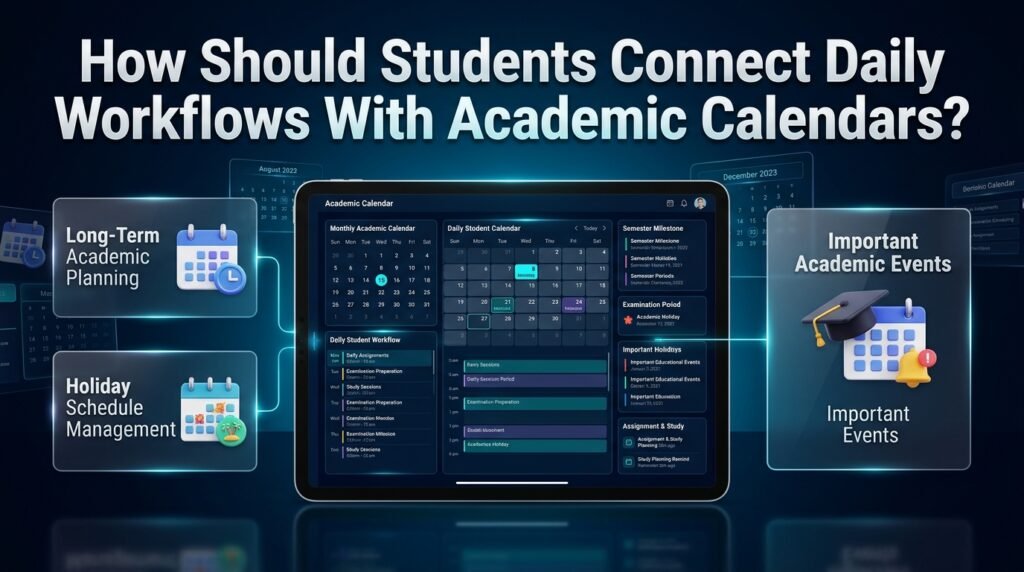
Daily planning becomes more reliable when students understand the broader academic calendar.
A daily task may be connected to an examination period, semester milestone, school event, or holiday.
These dates can influence how much time students have available for preparation.
Use Academic Calendars for Long-Term Awareness
An academic calendar provides a wider view of the educational year.
It helps students identify semester start dates, important deadlines, examination periods, holidays, and major institutional activities.
An Academic Calendar Planning approach helps connect these dates with everyday responsibilities.
Consider Holidays Before Scheduling Work
Academic holidays can affect study routines, assignment preparation, and examination planning.
Students should review scheduled breaks before creating long-term academic targets.
An Academic Holiday Calendar Builder can support the organization of educational holidays and related calendar dates.
Track Important Academic Events
Students may also have presentations, workshops, project reviews, institutional activities, and other important events throughout the year.
These activities should be considered when planning study periods.
A School Year Event Calendar can help provide a broader view of these events.
How Can Students Stay Productive Without Becoming Overwhelmed?
A productive daily workflow should make academic responsibilities easier to manage rather than creating additional pressure.
Students need a system that supports concentration, realistic expectations, and consistent progress.
Keep the Daily Plan Manageable
Avoid adding every possible academic activity to one day.
Select the responsibilities that genuinely require attention and distribute remaining work across suitable days.
A shorter, realistic plan is often easier to follow than an overloaded schedule.
Separate Deep Work From Routine Activities
Some academic tasks require sustained concentration.
Examples include:
- Solving difficult mathematics problems.
- Writing research assignments.
- Understanding complex scientific concepts.
- Preparing major presentations.
- Reviewing challenging examination topics.
These activities should receive suitable study periods.
Routine tasks, such as organizing notes or checking announcements, can be completed during less demanding periods.
Use Breaks as Part of the Schedule
Students should not treat breaks as wasted time.
Short periods of rest help create a more balanced routine and provide space between demanding activities.
A practical workflow should include meals, sleep, transportation, and personal commitments.
Reduce Unnecessary Digital Distractions
Students using digital productivity tools should avoid allowing notifications to interrupt every study session.
Turn off unnecessary alerts and keep only reminders that support important academic responsibilities.
The planning application should make studying easier, not become another source of distraction.
Common Mistakes Students Make When Using a Daily Workflow App
Even a well-designed planning system can become ineffective when students use it incorrectly.
Understanding common mistakes helps learners create better routines and avoid unnecessary complexity.
1. Adding Too Many Tasks to One Day
Students sometimes assume that every available hour should be used for academic work.
They create long lists containing several assignments, reading activities, lectures, and examination sessions without considering realistic completion times.
Why it happens: Students want to make rapid progress and underestimate the effort required.
Why it is harmful: An overloaded schedule creates pressure and makes unfinished work more common.
How to avoid it:
- Select a manageable number of important daily tasks.
- Estimate the time required for each activity.
- Include breaks and personal responsibilities.
- Move non-urgent work to suitable dates.
2. Using Too Many Productivity Applications
Installing several applications for similar purposes can divide academic information across different platforms.
One application may contain assignment deadlines, another may contain examination dates, and a third may store study reminders.
Why it happens: Students assume more applications will provide better organization.
Why it is harmful: Information becomes harder to locate, and duplicate entries may create confusion.
How to avoid it: Select one primary workflow system and use additional tools only when they provide a genuinely necessary function.
3. Ignoring the Actual Academic Timetable
A daily workflow becomes unreliable when it does not reflect the student’s real class schedule.
Students may accidentally schedule revision sessions during lectures or underestimate transportation time.
How to avoid it: Add fixed commitments before organizing flexible study activities.
4. Forgetting to Update Unfinished Activities
Leaving incomplete tasks in an outdated daily list can create a misleading picture of progress.
Why it is harmful: Students may repeatedly postpone activities without understanding why they remain unfinished.
How to avoid it: Review incomplete work, identify the reason for the delay, and assign a realistic new target.
5. Setting Deadlines Without Preparation Time
A final submission date does not explain how much work needs to happen beforehand.
Students who record only the official deadline may leave research, writing, and editing until the last moment.
How to avoid it: Divide major assignments into preparation stages and set personal target dates before the official submission.
6. Treating Every Academic Task Equally
A short reading activity and a major examination preparation session should not automatically receive the same priority.
How to avoid it: Evaluate each responsibility according to urgency, importance, difficulty, and required effort.
7. Ignoring Personal Responsibilities
A schedule that includes only classes and homework does not represent the student’s complete day.
Family commitments, transportation, meals, exercise, and rest also require time.
How to avoid it: Include important personal activities when estimating available study periods.
8. Spending More Time Planning Than Studying
Students can become overly focused on organizing task lists, adjusting calendar entries, and monitoring productivity statistics.
Why it is harmful: The planning system begins taking time away from meaningful academic work.
How to avoid it: Keep daily planning short and measure success through completed responsibilities and actual learning progress.
Expert Recommendations for Building a Sustainable Student Workflow

A useful workflow should remain practical during ordinary school days, examination periods, and unusually busy weeks.
The following recommendations focus on improving the quality of planning rather than increasing the number of digital tools.
Use the Three Most Important Tasks Method
At the beginning of each day, identify three academic activities that deserve the most attention.
For example:
- Complete the mathematics assignment.
- Review two science topics.
- Prepare notes for tomorrow’s lecture.
Smaller activities can remain on the general task list.
This method provides direction without making the daily plan unnecessarily long.
Schedule Difficult Work During Your Strongest Concentration Period
Students have different energy patterns.
Some find morning study sessions more productive, while others concentrate better in the afternoon or evening.
Observe when demanding academic work feels easiest and reserve those periods for challenging activities.
Use lower-energy periods for simpler tasks, such as organizing notes or reviewing deadlines.
Divide Large Projects Into Smaller Milestones
A large assignment can feel overwhelming when the only recorded activity is its final submission.
Create separate tasks for research, outlining, drafting, editing, and final review.
This makes progress easier to monitor and reveals delays before they become serious problems.
Review Upcoming Deadlines Every Week
A weekly review helps students identify workload changes before they create pressure.
Check upcoming assignments, examination dates, class requirements, and personal commitments.
If several major activities fall within the same period, distribute preparation across earlier days whenever possible.
Keep Flexible Time Available
Unexpected academic and personal activities are normal.
A class may run late, a project may require additional research, or a family responsibility may interrupt a planned study period.
Leaving some unallocated time makes the workflow more adaptable.
Measure Progress Through Meaningful Results
The number of completed checklist items does not always reflect academic understanding.
Students should also consider whether they can explain important concepts, solve practice questions independently, and complete assignments to the required standard.
A workflow should support learning outcomes rather than simply create impressive-looking productivity records.
How to Choose the Right Student Daily Workflow App
The right application depends on academic requirements, personal preferences, and the complexity of the student’s routine.
Students should evaluate practical features before choosing a system.
| Selection Factor | What to Evaluate |
|---|---|
| Ease of use | Can activities be recorded quickly? |
| Task organization | Can responsibilities be grouped by subject? |
| Calendar support | Can daily and weekly schedules be reviewed? |
| Deadline tracking | Are upcoming dates easy to monitor? |
| Reminders | Can important notifications be controlled? |
| Progress tracking | Can completed work be reviewed? |
| Device compatibility | Does it work on the devices being used? |
| Data privacy | Are personal academic details handled appropriately? |
| Cost | Are essential features available within budget? |
| Flexibility | Can the schedule be adjusted easily? |
Should Students Choose a Free or Paid Workflow Application?
A free application may be sufficient for students who need basic task management, calendars, and reminders.
Paid options may provide additional features such as collaboration, advanced organization, expanded storage, and automation.
However, students should not pay for functions they rarely use.
Begin with essential planning requirements and consider additional features only when they solve a specific problem.
Is a Mobile or Desktop Workflow Better?
Mobile applications are convenient for recording new assignments, checking reminders, and reviewing schedules during the school or university day.
Desktop platforms may provide a more comfortable environment for longer planning sessions, organizing detailed academic responsibilities, and reviewing larger calendars.
Students who use both devices should consider whether their chosen system supports reliable synchronization.
Should Students Use One Application for Everything?
A central planning system can organize many everyday academic activities, but specialized tools may still be useful for certain responsibilities.
For example, students may use separate systems for detailed class notes, collaborative documents, or specific examination arrangements.
The important thing is to maintain one reliable source for the main academic schedule and deadlines.
How Can Educational Institutions Support Better Student Workflows?
Student organization is influenced not only by individual habits but also by how educational institutions communicate academic information.
Schools, colleges, and universities can make daily planning easier by maintaining clear schedules and communicating important dates consistently.
Maintain Accurate Class and Subject Timetables
Students need reliable information about lesson periods, subject arrangements, and schedule changes.
Educational institutions should communicate timetable updates clearly to reduce confusion.
Coordinate Academic Deadlines
When assignment deadlines and examination dates are communicated through consistent channels, students can organize their preparation more effectively.
Teachers should provide clear submission requirements and reasonable information about important academic milestones.
Connect Institutional Calendars With Daily Planning
Academic calendars, school events, examination periods, and holidays influence students’ available study time.
Educational institutions should consider these activities together instead of treating them as unrelated scheduling responsibilities.
Support Independent Planning Skills
Students benefit from learning how to manage their own deadlines and academic responsibilities.
Teachers can encourage learners to divide assignments into stages, review weekly priorities, and maintain realistic study schedules.
These habits develop responsibility and support independent learning.
For a broader understanding of digital educational organization, students and educators can explore Educational Productivity Apps.
The goal is simple: spend less time wondering what needs to be done and more time completing meaningful academic work. A practical workflow, maintained consistently, can make everyday student life more organized, manageable, and productive.
How Can a Student Daily Workflow App Help Manage Classes, Assignments, and Daily Study Tasks?
Managing classes, assignments, homework, and personal study sessions becomes difficult when students have to remember everything separately. A student daily workflow app helps bring these responsibilities into one organized system, allowing learners to understand what needs attention and how their available time should be used.
Instead of creating a new plan every morning, students can review their existing timetable, check upcoming deadlines, and arrange study activities around fixed academic commitments. This makes daily planning more consistent and reduces the chances of forgetting important responsibilities.
For example, a university student with three lectures, a mathematics assignment, and an upcoming science examination can organize these activities according to their deadlines and preparation requirements. The student can reserve time for assignment work, schedule examination revision, and keep track of unfinished activities without maintaining several separate lists.
Important ways it helps students:
Centralized organization: Keep classes, homework, assignments, and study activities in one planning system.
Better time allocation: Arrange academic responsibilities around actual class timings and available study periods.
Deadline awareness: Identify upcoming submissions and examinations before they become urgent.
Daily priorities: Focus on important activities instead of randomly selecting tasks.
Progress monitoring: Review completed responsibilities and identify unfinished work.
The greatest advantage is that students spend less time deciding what to do next and more time completing meaningful academic work.
What Features Should Students Look for in a Daily Workflow and Study Planner App?
Students should look for features that solve their actual academic organization problems rather than choosing an application simply because it offers many advanced options. A useful daily workflow system should make it easier to manage class schedules, assignments, study sessions, examination dates, and changing academic responsibilities.
Task management and calendar organization should be considered essential because they help students understand both their immediate workload and upcoming commitments. Deadline reminders, priority settings, and progress tracking provide additional value when several subjects require attention at the same time.
Before choosing an application, students should evaluate whether its features support their everyday routine.
The most useful features include:
Daily and weekly scheduling: Helps students organize classes, study periods, and personal commitments.
Assignment management: Allows learners to record coursework, submission dates, and preparation activities.
Examination planning: Keeps test dates visible and supports subject-based revision.
Smart reminders: Provides notifications for important deadlines and scheduled activities.
Task prioritization: Helps distinguish urgent responsibilities from activities that can wait.
Progress tracking: Shows which assignments, revision topics, and academic activities have been completed.
Flexible scheduling: Makes it easier to adjust plans when classes or deadlines change.
Device compatibility: Allows students to review their schedules on the devices they regularly use.
Students should also consider ease of use and data privacy. An application that takes too much time to maintain may become another academic responsibility instead of a useful planning solution.
How Can Students Create a Realistic Daily Study Routine Using a Workflow App?
Creating a realistic study routine requires more than dividing the day into several study periods. Students must consider their actual class schedule, assignment workload, concentration levels, personal responsibilities, and the time needed for rest.
The most effective approach is to organize fixed commitments first and then use the remaining available time for independent learning. This prevents students from creating schedules that look productive but are difficult to follow in everyday life.
For example, a student attending classes from 8:30 AM to 2:00 PM might reserve the afternoon for assignment preparation and the evening for shorter revision sessions. The exact arrangement should depend on the student’s energy levels and academic requirements.
Follow these practical steps:
Record fixed commitments: Add lectures, school hours, transportation, and regular personal responsibilities before scheduling study sessions.
Identify important academic tasks: List assignments, homework, examinations, and unfinished coursework.
Set daily priorities: Select the three most important activities that deserve attention.
Allocate realistic study periods: Estimate how long each activity will take instead of assigning random time limits.
Include breaks: Leave enough time between demanding sessions to maintain a balanced routine.
Review progress: Check completed and unfinished activities at the end of the day.
Adjust the next schedule: Move delayed tasks to realistic periods rather than allowing them to accumulate.
A good daily routine should provide direction without making students feel that every minute must be controlled. Consistency, realistic expectations, and flexibility are more valuable than maintaining a perfect-looking timetable.
How Can a Student Daily Workflow App Help Manage Multiple Assignments and Examination Deadlines?
Managing multiple assignments and examination dates requires students to understand not only when academic work is due but also how much preparation is necessary before each deadline. A workflow application helps organize these responsibilities by keeping submission dates, preparation activities, and study priorities visible.
For example, a student may have a mathematics assignment due on Friday, a science report due on Monday, and an English examination scheduled for the following week. Completing these activities without a structured plan can create unnecessary pressure, especially when several responsibilities require attention within a short period.
A better approach is to divide large assignments into smaller stages and distribute examination revision across the available days.
A practical assignment and examination management method includes:
Record official deadlines: Enter every assignment submission date and examination date as soon as it becomes available.
Set personal target dates: Aim to complete important assignments before their official deadlines.
Divide large assignments: Separate research, outlining, writing, editing, and final submission into individual activities.
Organize examination topics: Divide each subject into chapters or revision units.
Prioritize difficult subjects: Give additional preparation time to topics that require more understanding or practice.
Review weekly workload: Identify days containing several academic deadlines and distribute preparation earlier.
Monitor unfinished work: Reschedule incomplete activities according to their importance and remaining time.
This method helps students avoid last-minute preparation and makes academic workload easier to understand. It also encourages them to start important activities earlier instead of depending on the final submission date.
What Is the Best Way to Choose a Student Daily Workflow App for Long-Term Academic Productivity?
Choosing a student daily workflow app should depend on the student’s academic requirements, preferred planning method, and the complexity of their everyday routine. An application that works well for a school student with a simple timetable may not provide enough organization for a university student managing several courses, research assignments, examinations, and group projects.
Students should first identify the problem they want to solve. Some mainly need a reliable class timetable, while others require assignment tracking, examination planning, recurring reminders, or a complete overview of their academic workload.
Instead of choosing an application based on popularity alone, evaluate how effectively it supports the activities that happen throughout the semester.
Consider these factors before making a decision:
Academic requirements: Check whether the application supports the subjects, courses, assignments, and examination schedules you manage.
Ease of use: Choose a system that makes adding and updating activities simple.
Planning flexibility: Make sure schedules can be adjusted when deadlines or class timings change.
Calendar organization: Look for daily, weekly, and monthly views that make upcoming responsibilities easier to understand.
Progress monitoring: Consider whether you can track assignment completion and examination preparation.
Device support: Check compatibility with your computer, tablet, or smartphone.
Pricing: Start with essential free features and consider paid options only when additional functions provide genuine value.
Privacy and reliability: Understand how academic information is stored and whether the application provides suitable account and data protection.
For long-term productivity, simplicity matters more than the number of available features. The best choice is an application that students can maintain consistently throughout ordinary academic weeks and demanding examination periods.
A well-organized workflow should gradually become part of everyday student life, helping learners manage responsibilities with greater confidence and less unnecessary confusion.
Conclusion
A student daily workflow app can make academic life more organized by bringing classes, assignments, study sessions, examination dates, and important reminders into one manageable system. Instead of relying on memory or switching between multiple planning methods, students can use a structured daily workflow to understand their priorities, manage available time, and complete academic responsibilities with greater confidence.
However, the real value of a productivity app does not come from simply adding tasks to a digital calendar. It comes from developing consistent habits, setting realistic daily goals, reviewing upcoming deadlines, and making adjustments when academic responsibilities change. A well-organized workflow should support learning rather than create another source of pressure.
Students can build a more connected planning routine by combining daily task management with academic calendars, class timetables, examination schedules, assignment deadlines, and milestone reminders. With the right planning approach, these tools help learners maintain a clearer view of both their immediate responsibilities and long-term academic goals.
Ultimately, a student daily workflow app is most effective when it matches a student’s actual routine and remains simple enough to use every day. By choosing suitable planning features and following a consistent schedule, students can reduce unnecessary confusion, improve time management, and create a more balanced and productive academic experience.