

Introduction
School Rotation Scheduling | When several classes need the same teacher, laboratory, computer room, or sports facility, even a carefully prepared school timetable can become difficult to manage. Students may arrive at the wrong classroom, teachers may face overlapping assignments, and important lessons can be delayed because the required resources are unavailable. These problems become more complicated when a school has multiple grade levels, specialist subjects, and changing academic commitments.
School rotation scheduling provides a structured way to organize classes, teachers, rooms, and learning activities across a repeating timetable. It helps schools decide which group attends each activity, when the activity takes place, and how students move between different learning environments. Instead of handling every scheduling conflict separately, administrators can establish a coordinated system that supports daily teaching and long-term academic planning.
Schools can use rotation scheduling for subject-based lessons, classroom learning stations, shared laboratories, alternating school days, physical education, intervention sessions, and specialist instruction. The right approach depends on the school’s size, curriculum, staffing arrangements, available facilities, and educational priorities.
This guide explains how school rotation scheduling works, which models are suitable for different educational settings, how to create a practical rotation timetable, and how to avoid common mistakes. It also explores resource management, calendar coordination, digital planning tools, and professional strategies that help schools maintain a reliable schedule.
For schools developing a more organized academic planning process, RTI Scheduler can serve as a relevant starting point for exploring connected scheduling and calendar-planning resources.
What Is School Rotation Scheduling?
School rotation scheduling is a method of arranging students, classes, teachers, rooms, and learning activities into a planned sequence that repeats over a specified period. Each group follows an assigned timetable so that instructional activities and shared resources are coordinated without unnecessary conflicts.
A rotation may take place every lesson, every day, every other day, or once a week. Some schools rotate students between specialist teachers, while others rotate small groups between classroom learning stations. The schedule can also determine when particular classes use laboratories, libraries, gyms, or technology facilities.
For example, a school with three student groups and three learning activities might assign mathematics to Group A, science to Group B, and language arts to Group C during the first period. During the next period, each group moves to a different activity according to the established sequence.
The purpose is not simply to make students move. A successful rotation ensures that every group receives its intended instruction while teachers, rooms, equipment, and time remain available when needed.
How to Create an Effective School Rotation Schedule
Schools often need rotation schedules to manage classroom activities, teacher assignments, student groups, laboratory sessions, library periods, and shared learning facilities. Without a properly planned rotation system, students may experience overlapping activities, teachers may face scheduling difficulties, and shared resources may not be used efficiently. Administrators should begin by identifying all groups, available time slots, assigned rooms, and rotation requirements. They should then distribute activities across the school timetable while considering teacher availability, classroom capacity, and suitable intervals between sessions. A well-organized rotation schedule improves resource utilization, maintains classroom coordination, and helps daily school operations run more smoothly.
For easier school rotation planning, explore this resource 👉 School Rotation Schedule Generator
This tool helps organize rotating activities, coordinate student groups, manage classroom schedules, and create a more structured rotation system for everyday school operations.
How to Create and Manage an Effective A/B Day School Schedule
Schools using an A/B day scheduling system need a well-organized timetable to manage alternating class days, subject periods, teacher assignments, and classroom availability. In this system, students follow one set of classes on A days and a different set on B days, allowing institutions to distribute lessons across alternating schedules. Administrators should clearly assign subjects to each day, maintain consistent period timings, and ensure that teachers and students understand the rotation pattern. It is also important to account for holidays, school events, and examination dates when preparing the calendar. A properly planned A/B schedule helps reduce timetable confusion, balance instructional time, and improve daily academic coordination.
For easier alternating-day timetable planning, explore this resource 👉 A B Day Schedule Maker
This tool helps organize A/B day rotations, coordinate alternating class periods, manage subject schedules, and maintain a clear academic timetable throughout the school term.
How to Organize a Six-Day School Cycle Schedule
Schools that follow a six-day rotating cycle need a structured planning system to coordinate subjects, classroom periods, teacher assignments, and daily academic activities. Unlike a traditional weekly timetable, a six-day cycle continues across school days, allowing lessons to rotate even when weekends or holidays interrupt the regular calendar. Administrators should begin by assigning subjects to each cycle day, distributing instructional periods evenly, and checking teacher and classroom availability. It is also important to communicate the rotation pattern clearly so students and teachers know which schedule applies on each day. A properly organized six-day cycle helps maintain balanced lesson distribution, reduce scheduling confusion, and improve academic coordination.
For easier rotating timetable management, explore this resource 👉 Six Day School Cycle Planner
This tool helps schools organize six-day rotations, coordinate subject periods, manage classroom schedules, and maintain a consistent academic cycle throughout the school term.
How Is Rotation Scheduling Different From a Traditional Timetable?
A traditional timetable usually specifies which subject a class studies during each period. A rotation schedule adds a coordinated sequence that determines how groups move between activities, teachers, facilities, or instructional arrangements.
The two approaches are not mutually exclusive. Most schools need a master timetable that combines ordinary subject allocations with rotation rules for activities that involve shared resources or multiple learning groups.
| Feature | Traditional fixed timetable | Rotation schedule |
|---|---|---|
| Main purpose | Assign subjects to periods | Coordinate sequences and resource use |
| Student movement | May be limited or fixed | Planned according to the rotation |
| Shared facilities | Allocated through room scheduling | Integrated into the rotation cycle |
| Repeating pattern | Usually follows a daily or weekly timetable | May follow daily, weekly, or multi-day cycles |
| Best use | Stable class and subject assignments | Shared resources, group activities, and changing learning arrangements |
A school can combine both methods to create a timetable that remains easy to understand while accommodating more complex scheduling needs.
How to Build an Effective Rotational Timetable Sequence
Educational institutions that use rotating timetables need a clear sequence to organize lessons, classroom periods, teacher assignments, and student groups across different school days. A properly designed rotation pattern ensures that subjects are distributed fairly and that students receive consistent instructional time without unnecessary scheduling conflicts. Administrators should begin by identifying the subjects and available periods, defining the rotation order, and assigning lessons according to teacher availability and classroom requirements. They should also review how weekends, holidays, and special school activities affect the sequence to maintain continuity throughout the academic cycle. A structured rotational timetable makes daily scheduling easier to manage and helps teachers and students follow changing academic routines with confidence.
For easier timetable sequence planning, explore this resource 👉 Rotational Timetable Sequence Builder
This tool helps organize rotating lesson sequences, coordinate subject periods, manage academic rotations, and maintain a consistent timetable structure throughout the school term.
Why Is School Rotation Scheduling Important?
School rotation scheduling helps educational institutions distribute teaching time and shared resources more effectively. It gives teachers and students a predictable sequence of activities while helping administrators identify conflicts before they disrupt the school day.
Its value becomes particularly clear when several classes depend on a limited number of specialist teachers or facilities.
1. It Improves the Use of Teachers and Facilities
A school may have enough teachers to deliver its curriculum but only one science laboratory, one computer room, or a small number of specialist instructors. Without a coordinated plan, classes may request the same resource simultaneously.
A rotation schedule assigns each class a suitable time slot. This makes resource use easier to manage and helps administrators determine whether existing facilities can meet demand.
For example, a computer teacher may work with three groups during separate periods, allowing students to receive instruction without competing for the same teacher or equipment.
2. It Creates More Predictable Student Routines
Students perform daily transitions more confidently when they understand where to go, what to bring, and which activity comes next.
A consistent rotation can reduce confusion, repeated announcements, and wasted instructional time. Teachers can also prepare materials in advance because they know which group will attend each session.
For younger students, visual rotation charts and consistent transition signals can make the process easier to follow.
3. It Supports Small-Group Instruction
Teachers sometimes need to work with a small group while other students complete independent or collaborative activities. A rotation schedule provides a framework for organizing these activities within the available lesson time.
For example, one group may receive direct instruction, another may complete a structured worksheet, and a third may participate in a supervised learning activity. The groups then rotate according to the planned sequence.
The activities should have clear learning objectives and suitable supervision. Dividing students into groups is not enough by itself; the instructional design must make productive use of each station.
4. It Reduces Scheduling Conflicts
Conflicts occur when a teacher is assigned to two classes at once, a room is double-booked, or an activity requires equipment that is already in use.
A well-designed rotation makes these constraints visible before implementation. Administrators can check the complete timetable instead of solving each problem after students and teachers have arrived.
This is particularly useful in secondary schools, where many classes share specialist teachers and subject-specific facilities.
5. It Helps Balance Academic Workloads
Rotation scheduling can distribute demanding subjects, practical sessions, and collaborative activities more evenly across the school week.
A school may avoid placing several resource-intensive lessons back-to-back or repeatedly scheduling the same group for difficult subjects at the end of the day.
Balanced scheduling does not mean every day must be identical. It means the overall pattern should support reasonable workloads, adequate preparation, and consistent access to instruction.
What Are the Main Types of School Rotation Scheduling?
Different schools require different rotation models. The most suitable choice depends on the number of groups, available teachers, room capacity, lesson objectives, and the amount of flexibility required.
1. Subject-Based Rotation
Subject-based rotation allows students to move between subjects or specialist teachers according to an established timetable.
For example, students may attend mathematics in one classroom, science in a laboratory, and language arts with another teacher during different periods.
This model works particularly well in secondary schools where teachers specialize in specific subjects.
Benefits include:
- More efficient use of specialist teachers.
- Clear subject and room assignments.
- Easier organization of subject-specific materials.
- Consistent access to specialist facilities.
The main challenge is coordinating movement between classrooms and ensuring that teachers are not assigned to overlapping sessions.
Schools can organize the subject sequence with a Subject Timetable Maker when they need a clearer view of lesson distribution across classes and periods.
2. Learning Station Rotation
Learning station rotation divides students into smaller groups that move between planned activities within a lesson or instructional block.
A typical classroom might have three stations:
- Teacher-led instruction.
- Independent practice.
- Collaborative or digital learning.
Suppose a class contains 24 students. The teacher divides them into three groups of eight and allocates 20 minutes to each activity. In a 60-minute lesson, every group can complete all three activities if transition time is accounted for within the schedule or the lesson duration is adjusted appropriately.
This model can support differentiated instruction because the teacher can provide more focused attention to a smaller group.
However, each station must have enough materials, clear instructions, and a suitable task. Students should know what to do if they finish early or need help while the teacher is working with another group.
3. A/B Day Rotation
An A/B day schedule divides courses across two alternating school-day patterns.
On an A day, students might attend mathematics, science, and language arts. On a B day, they might attend history, physical education, and arts.
This approach can support longer instructional periods and reduce the number of subjects students study during a single day.
The school must establish how the pattern works when a holiday, school closure, examination, or staff development day interrupts the normal cycle.
Administrators should also consider course continuity. Some subjects may require more frequent meetings than others, and longer gaps between lessons may not suit every curriculum.
4. Weekly Rotation
Weekly rotation assigns activities or facilities to different groups on particular days of the week.
For example, one class may use the library on Monday, while another class uses it on Tuesday. A laboratory or sports facility may follow a similar sequence.
This approach is helpful when several classes share limited resources but do not need access every day.
Its main advantage is predictability. Teachers can prepare materials in advance, and students can learn a stable weekly routine.
The limitation is that holidays and special events may interrupt the pattern. Schools should define whether the rotation pauses, shifts, or requires a replacement session when a scheduled day is missed.
5. Block Rotation
Block rotation organizes instruction into longer periods instead of dividing a subject into several short sessions.
A practical lesson might receive a 90-minute block to allow time for explanation, experimentation, practice, and review.
This model can be suitable for science experiments, art projects, technology activities, extended writing, and collaborative assignments.
However, a longer period needs careful pacing. Teachers should plan different stages of learning rather than extending one activity unnecessarily.
6. Hybrid Learning Rotation
Hybrid rotation schedules coordinate students across in-person lessons, online activities, and supervised independent learning.
For example, one group may attend a classroom session while another completes an approved online activity before the groups exchange activities according to the timetable.
This model requires clear instructions, suitable technology access, attendance procedures, and a reliable method for communicating schedule changes.
Schools should verify that every group receives the necessary instruction and support. An independent activity should not automatically be treated as an equivalent replacement for teacher-led instruction without considering its learning objectives.
Which School Rotation Model Should You Choose?

The best rotation model is the one that solves a specific operational or instructional problem without introducing unnecessary complexity.
| School requirement | Suitable starting model | Main consideration |
|---|---|---|
| Specialist teachers serving several classes | Subject-based rotation | Teacher availability |
| Small-group differentiated instruction | Learning station rotation | Supervision and task design |
| Longer periods across alternating days | A/B day rotation | Course continuity |
| Limited access to a shared facility | Weekly rotation | Calendar interruptions |
| Experiments and extended projects | Block rotation | Lesson pacing |
| In-person and online learning groups | Hybrid rotation | Access and participation |
Schools do not have to choose only one model. A secondary school may use subject-based scheduling for ordinary lessons, block rotation for laboratory work, and a weekly allocation for library sessions.
The key is to maintain one coordinated timetable so that the different arrangements do not conflict.
How to Create a School Rotation Schedule Step by Step
A reliable school rotation schedule begins with the school’s actual requirements. Administrators should identify constraints, choose a practical rotation cycle, assign resources, test the schedule, and communicate the approved plan.
Step 1: Identify the Scheduling Problem
Begin by defining the reason for introducing or changing the rotation.
The school may need to:
- Coordinate access to a shared laboratory.
- Reduce congestion during classroom transitions.
- Distribute specialist teachers across classes.
- Introduce small-group instruction.
- Organize alternating attendance.
- Improve access to sports or technology facilities.
Write down the expected outcomes before creating the timetable.
For example, if the main problem is competition for the computer room, the school may need a facility rotation rather than a complete redesign of every subject timetable.
Professional recommendation: Solve the most important scheduling problem first. Avoid changing stable parts of the timetable unless the change is necessary.
Step 2: Collect the Essential Information
Gather the details needed to determine which assignments are possible.
These should include:
- Classes, grades, and student groups.
- Required subjects and lesson frequency.
- Teacher availability and specialist qualifications.
- Classroom and facility capacity.
- Equipment requirements.
- Lesson durations and transition periods.
- Lunch breaks and fixed school activities.
- Accessibility and student support needs.
- Holidays, examinations, and important school events.
A laboratory session, for example, may require a qualified teacher, an available room, specific equipment, and enough time to complete the practical work safely.
All these conditions must be satisfied together. Checking only whether a period is free will not reveal every scheduling problem.
Step 3: Choose the Rotation Cycle
Determine whether students will rotate every lesson, daily, every other day, weekly, or according to another repeating pattern.
The cycle should match the instructional objectives and operational requirements.
For example, classroom learning stations may rotate several times during one lesson, while access to a shared sports facility may be scheduled by weekday.
Create a simple draft before filling in the complete school timetable.
| Period | Group A | Group B | Group C |
|---|---|---|---|
| Period 1 | Mathematics | Science | Language arts |
| Period 2 | Science | Language arts | Mathematics |
| Period 3 | Language arts | Mathematics | Science |
This example shows three groups rotating through three activities. It is a starting model, not a complete operational timetable. Teachers, rooms, equipment, and lesson durations must still be checked.
Step 4: Assign Teachers and Rooms
Once the sequence is established, allocate teachers and rooms to each activity.
A teacher cannot teach two classes at the same time. A laboratory cannot accommodate overlapping sessions that require exclusive use of the same facility.
Create a resource matrix to compare assignments.
| Resource | Period 1 | Period 2 | Period 3 |
|---|---|---|---|
| Science teacher | Group B | Group A | Group C |
| Laboratory | Group B | Group A | Group C |
| Mathematics teacher | Group A | Group C | Group B |
The assignments must match the group rotation and actual staff availability. If a teacher remains in one room, the school must also plan how groups reach that room without creating another conflict.
A Class Timetable Grid Builder can help organize period assignments into a structured grid that is easier to inspect and revise.
Step 5: Include Transition Time
Students need time to move between classrooms, collect materials, and prepare for the next activity.
If a lesson lasts 40 minutes and students need five minutes to change rooms, the school must account for that transition in its daily schedule. It should not assume that students can move instantly between activities.
Consider:
- Distance between classrooms.
- Number of groups moving simultaneously.
- Age and mobility of students.
- Equipment that must be carried.
- Safety requirements.
- Time needed to set up the next activity.
💡 Pro Tip: Test the actual movement pattern during a normal school day. Real transition times may be longer than expected, especially when several classes share the same corridors.
Step 6: Check Curriculum Coverage
Review the schedule across the entire rotation cycle, not just one day.
Count how many lessons each class receives in every subject. Confirm that practical activities have adequate time and that important lessons are not repeatedly missed when the cycle changes.
Check whether the rotation provides reasonable spacing between connected lessons. For example, students may struggle to complete a multi-stage project if its sessions are separated by long gaps.
The timetable should support the curriculum rather than forcing the curriculum to fit an arbitrary pattern.
Step 7: Review Teacher Workloads
Teacher assignments should be practical as well as technically possible.
Consider preparation time, marking, classroom setup, supervision duties, and the effort required to move between rooms. A schedule that fills every period may still create an unreasonable workload.
Specialist teachers may need additional preparation time when lessons involve equipment, experiments, or different age groups.
Discuss the draft with affected teachers before final approval. Their feedback can reveal practical issues that are difficult to identify from a spreadsheet alone.
Step 8: Create Clear Timetable Versions
Different users need different views of the same schedule.
A useful system may include:
- A master timetable for administrators.
- Individual teacher schedules.
- Class schedules for students.
- Room-use schedules for shared facilities.
- Rotation charts for classroom learning stations.
Use consistent class names, subject labels, room numbers, and period times. Colors can help distinguish activities, but written labels should remain clear for accessibility and printing.
A Student Class Period Organizer may be relevant when presenting class periods in a student-friendly format.
Step 9: Test the Schedule
Before publishing the timetable, check the complete rotation for conflicts.
Look for teachers assigned to overlapping lessons, rooms allocated to multiple groups, missing subject sessions, inadequate transitions, and activities scheduled when equipment is unavailable.
Then test realistic scenarios.
What happens if a teacher is absent? What happens when a holiday interrupts the rotation? Can a group reach its next classroom on time? Is there enough capacity for every scheduled student?
A schedule that works only under perfect conditions needs further review.
Step 10: Communicate the Approved Plan
Publish the approved timetable through the school’s established communication channels.
Explain the rotation cycle, start date, class assignments, room locations, and procedures for changes. Give teachers enough time to prepare lesson materials and help students understand the new routine.
A Weekly Lesson Period Planner can complement the process of organizing recurring lessons across a weekly timetable.
Step 11: Monitor and Improve the Rotation
After launch, collect feedback from teachers, students, and administrators.
Review late transitions, room conflicts, missed lessons, teacher workload, and resource utilization. Identify recurring issues instead of making repeated changes without understanding the cause.
If the same corridor becomes crowded every day, the problem may require staggered movement rather than a complete timetable redesign.
A successful rotation remains stable enough for people to learn the routine while allowing justified changes when school requirements evolve.
A Practical School Rotation Scheduling Example
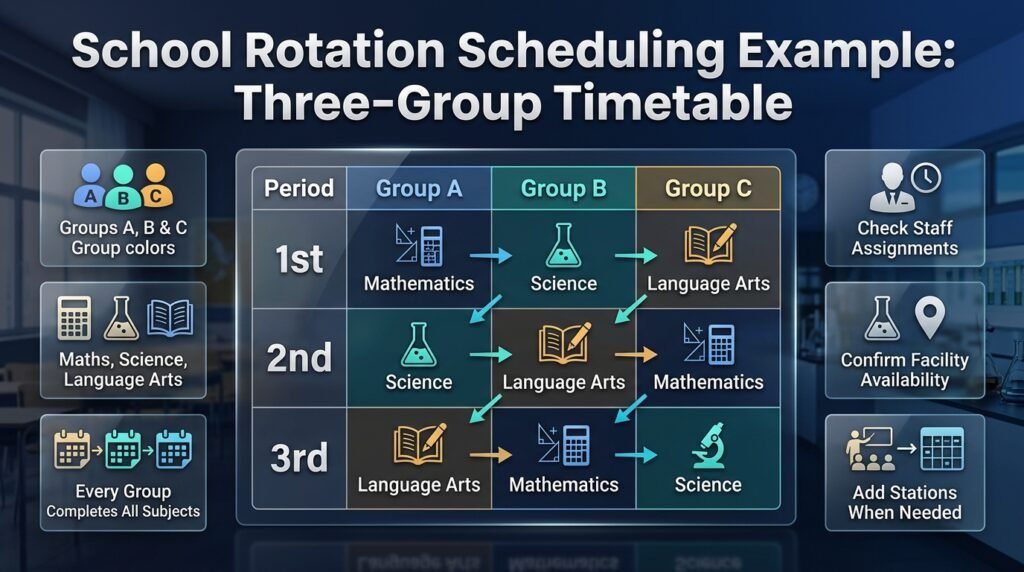
Imagine a secondary school with three groups that need mathematics, science, and language arts during a three-period cycle.
The school has designated teachers and appropriate learning spaces for each subject. Administrators want every group to complete all three activities without overlapping assignments.
An illustrative rotation looks like this:
| Period | Group A | Group B | Group C |
|---|---|---|---|
| First | Mathematics | Science | Language arts |
| Second | Science | Language arts | Mathematics |
| Third | Language arts | Mathematics | Science |
By the end of the third period, each group has attended all three subjects.
However, this pattern is workable only if the teacher and room assignments support it. If the school has only one science teacher and one laboratory, both must be available at the exact time assigned to each science group. If the timetable requires simultaneous science sessions, the school needs an alternative arrangement.
How Can the School Adapt This Example?
Administrators can extend the model by adding activities, adjusting lesson lengths, or allocating a period for intervention and enrichment.
For instance, a fourth station may be introduced if staffing, time, and facilities allow it. A practical subject may receive a longer block, while independent work may use a shorter period.
The school should not add stations merely to make the rotation appear more comprehensive. Each additional activity increases coordination requirements and should serve a clear educational purpose.
The example also demonstrates why a student timetable alone is insufficient. A successful rotation must coordinate student movement, teacher assignments, rooms, equipment, and instructional time.
How to Coordinate Rotation Scheduling With the Academic Calendar
School rotation scheduling must work alongside the academic calendar. Public holidays, school events, staff development, examinations, and unexpected closures can interrupt a normal rotation cycle.
A school should establish a consistent rule for handling interruptions before they occur.
For example, if a scheduled laboratory lesson falls on a holiday, the school might move the lesson to the next available suitable period. Another school may pause the cycle and resume it on the next instructional day. The correct approach depends on curriculum requirements, local policies, and available resources.
How to Organize a Rotating School Day Calendar
Schools that follow rotating day schedules need a clear calendar to manage changing class periods, subject rotations, teacher assignments, and daily academic activities. Instead of following the same timetable every day, a rotating schedule distributes lessons across different days to provide balanced access to subjects, classrooms, and teaching resources. Administrators should identify the rotation pattern, assign subjects to appropriate periods, and ensure that teachers and students understand which schedule applies on each school day. It is also important to consider holidays, special events, and examination periods when planning the calendar. A properly organized rotating school calendar reduces confusion, improves timetable coordination, and helps maintain consistent academic operations.
For easier rotating schedule management, explore this resource 👉 Rotating School Day Calendar
This resource helps schools organize rotating academic days, manage changing class schedules, coordinate subject periods, and maintain a clear overview of daily school activities throughout the academic term.
Use a Central Academic Calendar
A central calendar helps administrators identify important dates before approving the rotation.
The Academic Calendar Planning process can support the coordination of term dates and school-wide scheduling requirements.
For holiday management, the Academic Holiday Calendar Builder provides a relevant planning reference. Schools can also use a School Year Event Calendar to track assemblies, sports days, staff training, and other events that may affect ordinary lessons.
A Semester Milestone Calendar can help administrators identify important points in the academic cycle, while an Academic Milestone Reminder Planner can support reminders for upcoming planning responsibilities.
These resources address connected planning needs, but the school must still maintain an accurate rotation timetable and define how changes are approved.
What Happens When a Holiday Interrupts the Rotation?
Create a written recovery procedure.
The procedure should identify whether the rotation pauses, advances, or requires a replacement lesson. It should also explain who approves changes and how affected teachers and students are informed.
Avoid allowing different departments to make conflicting decisions independently.
If the interruption affects examinations or major assessments, coordinate the revised plan with the Exam Schedule Generator, Test Date Timetable Planner, and Exam Session Calendar Builder, as appropriate.
For more specific assessment arrangements, the Assessment Sitting Schedule and Examination Timetable Organizer can be considered as related planning resources.
The goal is to prevent an adjustment to the ordinary rotation from creating a second conflict with an examination or assessment session.
How to Manage Deadlines and Assignments Around Rotations
Rotation schedules can affect when students receive instructions, complete classroom activities, and prepare assignments. If a lesson is moved, students may have less time to complete work that depends on that session.
Schools should therefore coordinate important academic deadlines with the rotation timetable.
An Academic Deadline Management process can help administrators review important deadlines when instructional dates change.
For individual assignments, a Coursework Due Date Manager and an Assignment Submission Calendar are relevant to organizing submission dates and academic responsibilities.
Example: A Missed Lesson Before an Assignment Deadline
Suppose students are scheduled to receive project instructions during a lesson that is cancelled because the school hosts a special event. The assignment deadline remains unchanged, but students have lost an important preparation session.
The school should determine whether the lesson can be rescheduled, whether the instructions can be shared through an approved alternative, or whether the deadline requires review.
Administrators should also consider fairness across groups. If only one group loses the planned preparation time, the school should avoid creating an unnecessary disadvantage.
This is why timetable changes should be reviewed for their academic consequences, not just their effect on room availability.
How to Choose a School Rotation Scheduling Tool
The right scheduling tool depends on the complexity of the school timetable, the number of resources involved, and the amount of revision required.
A small school with a few groups may manage a rotation in a spreadsheet. A larger institution with many classes, specialist teachers, restricted rooms, and changing cycles may benefit from dedicated scheduling software.
The important factor is whether the tool supports the school’s actual workflow.
When Is a Spreadsheet Sufficient?
A spreadsheet may be appropriate when the rotation involves a limited number of groups, few shared facilities, and relatively infrequent changes.
To make it reliable:
- Use a consistent naming system for classes and rooms.
- Keep separate views for teachers, classes, and facilities.
- Use formulas or validation rules where practical.
- Maintain one approved master version.
- Record changes and their effective dates.
- Review the schedule manually for conflicts.
The limitation is that a spreadsheet does not automatically detect every conflict unless the necessary checks are designed and maintained correctly.
When Should a School Consider Dedicated Software?
Dedicated software may be more suitable when administrators repeatedly encounter scheduling conflicts or need to coordinate several rotation patterns at once.
Look for features such as editable timetable grids, teacher availability records, room allocation, conflict warnings, reusable templates, and clear printable schedules.
Do not assume that every tool provides all these features. Verify the actual capabilities before depending on automated checks or reporting.
The wider collection of Academic Planning and Scheduling Tools may be relevant when organizing related academic planning activities.
What Should Administrators Compare?
| Requirement | What to evaluate |
|---|---|
| Timetable complexity | Can the tool represent the school’s rotation cycles? |
| Conflict management | Can it identify overlapping teacher and room assignments? |
| Editing | Can authorized staff revise schedules efficiently? |
| Communication | Can the school create clear class and teacher timetables? |
| Calendar coordination | Can changes be checked against academic dates? |
| Version control | Can staff identify the approved timetable? |
| Cost | Does the solution fit the school’s budget? |
| Training | Can staff learn and maintain the workflow? |
Expert tip: Test a scheduling tool with a realistic sample that includes a shared teacher, a restricted room, and an unexpected change. This will reveal more about its usefulness than simply viewing a demonstration timetable.
Common School Rotation Scheduling Mistakes to Avoid

Even a well-designed rotation can fail when administrators overlook practical constraints or make changes without coordinating the wider timetable.
Mistake 1: Scheduling Subjects Without Checking Resources
Why it happens: Administrators begin with subject periods and check teacher and room availability later.
Why it causes problems: A lesson may be placed in a period when the teacher is unavailable or the required facility is occupied.
How to avoid it: Record all essential constraints first. Check teacher, room, equipment, and class assignments together before approving the schedule.
Mistake 2: Ignoring Transition Time
Why it happens: Timetable designers count only lesson duration.
Why it causes problems: Students arrive late, corridors become congested, and teachers lose instructional time.
How to avoid it: Include realistic passing time, examine room locations, and stagger movement where appropriate.
Mistake 3: Creating an Overly Complicated Rotation
Why it happens: Administrators introduce different patterns for every group to solve individual problems.
Why it causes problems: Students struggle to remember the sequence, teachers rely on repeated announcements, and small changes become difficult to manage.
How to avoid it: Use the simplest workable pattern. Provide visual schedules and consistent labels.
Mistake 4: Forgetting Holidays and School Events
Why it happens: The timetable is built around a normal week without considering interruptions.
Why it causes problems: Missed sessions may create unequal subject coverage or conflicts with examinations.
How to avoid it: Review the rotation against the academic calendar and define a recovery procedure before the term begins.
Mistake 5: Treating Every Group’s Needs as Identical
Why it happens: Uniformity makes timetables easier to create.
Why it causes problems: Different activities may need different durations, supervision, or accessibility arrangements.
How to avoid it: Maintain a consistent overall structure while making justified adjustments for student needs and instructional requirements.
Mistake 6: Updating One Timetable but Not the Others
Why it happens: An administrator informs a teacher about a change but forgets to update the master schedule or student-facing copies.
Why it causes problems: Staff and students may follow different versions of the timetable.
How to avoid it: Maintain one authoritative master version. Assign responsibility for publishing changes and clearly mark outdated copies.
Mistake 7: Skipping the Trial Period
Why it happens: The timetable appears correct on a computer screen, so administrators assume it will work in practice.
Why it causes problems: Real transitions, equipment needs, and student movement may differ from initial assumptions.
How to avoid it: Test the rotation with a limited number of groups, gather feedback, and correct practical problems before expanding it.
Mistake 8: Filling Every Period Without Reviewing Workload
Why it happens: The focus is on maximizing scheduled activity rather than ensuring that the arrangement is sustainable.
Why it causes problems: Teachers may lack preparation time, and students may face an unbalanced sequence of demanding lessons.
How to avoid it: Review lesson frequency, preparation requirements, and the distribution of difficult subjects across the full cycle.
Expert Strategies for Improving School Rotation Scheduling
Professional scheduling requires more than assigning subjects to available periods. It involves prioritizing constraints, managing changes, communicating clearly, and measuring whether the timetable actually works.
Schedule the Most Restrictive Activities First
Start with the activities that have the fewest scheduling options.
These often include specialist teachers, laboratories, practical lessons requiring specific equipment, and groups that need particular rooms or accessibility arrangements.
Once these constraints are satisfied, flexible activities can be allocated to the remaining periods.
This approach reduces the likelihood of having to redesign the entire timetable because one essential resource has no available slot.
Keep One Authoritative Master Timetable
A master timetable should contain the approved assignments for classes, teachers, rooms, and periods.
Simpler versions can then be created for individual users, but every version must reflect the same approved schedule.
This reduces inconsistencies and makes it easier to identify the consequences of a change.
Establish a Change-Control Process
Every significant timetable change should record what is changing, why it is necessary, who approved it, and when it takes effect.
A simple change record can include the affected class, teacher, room, period, reason for adjustment, conflict checks, and publication date.
This is particularly important when several administrators or department heads share responsibility for scheduling.
Plan for Teacher Absences
Teacher absences can interrupt several groups when one specialist teaches multiple classes.
Schools should define which lessons can be covered, moved, combined, or rescheduled. They must also consider staff qualifications, student supervision, equipment requirements, and the availability of suitable rooms.
A contingency plan should protect student safety and essential learning while minimizing disruption to the wider timetable.
Measure Whether the Rotation Is Working
Choose a few meaningful indicators before introducing the schedule.
These might include:
- Number of teacher and room conflicts.
- Frequency of late transitions.
- Percentage of planned lessons delivered.
- Number of timetable changes after launch.
- Teacher feedback about workload.
- Student understanding of the rotation sequence.
- Access to specialist facilities across groups.
Review these indicators after implementation. Recurring delays or missed lessons may reveal structural problems that need a targeted adjustment.
Keep Flexibility Within Clear Rules
A school needs a way to accommodate unexpected events without making the timetable unpredictable.
For example, teachers may be allowed to exchange certain activities when the change does not affect other classes or shared facilities. More significant changes may require administrative approval.
Written rules help prevent informal rescheduling from creating new conflicts elsewhere.
How Do You Create an Effective School Rotation Schedule?
Creating an effective school rotation schedule starts with understanding how classes, teachers, classrooms, and learning resources need to work together. School administrators should first identify the subjects that require specialist teachers, the facilities shared by multiple classes, and the time needed for each lesson. Once these requirements are clear, they can select a suitable rotation pattern and assign each group to specific periods without creating scheduling conflicts.
A well-planned schedule should also account for student movement, teacher preparation time, curriculum requirements, and unexpected changes. Before introducing the timetable across the school, administrators should test it with a small number of classes and collect feedback from teachers.
Important points to consider:
List all classes, subjects, teachers, rooms, and equipment requirements.
Select a daily, weekly, subject-based, or learning-station rotation model.
Check for overlapping teacher assignments and double-booked classrooms.
Include realistic transition time between activities.
Review the schedule regularly and update it when school requirements change.
What Is the Best Rotation Model for Schools?
The best rotation model depends on the school’s teaching approach, available resources, class sizes, and curriculum structure. Subject-based rotation works well when students move between specialist teachers, while learning station rotation is useful for small-group instruction and differentiated learning. A/B day scheduling may suit schools that prefer longer lessons across alternating days, whereas weekly rotation can help manage limited access to facilities such as laboratories, libraries, and sports areas.
Administrators should choose a model that solves a real scheduling problem rather than adopting a complicated system simply because it offers more options. In some schools, combining two models can provide greater flexibility without making the timetable difficult to follow.
Common rotation models include:
Subject-based rotation: Students attend different subjects with specialist teachers.
Learning station rotation: Groups move between teacher-led, independent, and collaborative activities.
A/B day rotation: Different subjects follow alternating school-day patterns.
Weekly rotation: Classes receive scheduled access to shared facilities on particular days.
Block rotation: Longer periods support practical lessons, experiments, and extended projects.
How Can Schools Prevent Conflicts in a Rotation Timetable?
Schools can prevent most rotation scheduling conflicts by checking teacher availability, room capacity, lesson requirements, and equipment access before finalizing the timetable. A schedule may look correct when viewed from an individual classroom’s perspective but still fail when the same teacher or facility is assigned to another group at the same time. Administrators should therefore review the entire timetable rather than checking each class independently.
Maintaining one approved master timetable is also important. When a lesson changes, the corresponding teacher schedule, room allocation, and student timetable should be updated together. For larger schools, scheduling software or carefully designed spreadsheet checks can help identify overlapping assignments before they disrupt lessons.
Practical ways to reduce conflicts:
Assign every shared room and specialist teacher to a specific time slot.
Check all classes against the same master timetable.
Include transition periods and room preparation time.
Record timetable changes and communicate them to affected staff.
Test the schedule for teacher absences, holidays, and room unavailability.
How Does School Rotation Scheduling Improve Student Learning?
School rotation scheduling can improve the learning experience by creating a predictable structure for lessons, small-group activities, and access to specialist instruction. When students know where to go and what they need for each activity, less time is wasted on confusion and transitions. Teachers can also prepare materials in advance and organize lessons around specific learning objectives.
In classroom station rotation, teachers may work directly with one group while other students complete independent practice or collaborative tasks. This arrangement can provide more opportunities for targeted instruction and help teachers identify students who need additional support. However, the benefits depend on the quality of the activities, suitable supervision, and realistic timing rather than the rotation pattern alone.
Ways rotation scheduling can support learning:
Creates consistent routines that students can follow.
Provides opportunities for small-group teaching and individual feedback.
Improves access to specialist rooms, equipment, and learning activities.
Encourages students to develop organization and time-management skills.
Helps teachers distribute instructional activities more purposefully.
How Often Should Schools Review and Update Their Rotation Schedules?
Schools should review rotation schedules regularly and update them whenever staffing changes, curriculum requirements, facility availability, or academic calendar events make an adjustment necessary. A timetable that worked at the beginning of the term may become less effective when new classes are added, teachers become unavailable, or examination periods interrupt the normal routine.
However, frequent changes without a clear reason can create confusion for students and staff. Administrators should establish a review process that considers actual scheduling problems, teacher feedback, missed lessons, transition delays, and resource use. Any approved adjustment should be communicated clearly, with the effective date and affected groups identified.
A useful review process includes:
Checking the timetable before each new term or major scheduling cycle.
Reviewing recurring room conflicts and delayed transitions.
Collecting feedback from teachers and relevant school staff.
Adjusting schedules when holidays, examinations, or special events affect lessons.
Keeping one current master timetable and marking outdated versions clearly.
The goal is to maintain a stable, understandable rotation that can adapt to genuine school needs without unnecessarily disrupting teaching and learning.
Conclusion
School rotation scheduling is an essential part of creating a well-organized, balanced, and effective learning environment. When schools plan class rotations carefully, they can manage classroom availability, teacher workloads, shared facilities, subject periods, and student movement with greater consistency. A well-structured rotation schedule also helps reduce timetable conflicts, avoid unnecessary disruptions, and ensure that students receive fair access to learning opportunities throughout the school week.
The most effective approach is to build a schedule around the school’s actual requirements rather than choosing a rotation model simply because it works for another institution. Administrators should consider class sizes, subject priorities, teacher availability, room capacity, student needs, and the resources required for practical or specialized lessons. They should also communicate schedule changes clearly and review the timetable regularly to keep it accurate as academic requirements evolve.
Schools can make this process easier by coordinating rotation plans with their wider academic calendar, lesson timetables, assessment dates, and important school events. Using structured academic planning and scheduling tools can help administrators organize these responsibilities in one consistent planning process.
Ultimately, successful school rotation scheduling is not just about assigning classes to periods or rooms. It is about creating a dependable system that supports teaching quality, student engagement, staff coordination, and the efficient use of school resources. With thoughtful planning, clear communication, and regular evaluation, schools can develop flexible rotation schedules that respond to changing needs while maintaining a smooth and productive academic routine.