
Introduction
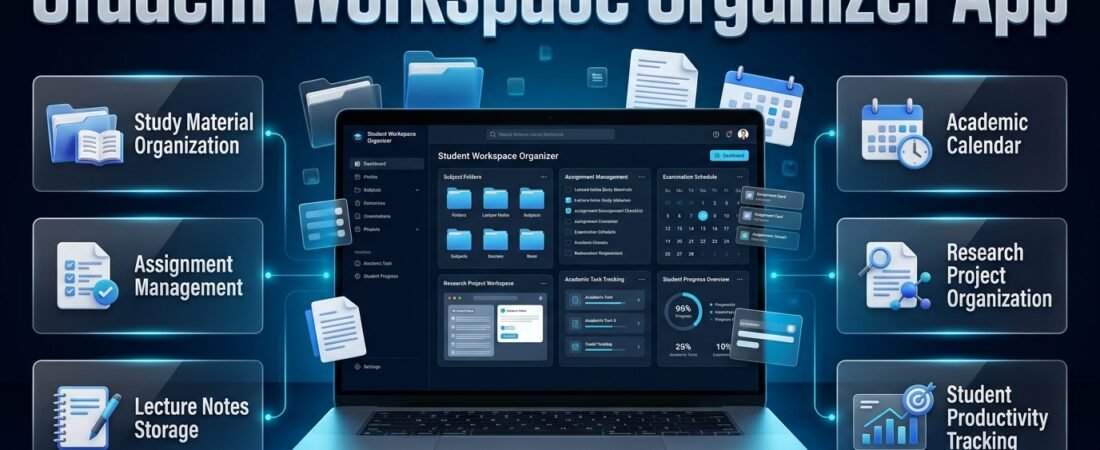
Student Workspace Organizer App | Managing academic responsibilities becomes increasingly difficult when students have to deal with multiple subjects, assignments, lecture notes, examination schedules, research projects, and personal commitments at the same time. Even students who understand their subjects well can struggle to stay organized when important information is scattered across different folders, applications, notebooks, and calendars.
Imagine opening your laptop to complete an assignment but spending the first fifteen minutes searching for lecture notes, checking submission instructions, and trying to remember the actual deadline. These small interruptions may not seem serious individually, but they can affect concentration and make everyday academic work more stressful.
A student workspace organizer app provides a structured digital environment where students can manage their academic activities, organize learning materials, track assignments, plan study sessions, and maintain a clearer overview of their educational responsibilities.
Instead of treating every academic activity as a separate responsibility, students can create an organized workspace that connects their study resources, schedules, tasks, and progress. This makes it easier to understand what needs attention, which activities are approaching their deadlines, and how different responsibilities fit into a weekly routine.
For students who want a more structured approach to educational organization, RTI Scheduler provides a useful starting point for exploring academic planning and scheduling concepts.
This guide explains how student workspace organizer applications work, which features matter most, how to build an effective digital study environment, and how to avoid the organizational mistakes that often reduce student productivity.
What Is a Student Workspace Organizer App?
A student workspace organizer app is a digital organization platform designed to help learners manage their academic information, study activities, assignments, educational resources, and daily responsibilities in a structured environment.
Its purpose is to reduce the confusion associated with scattered information and provide students with a more consistent way to organize their educational activities.
A student workspace can include several connected areas:
- Academic task management: Recording homework, assignments, projects, and other responsibilities.
- Study resource organization: Arranging lecture notes, documents, research materials, and educational files.
- Academic scheduling: Managing classes, examinations, study sessions, and important institutional dates.
- Project organization: Dividing larger academic projects into smaller activities.
- Progress monitoring: Understanding which tasks are completed and which still require attention.
- Personal productivity: Organizing everyday responsibilities that affect available study time.
The main difference between a basic digital notebook and a student workspace is the way information is connected.
For example, a research assignment may require students to collect information, review lecture materials, prepare an outline, write a report, and submit the completed document. A properly organized workspace can keep these activities connected instead of treating them as unrelated tasks.
How Does a Student Workspace Organizer Work?
A student workspace generally follows a simple organizational structure. Students create a main environment, add subject-based sections, and organize individual responsibilities within those sections.
A typical structure might look like this:
Student Workspace
- Academic Dashboard
- Mathematics
- Lecture Notes
- Assignments
- Revision Materials
- Computer Science
- Course Resources
- Programming Tasks
- Project Documents
- English
- Reading Materials
- Writing Assignments
- Examination Preparation
- Weekly Study Plan
- Important Academic Deadlines
This structure allows students to locate information without searching through unrelated files.
A useful workspace should also support regular updates. When an assignment is completed, its status should change. When an examination date is announced, it should be added to the appropriate calendar. When new lecture materials become available, they should be stored in the correct subject section.
The result is an organized environment that reflects the student’s current academic responsibilities.
Who Can Benefit From a Student Workspace Organizer?
Different types of learners can benefit from a structured digital workspace, although their organizational requirements may vary.
| Student Type | Main Organizational Requirements |
|---|---|
| High school students | Homework, subject notes, tests, and classroom activities |
| College students | Coursework, independent study, assignments, and examinations |
| University students | Research projects, multiple courses, academic deadlines, and presentations |
| Online learners | Recorded lectures, virtual classes, digital resources, and submission dates |
| Distance learners | Independent study schedules, course materials, and progress monitoring |
| Research students | Research documents, project milestones, references, and writing activities |
The best organizational system depends on the number and complexity of responsibilities a student needs to manage.
Why Do Students Need a Digital Workspace Organizer?
Students often assume that poor productivity comes from having insufficient study time. However, the problem may actually be related to how their academic responsibilities are organized.
When important information is difficult to find, students spend time managing their materials instead of using them.
A digital workspace helps address this problem by creating a more consistent structure for everyday academic activities.
1. It Keeps Academic Information in One Organized Environment
One of the biggest challenges students experience is managing information across multiple locations.
A lecture document may be saved on a laptop, assignment instructions may be available in an email, and an examination reminder may exist only in a personal calendar.
This creates unnecessary confusion.
A student workspace provides a central organizational structure where relevant information can be grouped according to subjects, courses, projects, and responsibilities.
For example, a university student studying five subjects can maintain separate sections for each course.
Each section can contain:
- Lecture materials.
- Assignment instructions.
- Important documents.
- Revision resources.
- Upcoming academic activities.
This approach makes information easier to locate and reduces the possibility of overlooking important materials.
2. It Helps Students Understand Their Daily Priorities
Having a long list of academic responsibilities doesn’t automatically make it clear what should be completed first.
Students need a way to distinguish urgent tasks from activities that can be completed later.
A workspace can help by organizing responsibilities according to deadlines, importance, and estimated completion time.
For example:
| Academic Task | Deadline | Priority |
|---|---|---|
| Mathematics assignment | Monday | High |
| Biology chapter revision | Wednesday | Medium |
| English presentation | Friday | High |
| Organize research notes | Next week | Low |
This makes it easier to decide how to use available study time.
Students should remember that priorities can change. A task that initially seems less urgent may become important when its deadline approaches.
3. It Reduces the Risk of Missing Important Deadlines
Academic deadlines are particularly difficult to manage when students have several courses with different submission requirements.
A workspace can provide a consistent location for recording assignment dates, examination schedules, and project milestones.
Instead of remembering everything mentally, students can review their upcoming responsibilities whenever necessary.
For a more detailed approach to managing educational deadlines, students can explore Academic Deadline Management.
A reliable deadline system should include the actual submission date, the task’s current status, and enough time for preparation and final review.
4. It Supports Better Study Planning
A study session becomes more productive when students know what they intend to accomplish.
Without a clear plan, learners may spend too much time deciding which chapter to read or which assignment to complete.
A workspace helps translate general academic goals into specific activities.
For example, instead of recording:
“Prepare for mathematics examination.”
A student can create smaller activities:
- Review algebra formulas.
- Complete ten practice questions.
- Revise quadratic equations.
- Check previous examination questions.
- Identify difficult topics.
These activities provide a clearer direction for each study session.
Developing Consistent Learning Habits Through Digital Student Planning
Maintaining a productive academic routine involves more than simply deciding when to study. Students need a practical way to coordinate their class schedules, homework, revision goals, assignment deadlines, and personal commitments without making their daily plans unnecessarily complicated. A digital student routine can bring these responsibilities into a more manageable structure by helping learners organize activities according to their importance and available time. Students can begin by listing their regular academic commitments, identifying subjects that require extra attention, and assigning realistic study periods throughout the day. They can also use reminders to prepare for upcoming tests, complete unfinished assignments, and review important classroom topics before moving on to new material. One useful habit is to check the routine at the beginning and end of each day, allowing students to understand what needs attention and adjust unfinished tasks without disrupting the entire schedule. A flexible digital routine supports better organization while encouraging students to take greater responsibility for their learning progress.
For a more structured way to coordinate daily study activities and academic commitments, explore 👉 Digital Student Routine App
This resource helps students build organized daily routines, plan learning activities, and maintain consistent study habits throughout the academic year.
5. It Makes Long-Term Academic Goals Easier to Manage
Some academic responsibilities require several weeks or months of preparation.
Examples include semester projects, research assignments, examination preparation, and major presentations.
A digital workspace can divide these responsibilities into smaller milestones.
This makes long-term goals easier to monitor and reduces the pressure of completing everything shortly before the final deadline.
What Features Should a Good Student Workspace Organizer App Include?
Not every application needs advanced functionality. Students should focus on features that solve genuine organizational problems rather than choosing a platform simply because it offers a large number of options.
The following features are particularly useful when building a practical academic workspace.
1. A Centralized Academic Dashboard
A dashboard provides an overview of important academic information.
It should help students understand their current responsibilities without requiring them to open several different sections.
A useful dashboard may display:
- Today’s most important tasks.
- Upcoming assignment deadlines.
- Examination reminders.
- Current study priorities.
- Unfinished activities.
- Important academic events.
For example, a student opening the dashboard on Monday morning should be able to identify the three most important activities scheduled for that day.
The dashboard should not become a storage location for every document and reminder. Detailed information belongs in the relevant sections.
Expert Tip: Display immediate priorities on the dashboard and keep long-term academic information in separate views. This prevents unnecessary visual clutter.
2. Subject-Based Workspace Organization
Subject-based organization allows students to separate information according to individual courses.
This is particularly useful when managing several subjects that contain different assignments, documents, and learning resources.
A practical subject structure may include:
| Section | Information |
|---|---|
| Course Overview | Course details and important information |
| Lecture Notes | Daily and weekly class notes |
| Assignments | Coursework and submission requirements |
| Study Materials | Documents, reading resources, and references |
| Revision | Examination preparation and practice questions |
| Projects | Long-term academic activities |
Students should avoid creating too many subcategories.
A simple structure that remains consistent is generally easier to maintain than a complicated filing system.
3. Assignment and Task Management
Task management is one of the most important functions of an academic workspace.
It allows students to record responsibilities, assign deadlines, and monitor completion progress.
Each task should contain enough information to explain what needs to be done.
For example:
Task: Complete Computer Science Project
- Subject: Computer Science.
- Deadline: November 18.
- Priority: High.
- Status: In Progress.
- Required work: Research, programming, testing, and documentation.
A detailed task record reduces confusion and makes it easier to resume work after a break.
4. Academic Calendar Integration
A calendar provides a broader overview of academic responsibilities.
It helps students understand how lectures, examinations, assignment deadlines, and personal commitments are distributed across different days.
A useful academic calendar may include:
- Class schedules.
- Examination dates.
- Assignment deadlines.
- Project milestones.
- Academic holidays.
- Important institutional events.
Students who need a structured approach to educational dates can explore Academic Calendar Planning.
The calendar should be updated whenever an instructor or educational institution announces a change.
5. Notes and Document Management
A student workspace should make it easy to organize and retrieve educational materials.
Students regularly work with lecture notes, PDF documents, presentations, research files, spreadsheets, and assignment instructions.
Without consistent organization, these resources can become difficult to manage.
Useful document management practices include:
- Creating separate subject folders.
- Using descriptive document names.
- Grouping files according to academic topics.
- Keeping updated versions of important documents.
- Archiving completed projects.
- Maintaining backups.
For example, instead of saving a document as “New Notes 5,” use a name such as “Physics Chapter 6 – Electricity Notes.”
This makes the document easier to identify later.
6. Reminders and Notifications
Reminders help students remember important responsibilities.
They can be particularly useful for activities that have fixed deadlines or require preparation several days in advance.
Examples include:
- Assignment submissions.
- Examination dates.
- Project milestones.
- Research meetings.
- Registration deadlines.
- Scheduled revision sessions.
However, students should avoid setting too many notifications.
When every small activity generates an alert, important reminders can become difficult to distinguish from ordinary notifications.
Use alerts for meaningful deadlines and activities that are easy to overlook.
7. Progress Tracking and Completion Status
Progress tracking helps students understand how much work has been completed.
It is particularly useful for larger projects and examination preparation.
For example:
| Study Activity | Status |
|---|---|
| Review Chapter 1 | Completed |
| Review Chapter 2 | Completed |
| Review Chapter 3 | In Progress |
| Complete Practice Test | Not Started |
| Final Revision | Not Started |
Students can use these records to identify unfinished activities and adjust their study plans.
Progress tracking should provide useful information rather than become another activity that requires excessive maintenance.
8. Flexible Workspace Views
Students organize information in different ways.
Some prefer a calendar, while others prefer task lists or subject-based folders.
A flexible workspace may provide:
- Daily views.
- Weekly schedules.
- Monthly calendars.
- Assignment lists.
- Subject dashboards.
- Project boards.
- Progress summaries.
The ability to switch between different views helps students understand their academic responsibilities from different perspectives.
9. Collaboration and Shared Workspaces
Group assignments often require students to coordinate several activities.
A shared workspace can help group members understand their responsibilities and monitor project progress.
Useful collaboration options may include:
- Shared task lists.
- Document access.
- Assignment ownership.
- Comments and updates.
- Project deadlines.
- Progress visibility.
Students should establish clear access permissions before sharing academic documents.
10. Data Security and Backup Options
A digital workspace may contain important academic documents, personal information, and educational records.
Students should consider how an application protects and stores their information.
Important considerations include:
- Account security.
- Strong passwords.
- Two-factor authentication.
- Document access permissions.
- Data export options.
- Backup and recovery features.
- Privacy settings.
A workspace should not only be convenient but also reliable enough to support long-term academic organization.
How to Build an Effective Student Workspace Step by Step
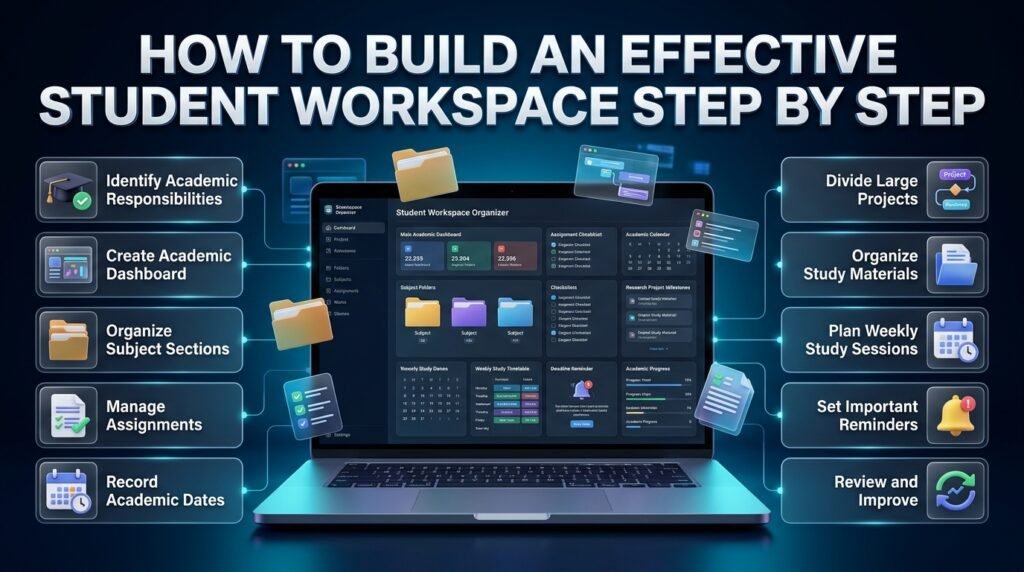
Building a productive workspace doesn’t require students to organize everything perfectly from the beginning.
The better approach is to start with essential academic responsibilities and gradually develop a structure that supports everyday learning.
Step 1: Identify Your Academic Responsibilities
Before creating folders or adding tasks, make a complete list of the responsibilities you regularly manage.
These may include:
- Attending lectures.
- Completing assignments.
- Reviewing course materials.
- Preparing for examinations.
- Participating in group projects.
- Completing independent research.
- Managing academic deadlines.
Why it matters: Your workspace should reflect your actual responsibilities instead of containing unnecessary categories.
Professional advice: Identify the three organizational problems that affect your studies most frequently. Start by solving those problems.
Common mistake: Building an advanced workspace before understanding which information needs to be organized.
Step 2: Create a Main Academic Dashboard
Your dashboard should act as the starting point for daily academic organization.
Include only the information that helps you understand your current workload.
A useful dashboard may contain:
- Today’s priorities.
- Upcoming deadlines.
- Current assignments.
- Important examination dates.
- Weekly academic goals.
Avoid placing every document and completed task on the main screen.
The objective is to make important information visible without creating unnecessary distractions.
Step 3: Create Separate Sections for Your Subjects
Create one main section for each active subject or course.
For example:
Mathematics
- Lecture Notes.
- Homework.
- Practice Questions.
- Revision Materials.
Biology
- Class Notes.
- Assignments.
- Laboratory Work.
- Examination Preparation.
Computer Science
- Course Documents.
- Programming Exercises.
- Research Materials.
- Project Files.
This structure helps students maintain consistency across different subjects.
Step 4: Add Assignments and Academic Responsibilities
Record your current assignments and other important responsibilities.
For each task, include:
- A clear task title.
- Relevant subject.
- Submission date.
- Priority level.
- Completion status.
- Supporting instructions.
Students should use meaningful descriptions rather than vague titles.
For example, “Complete Chapter 5 Exercises” provides more useful information than simply writing “Math Work.”
Step 5: Record Important Academic Dates
Add examination dates, submission deadlines, lecture schedules, and institutional events to your calendar.
A broader academic calendar can help students understand how their responsibilities fit into the semester.
For additional scheduling organization, Semester Milestone Calendar can be explored as a related planning resource.
Make sure to distinguish between confirmed dates and tentative dates.
This is particularly important when educational institutions sometimes change examination or academic schedules.
Step 6: Divide Large Projects Into Smaller Activities
Large academic projects should not be treated as single tasks.
A research assignment, for example, may involve:
- Understanding the topic.
- Selecting a research direction.
- Collecting relevant information.
- Preparing an outline.
- Writing the first draft.
- Reviewing the content.
- Completing final corrections.
- Preparing the submission.
Assign realistic deadlines to each stage.
This approach makes progress easier to monitor and gives students more control over their workload.
Step 7: Organize Your Digital Study Materials
Place documents in their relevant subject sections.
Use consistent naming conventions so that files can be identified quickly.
A practical naming format is:
Subject – Topic – Date or Version
Examples:
- Biology – Cell Structure – Lecture 03.
- Mathematics – Algebra Practice – Week 02.
- Computer Science – Database Project – Draft 01.
Avoid keeping multiple unexplained versions of the same document.
Step 8: Create a Realistic Weekly Study Plan
A weekly plan should connect academic responsibilities with the time available to complete them.
Consider:
- Class timings.
- Assignment deadlines.
- Examination preparation.
- Personal commitments.
- Breaks and rest periods.
Don’t schedule every available minute.
Students need flexibility because unexpected activities and changes in workload are part of normal academic life.
Step 9: Set Important Reminders
Use reminders for important dates and activities.
For major assignments, create preparation reminders rather than relying only on a notification on the final submission day.
For example:
- Seven days before: Review assignment progress.
- Four days before: Complete the main draft.
- Two days before: Edit and correct.
- One day before: Check submission requirements.
This provides enough time to identify problems before the deadline.
Step 10: Review and Improve Your Workspace
At the end of each week, review the information stored in your workspace.
Check which activities were completed, which responsibilities remain unfinished, and whether upcoming deadlines are recorded correctly.
Remove outdated information and reorganize sections that have become difficult to use.
A workspace should evolve with your academic requirements.
How to Organize Different Academic Activities in One Workspace
Different academic activities require different organizational approaches.
A student preparing for an examination has different requirements from someone completing a research project or managing weekly homework.
The following methods help students create a workspace that supports different types of academic work.
Organizing Daily Study Tasks
Daily tasks should represent specific activities that can realistically be completed during the day.
Examples include:
- Reading one lecture chapter.
- Completing mathematics exercises.
- Reviewing biology notes.
- Preparing presentation slides.
- Practicing examination questions.
Avoid adding too many activities to a single day.
A smaller list of meaningful priorities is more useful than an unrealistic schedule containing twenty unfinished tasks.
Students who want to improve their everyday organization can also explore Student Daily Workflow App.
The purpose of a daily workflow is to provide a clear sequence of activities rather than forcing students to follow a rigid schedule regardless of changing circumstances.
Organizing Weekly Lessons and Class Periods
Students need to understand how their lessons are distributed throughout the week.
A structured weekly plan makes it easier to identify available study periods and avoid conflicts between academic activities.
A weekly lesson organization system can contain:
- Subject names.
- Class timings.
- Instructor information.
- Room or online meeting details.
- Break periods.
- Additional study sessions.
Students can explore Weekly Lesson Period Planner for related educational scheduling concepts.
For more subject-specific organization, Subject Timetable Maker provides another relevant planning resource.
Organizing Class Periods and Timetable Information
A student’s daily academic routine may include several classes with different durations and locations.
Keeping these details organized helps students understand where they need to be and when their next academic activity begins.
A practical class organization structure should include:
- Course or subject.
- Start and end time.
- Classroom or learning location.
- Instructor.
- Break duration.
- Changes to the regular schedule.
Students managing detailed class periods can explore Student Class Period Organizer.
A visual weekly arrangement can also make scheduling conflicts easier to identify. The Class Timetable Grid Builder is relevant to this type of timetable organization.
Organizing Assignments and Coursework
Assignments require more than a title and a submission date.
Students should understand the instructions, required materials, expected output, and preparation stages.
For example, a written assignment may require research, reading, drafting, editing, and final submission.
A useful assignment record should contain:
| Assignment Detail | Example |
|---|---|
| Assignment | Environmental Science Report |
| Subject | Environmental Science |
| Due date | November 20 |
| Research status | Completed |
| Writing status | In Progress |
| Final review | Pending |
| Submission | Not Started |
Students managing several coursework responsibilities can explore Coursework Due Date Manager.
A separate School Deadline Overview Tool is also relevant when students need a broader view of educational deadlines.
Organizing Examination Preparation
Examination preparation requires careful planning because several subjects may have different examination dates.
Students should record the examination schedule and divide revision into manageable activities.
A useful examination preparation section can include:
- Examination dates.
- Subject names.
- Chapters to revise.
- Practice questions.
- Mock examination results.
- Topics requiring additional attention.
An Exam Schedule Generator is relevant when organizing examination dates.
For students who need to plan individual test dates alongside other academic activities, Test Date Timetable Planner provides a related planning concept.
Organizing Examination Sessions
Some educational environments require more detailed examination arrangements than simply recording a date and subject.
Students and educational coordinators may need to manage session times, candidate groups, examination locations, and other relevant information.
An organized examination workspace should clearly distinguish between:
- Examination date.
- Session start and end time.
- Subject or paper.
- Candidate group.
- Assigned venue.
- Important instructions.
For these more detailed arrangements, students and educational planners can explore Exam Session Calendar Builder and Assessment Sitting Schedule.
An Examination Timetable Organizer is another relevant resource for arranging examination information in a structured format.
Organizing Academic Milestones and Reminders
Academic milestones are important events that occur throughout a course or semester.
Examples include:
- Course registration.
- Research proposal approval.
- Project presentations.
- Coursework completion.
- Examination preparation.
- Final submissions.
Students should record these events separately from ordinary daily tasks when they require longer preparation periods.
An Academic Milestone Reminder Planner can be explored for this type of planning.
Organizing School Rotations and Changing Timetables
Some educational institutions use rotating schedules rather than repeating the same timetable every day.
Students may attend different subjects according to a rotating sequence.
For example, one school may use a two-day A/B timetable, while another may operate a six-day academic cycle.
In these situations, a standard weekly planner may not provide enough flexibility.
Students and educational coordinators can explore School Rotation Scheduling for related scheduling requirements.
A School Rotation Schedule Generator is relevant when organizing repeating timetable sequences.
For institutions using changing school-day arrangements, the Rotating School Day Calendar provides another related planning concept.
An A B Day Schedule Maker is particularly relevant to institutions that alternate between two different timetable patterns.
For a longer repeating cycle, a Six Day School Cycle Planner can help organize the sequence of academic days.
A Rotational Timetable Sequence Builder is also relevant when the timetable follows a repeating sequence rather than a conventional Monday-to-Friday arrangement.
These scheduling approaches demonstrate why a flexible academic workspace is valuable: students need an organizational structure that reflects the actual timetable used by their institution.
Student Workspace Organizer App vs. Separate Productivity Applications
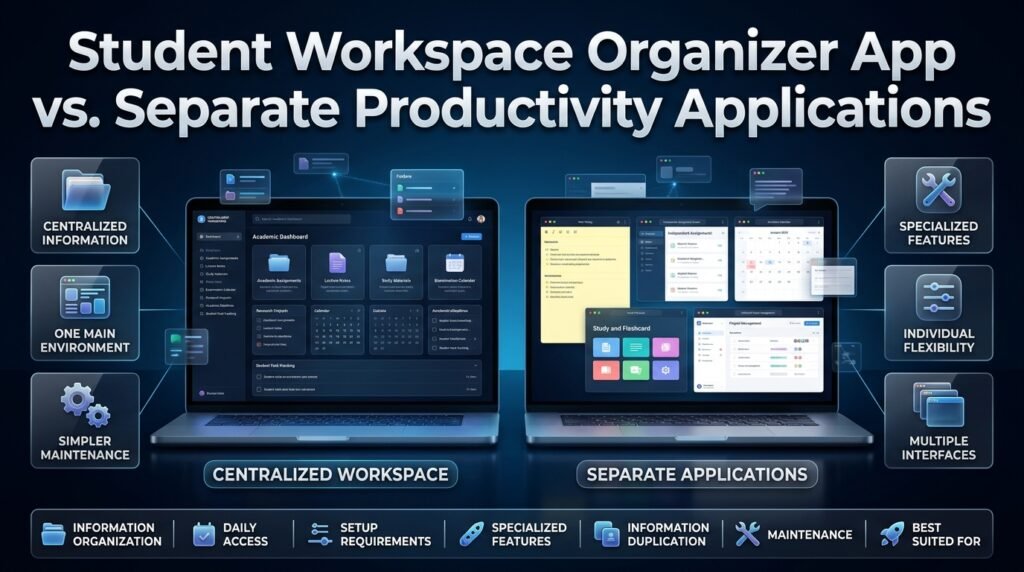
Students sometimes struggle to decide whether they should use one centralized platform or several specialized applications.
Both approaches can work, but the right choice depends on academic workload, personal preferences, and the features required.
| Comparison | Centralized Workspace | Multiple Separate Applications |
|---|---|---|
| Information organization | More centralized | Distributed across platforms |
| Daily access | One main environment | Several interfaces |
| Setup requirements | Usually simpler | Requires multiple configurations |
| Specialized features | Depends on platform | More individual flexibility |
| Information duplication | Potentially lower | Can become higher |
| Maintenance | One primary system | Several systems to maintain |
| Best suited for | General academic organization | Specialized individual needs |
When Is One Centralized Workspace Better?
A centralized workspace is useful when students want to manage most academic responsibilities within one environment.
For example, a university student studying five courses may prefer a central dashboard containing assignments, important dates, study resources, and project information.
This reduces the need to remember where different information has been stored.
However, students should check whether the platform actually provides the features they need.
A centralized workspace isn’t automatically better if it lacks important functionality.
When Should Students Use Multiple Applications?
Separate applications can be useful when students require specialized features.
For example, a learner may prefer a dedicated flashcard application for memorization and a different platform for detailed academic notes.
This arrangement can work as long as responsibilities remain clearly organized.
The main challenge is information duplication.
If an assignment deadline is recorded in three different applications, students must ensure that all copies remain accurate.
Professional recommendation: Choose one primary source for academic deadlines and use other applications only when they provide a clear additional benefit.
How Can a Student Workspace Improve Academic Productivity?
A workspace improves productivity when it helps students move from planning to actual academic work.
Simply recording tasks doesn’t guarantee that they will be completed. Students need a practical system that supports consistent action.
Use a Three-Priority Daily System
At the beginning of each day, identify three important academic activities.
For example:
- Complete the mathematics assignment.
- Review two biology chapters.
- Prepare computer science project notes.
These priorities should represent meaningful progress rather than small activities that create the appearance of productivity.
Other responsibilities can remain on a secondary list.
Connect Study Materials With Their Related Tasks
When an assignment is recorded, keep its supporting materials easy to locate.
For example, a computer science programming task may require lecture notes, coding instructions, previous exercises, and project documentation.
Organizing these resources alongside the assignment reduces unnecessary searching.
Use Realistic Time Estimates
Students often underestimate how long academic activities take.
Reading a chapter may require thirty minutes, while preparing a detailed report may require several hours.
Record realistic time estimates when creating a daily schedule.
This makes it easier to distribute activities across available study periods.
Build Flexibility Into Your Routine
Unexpected responsibilities can interrupt even a carefully prepared schedule.
Students should leave some available time for activities that take longer than expected.
A flexible workspace allows tasks to be rescheduled without requiring the entire weekly plan to be rebuilt.
Separate Planning From Studying
Students sometimes spend more time customizing their workspace than completing their academic responsibilities.
A productive system should require only a small amount of maintenance.
Spend a few minutes updating your tasks, then focus on learning.
The objective is to support academic performance rather than make organization an activity in itself.
How to Choose the Right Student Workspace Organizer App
The best application depends on what a student needs to manage.
A high school learner may require a simple assignment organizer, while a university student may need project management, document organization, and advanced scheduling options.
Before selecting a platform, consider the following factors.
Ease of Use
The application should be easy to understand.
Students should be able to create tasks, access documents, update deadlines, and review their schedules without unnecessary steps.
A complicated platform may discourage regular use.
Device Compatibility
Consider the devices you use for studying.
Some students primarily work on laptops, while others depend on smartphones or tablets.
Check whether the application supports your devices and whether information can be accessed consistently.
Available Organization Features
Evaluate whether the application supports your main academic activities.
Important features may include:
- Subject-based sections.
- Task management.
- Academic calendars.
- Assignment tracking.
- Document organization.
- Reminders.
- Project management.
- Progress monitoring.
Don’t pay for advanced functions that you are unlikely to use.
Customization Options
Students should be able to arrange information according to their learning preferences.
However, customization should remain practical.
The purpose is to improve access to information, not create a complicated interface.
Collaboration Capabilities
If you regularly work on group projects, check whether the application supports shared tasks, document access, and collaboration.
These features can help group members understand their responsibilities.
Pricing and Free Plan Limitations
Many applications provide free and paid options.
Before choosing a plan, check:
- Available storage.
- Number of supported projects.
- Collaboration limits.
- Device restrictions.
- Export options.
- Subscription costs.
A free version may be enough for students with basic academic requirements.
Privacy and Data Management
Students should understand how their information is stored and protected.
Check account security, sharing permissions, backup availability, and document recovery options.
Important academic records should never depend on a single unprotected copy.
Common Mistakes Students Make When Using a Workspace Organizer
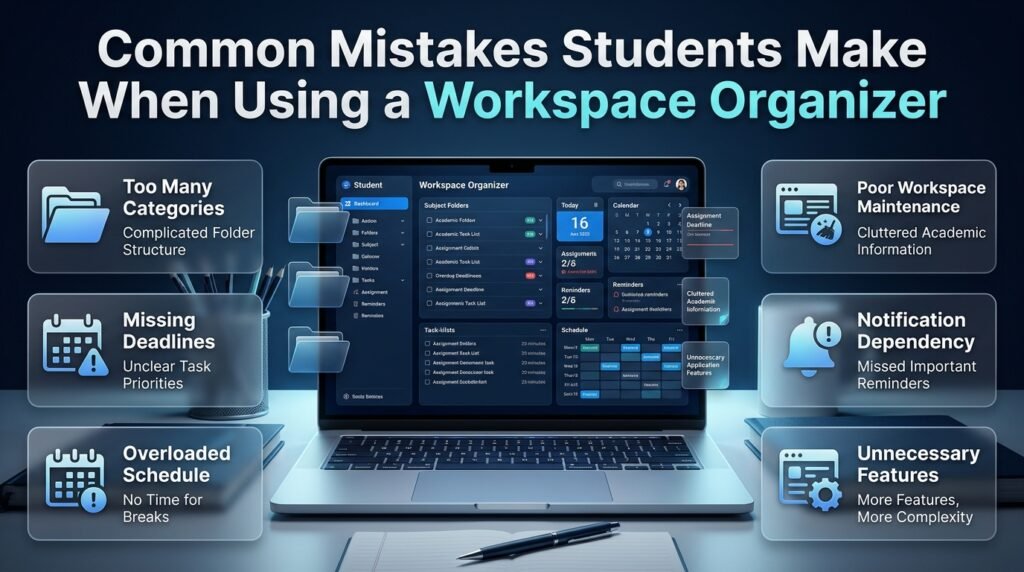
Even a useful digital workspace can become ineffective when students develop poor organizational habits.
Understanding these problems can help learners maintain a system that remains practical throughout the academic year.
Creating Too Many Categories
Some students believe that every topic needs its own folder and every activity needs a separate section.
This creates an unnecessarily complicated environment.
Why it happens: Students confuse detailed organization with effective organization.
Why it’s harmful: They spend additional time deciding where information belongs.
How to avoid it:
- Start with broad subject categories.
- Create subfolders only when needed.
- Combine sections containing similar information.
- Review unnecessary categories regularly.
Recording Tasks Without Clear Deadlines
A task list containing responsibilities but no completion dates makes prioritization difficult.
Students may know what needs to be done without understanding when it should be completed.
How to avoid it: Add realistic deadlines to important tasks and use milestones for longer projects.
Overloading the Daily Schedule
Planning too many activities can make the entire system unrealistic.
Students may forget to account for lectures, transportation, breaks, and personal responsibilities.
How to avoid it:
- Estimate task duration.
- Prioritize important activities.
- Leave room for unexpected work.
- Schedule reasonable breaks.
- Adjust plans when necessary.
Ignoring Workspace Maintenance
An outdated workspace can become more confusing than having no system at all.
Completed tasks remain active, old reminders create clutter, and important dates may no longer be accurate.
How to avoid it: Perform a short daily review and a more detailed weekly review.
Depending Completely on Notifications
Notifications can support organization, but they should not replace an actual planning routine.
Students may miss important information if alerts are disabled or overlooked.
How to avoid it: Maintain an academic calendar and use notifications as additional reminders.
Choosing Features Instead of Solving Problems
An application with many advanced functions isn’t necessarily suitable for every student.
Why it’s harmful: Unnecessary features increase setup time and make daily use more complicated.
How to avoid it: Identify your main academic requirements before selecting a platform.
Expert Recommendations for Maintaining a Productive Student Workspace
A useful workspace should remain manageable during ordinary school days, examination periods, and unusually busy academic weeks.
The following recommendations focus on building an organizational system that students can maintain consistently.
Follow the Weekly Review Method
Choose a regular time each week to review your academic responsibilities.
During this review:
- Check upcoming examination dates.
- Identify unfinished assignments.
- Update project progress.
- Remove outdated reminders.
- Review study materials.
- Plan the following week.
A weekly review helps students identify problems before they affect important deadlines.
Use Consistent File Naming
A simple naming convention makes educational documents easier to locate.
For example:
Subject – Topic – Date – Version
Avoid names such as “Final Final New Document.”
Clear names reduce confusion when multiple versions of an assignment exist.
Keep Your Workspace Focused
Your main dashboard should display only information that helps you make decisions.
Detailed documents, archived projects, and completed activities should remain in their appropriate sections.
A clean dashboard makes important responsibilities easier to identify.
Plan Backward From Major Deadlines
For important projects, begin with the final submission date and work backward.
A project due in two weeks might require:
| Time | Activity |
|---|---|
| 14 days before | Understand topic and research |
| 11 days before | Prepare outline |
| 8 days before | Complete first draft |
| 5 days before | Review and improve |
| 3 days before | Final corrections |
| 1 day before | Check submission requirements |
This approach helps distribute work and provides time for unexpected problems.
Maintain a Separate Long-Term Academic Overview
Daily tasks should not replace semester planning.
Keep a broader overview of examinations, important projects, academic holidays, and major educational events.
Students interested in broader academic organization can explore Academic Planning and Scheduling Tools.
Use Productivity Tools With a Clear Purpose
Different applications may support different parts of academic organization.
Students can compare Educational Productivity Apps and Student Productivity Apps when evaluating the broader range of educational productivity solutions.
A student should select tools according to actual requirements rather than install several applications that perform nearly identical functions.
For students exploring a broader academic productivity environment, Student Productivity App is another relevant resource.
How Should Students Manage Academic Workload During Busy Periods?
Academic workload changes throughout the semester.
During ordinary weeks, students may have regular lectures and small assignments. During examination periods, they may need to prepare for several subjects while completing remaining coursework.
A useful workspace should help students adjust their priorities as workload increases.
Identify High-Pressure Academic Periods Early
Review the academic calendar and identify weeks containing several major responsibilities.
For example, a student may have two examinations and three assignments scheduled within the same week.
Identifying this situation early allows them to begin preparation before the workload becomes overwhelming.
Divide Responsibilities According to Importance
Not every academic activity requires the same level of attention.
Consider:
- Fixed examination dates.
- Major assignment submissions.
- Required project milestones.
- Regular study activities.
- Optional additional learning.
Complete essential responsibilities first while maintaining enough time for ongoing coursework.
Use a Short-Term Planning View
During busy periods, students may benefit from reviewing the next three to seven days rather than concentrating only on long-term plans.
This helps them understand immediate responsibilities without losing awareness of future deadlines.
Keep Study Materials Ready
Searching for notes during an examination preparation session wastes valuable time.
Before beginning revision, organize relevant chapters, practice questions, and reference materials.
A prepared study environment allows students to focus on learning.
Avoid Making the Schedule Unrealistic
A heavy workload doesn’t mean students should remove every break from their routine.
An unrealistic schedule can become difficult to maintain and may lead to unfinished activities.
Build a practical plan that reflects the time genuinely available.
How Can a Student Workspace Support Online and Distance Learning?
Online education introduces additional organizational challenges.
Students may receive information through learning management systems, email, recorded lectures, video meetings, digital documents, and discussion platforms.
Without a clear system, important educational information can become difficult to locate.
Organize Online Courses Separately
Create a section for each active online course.
Include:
- Course information.
- Recorded lecture details.
- Reading materials.
- Assignment instructions.
- Discussion activities.
- Submission deadlines.
This reduces confusion between different courses.
Maintain a Digital Lecture Record
Students should record important lecture information in an organized format.
A useful lecture record can include:
- Lecture date.
- Subject.
- Main topics.
- Important explanations.
- Questions requiring clarification.
- Follow-up study activities.
This helps students review previous lessons without searching through unrelated documents.
Track Online Submission Requirements
Online assignments may have specific submission instructions.
Students should record the required file format, submission location, deadline, and any additional instructions.
This is particularly important when several courses use different submission systems.
Organize Recorded Lectures
Recorded lectures can be useful revision resources, but they should be organized according to course and topic.
Students should also record which lessons have been watched and which still need attention.
This prevents repeated viewing of the same materials while other lessons remain incomplete.
How Can Students Measure Whether Their Workspace Is Working?
A student workspace should be evaluated according to its practical results.
An attractive dashboard doesn’t necessarily mean that academic organization has improved.
Students should focus on whether their system makes important activities easier to manage.
Monitor Assignment Completion
Review whether assignments are being completed before their deadlines.
If several tasks repeatedly remain unfinished, the problem may involve unrealistic planning or poor prioritization.
Check Information Accessibility
Ask how quickly you can locate important lecture notes, assignment instructions, and examination information.
If searching for documents remains difficult, improve the folder structure and naming conventions.
Review Schedule Accuracy
Check whether your calendar reflects actual class timings, deadlines, and examination dates.
An inaccurate calendar can create more problems than having no calendar at all.
Evaluate Daily Maintenance Time
A productive workspace should not require excessive maintenance.
If updating tasks and organizing documents takes too long, simplify the system.
Assess Study Consistency
Consider whether the workspace helps you begin study sessions with clearer priorities.
The purpose is to reduce organizational friction and support consistent academic work.
What Features Should Students Look for in a Student Workspace Organizer App?
Students should look for features that make academic responsibilities easier to organize, access, and manage. A useful student workspace organizer should provide more than a simple task list. It should help learners manage assignments, study materials, academic schedules, deadlines, and ongoing projects within a structured environment.
The most important consideration is whether the application supports the student’s actual study routine. For example, a university student managing several courses may need subject-based folders, assignment tracking, calendar management, and progress monitoring. A high school student may benefit more from straightforward homework organization and examination reminders.
Important features to consider include:
Centralized dashboard: Provides an overview of daily priorities and upcoming academic responsibilities.
Task management: Helps students record assignments, set deadlines, and monitor completion.
Calendar organization: Keeps lectures, examinations, and important academic dates accessible.
Document management: Makes it easier to arrange lecture notes, PDFs, research materials, and course documents.
Progress tracking: Shows which assignments and study activities have been completed.
Reminders: Helps prevent important deadlines and scheduled activities from being overlooked.
Device compatibility: Allows students to access their academic information across supported devices.
A good application should make studying more organized without requiring students to spend excessive time managing the software itself.
How Can a Student Workspace Organizer App Improve Academic Productivity?
A student workspace organizer can improve academic productivity by reducing the time spent searching for information, remembering deadlines, and deciding which activity should be completed next. When assignments, notes, schedules, and study priorities are properly organized, students can approach their academic responsibilities with greater clarity.
For example, imagine a student preparing for three examinations while completing two assignments. Without an organized system, the student may repeatedly switch between documents, calendars, and unrelated task lists. A centralized workspace provides a clearer overview of upcoming responsibilities and helps distribute study activities across available time.
Practical ways it supports productivity include:
Better prioritization: Students can identify urgent assignments and important study activities.
Less information searching: Subject-based organization makes lecture materials easier to locate.
Improved time management: A structured schedule helps distribute academic work realistically.
Consistent study routines: Daily and weekly task lists provide direction for study sessions.
Fewer missed deadlines: Reminders and deadline records help students stay aware of important dates.
Clearer progress: Completed and unfinished tasks become easier to identify.
The greatest benefit comes from using the workspace consistently. An application cannot complete assignments or improve academic performance automatically, but it can provide the organizational structure students need to work more effectively.
How Should Students Organize Assignments, Study Notes, and Academic Deadlines in One Workspace?
Students should organize their workspace according to subjects or courses and maintain separate sections for notes, assignments, study materials, and important deadlines. This approach creates a logical structure where related academic information remains accessible without mixing unrelated responsibilities.
For instance, a student studying Mathematics, Biology, and Computer Science can create a separate section for each subject. Each section can contain lecture notes, assignment instructions, supporting documents, and examination preparation materials.
A practical organizational structure includes:
Subject folders: Create individual sections for every active course.
Assignment records: Include task descriptions, submission dates, priorities, and completion status.
Study notes: Arrange lecture materials according to chapters, topics, or class dates.
Academic calendar: Record examinations, presentations, project milestones, and important institutional dates.
Progress records: Update completed activities and identify unfinished work.
Reminder system: Set notifications for important deadlines and preparation activities.
For larger assignments, students should also divide the work into smaller stages. Research, outlining, writing, editing, and final submission can each have separate completion dates.
This structure makes it easier to understand what needs to be completed, where the relevant materials are stored, and how much time remains before an academic deadline.
Is a Student Workspace Organizer App Better Than Using Separate Productivity Apps?
A centralized student workspace can be more convenient for learners who want to manage their academic responsibilities in one organized environment. However, using separate productivity applications can also be effective when students need specialized features that a single platform doesn’t provide.
The right choice depends on the complexity of the student’s academic workload and the tools required to manage it.
For example, a student managing regular coursework may find one centralized workspace sufficient for assignments, notes, reminders, and schedules. However, a research student may prefer specialized applications for reference management, detailed note-taking, and collaborative project work.
Consider these differences before choosing:
Centralized workspace: Keeps academic information in one main environment.
Separate applications: Provide flexibility for specialized academic activities.
Information management: A centralized system can reduce duplicated records.
Customization: Multiple specialized tools may offer more individual flexibility.
Maintenance: Several applications require students to manage different interfaces and settings.
Accessibility: Students should consider whether their selected tools work across their devices.
A practical recommendation is to choose one primary location for academic deadlines and task management. Additional applications should only be introduced when they provide a clear benefit.
Using more tools doesn’t automatically create better productivity. A simple, consistent system is often easier to maintain throughout an academic semester.
How Can Students Maintain an Organized Digital Workspace Throughout the Academic Year?
Students can maintain an organized digital workspace by following consistent daily and weekly maintenance habits. Academic responsibilities change throughout the year, so the workspace should be updated whenever new assignments, examination dates, projects, or course requirements are introduced.
A system that works during the first few weeks of a semester may need adjustments when examination preparation and major projects begin. Regular reviews help prevent outdated information and unfinished activities from creating unnecessary confusion.
Useful maintenance practices include:
Perform a daily review: Check completed tasks, update unfinished activities, and review the following day’s priorities.
Organize new documents immediately: Save lecture notes and assignment files in their relevant subject sections.
Update academic dates: Record newly announced deadlines, examination changes, and important institutional events.
Archive completed work: Move finished projects and outdated materials out of active workspace sections.
Review weekly priorities: Identify approaching deadlines and distribute upcoming study activities.
Remove unnecessary clutter: Delete duplicate records and combine categories that no longer serve a useful purpose.
Maintain backups: Keep important academic documents protected against accidental deletion or device problems.
A short daily review of approximately five to ten minutes, combined with a more detailed weekly review, can help students maintain an effective organizational system.
The goal isn’t to keep the workspace perfectly arranged every minute. It is to ensure that important academic information remains accurate, accessible, and useful whenever students need it.
Conclusion
A well-organized academic workspace can make student life more manageable by bringing assignments, study notes, class schedules, examination dates, and important deadlines into one structured system. Instead of switching between multiple applications or relying on scattered reminders, students can use a student workspace organizer app to keep their academic responsibilities organized and easier to track.
The real value of a digital workspace is not simply storing information. It is helping students understand what needs attention, plan their study time, monitor upcoming responsibilities, and maintain a consistent daily routine. When tasks, schedules, and academic milestones are organized properly, students can reduce unnecessary distractions and spend more time on meaningful learning activities.
To get the best results, students should choose an organizer that matches their academic needs, keep their information updated, set realistic priorities, and review their progress regularly. A simple and consistent system is often more effective than using too many complicated productivity features.
Ultimately, an organized digital workspace supports better time management, improved academic focus, and greater control over the learning process. With the right planning habits and a reliable scheduling solution, students can manage their academic workload more confidently throughout the school year or semester.